
 Image 1 of 7
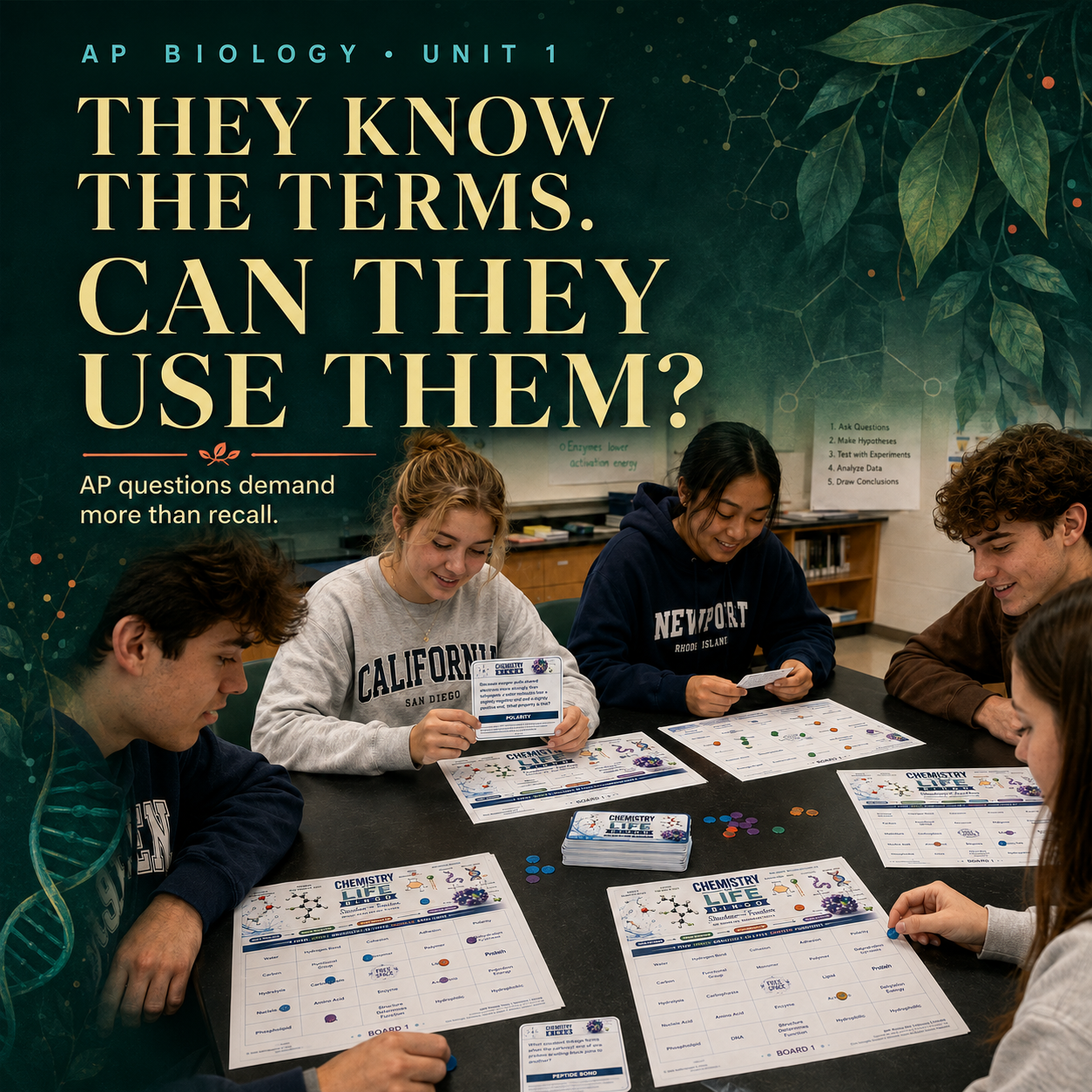 Image 2 of 7
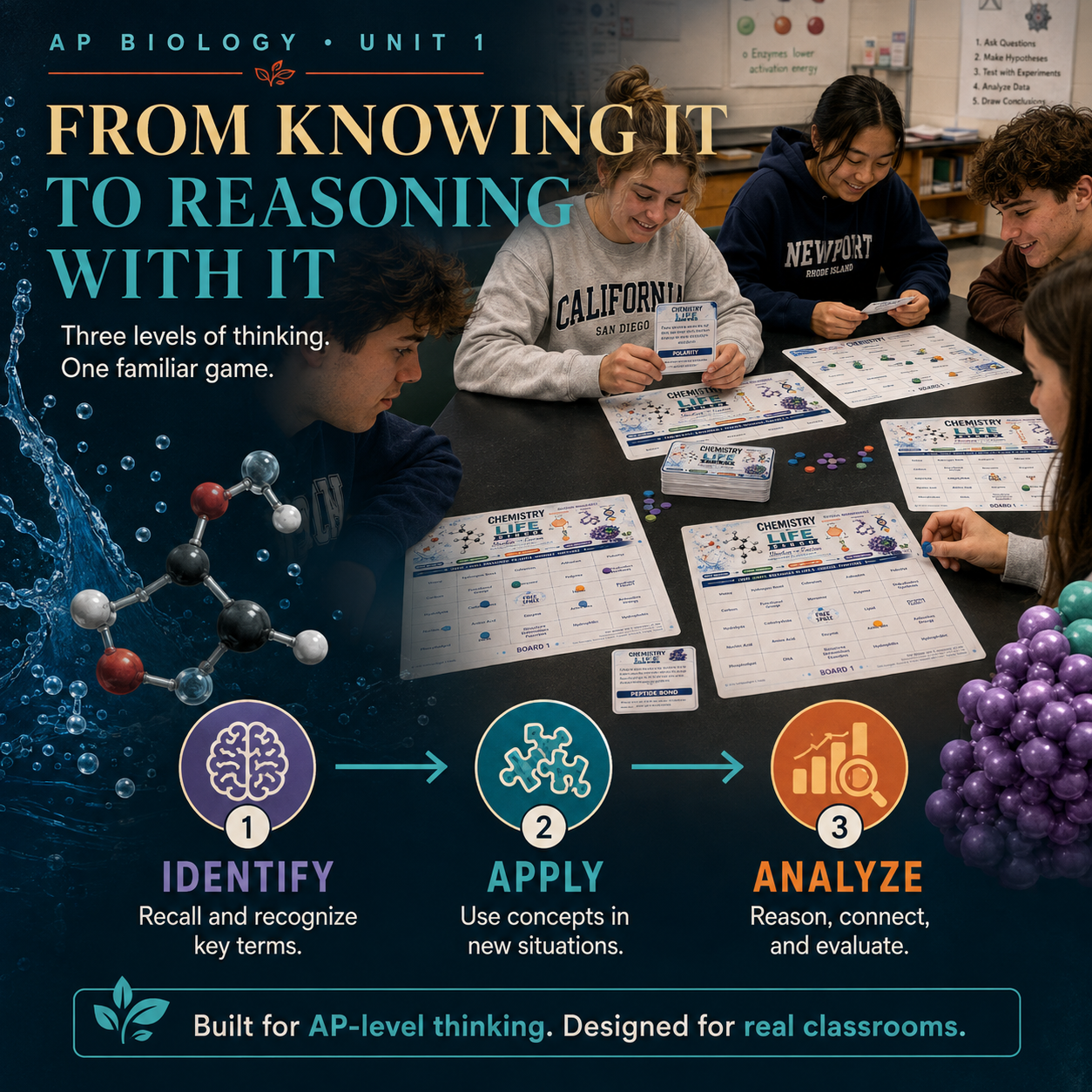 Image 3 of 7
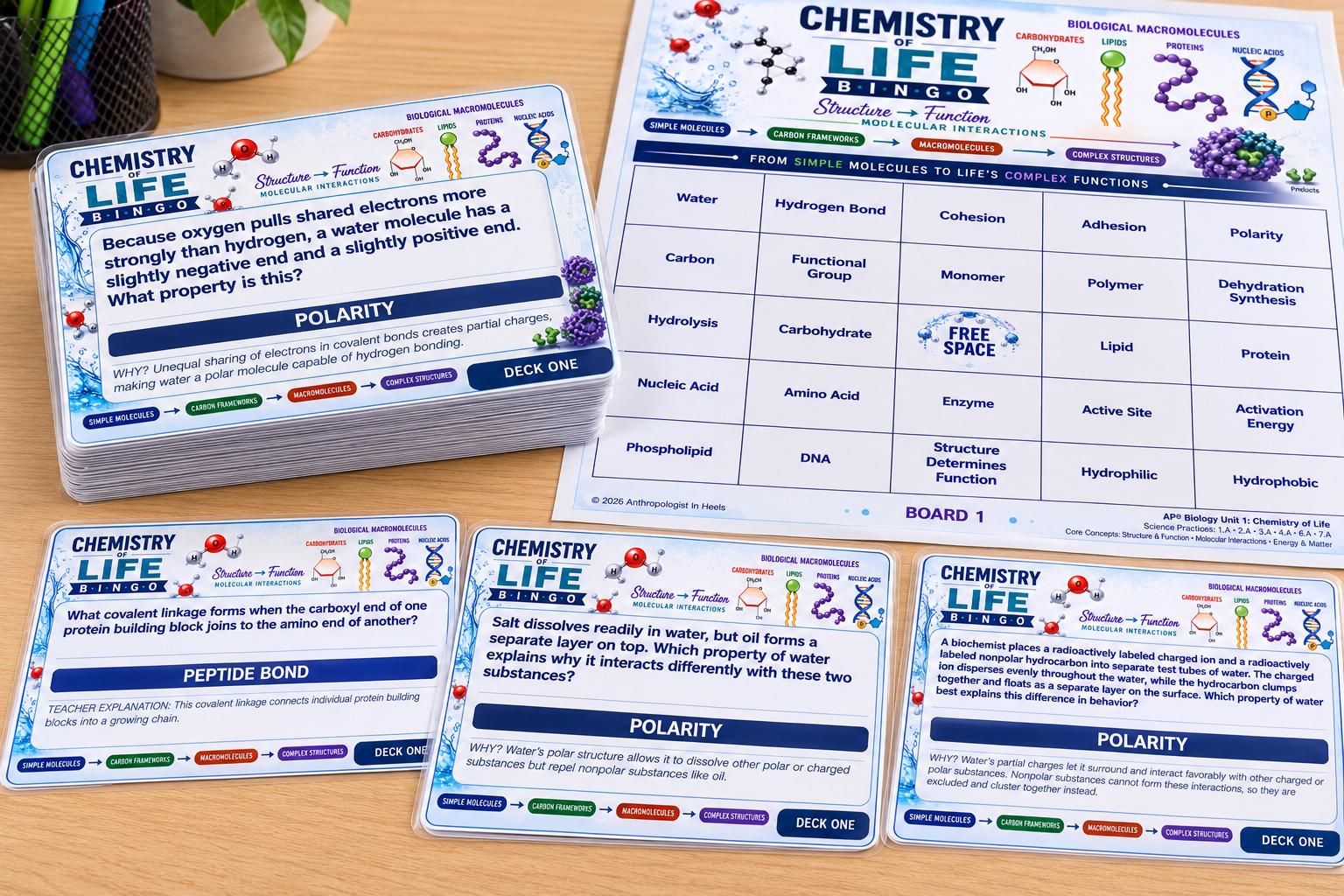 Image 4 of 7
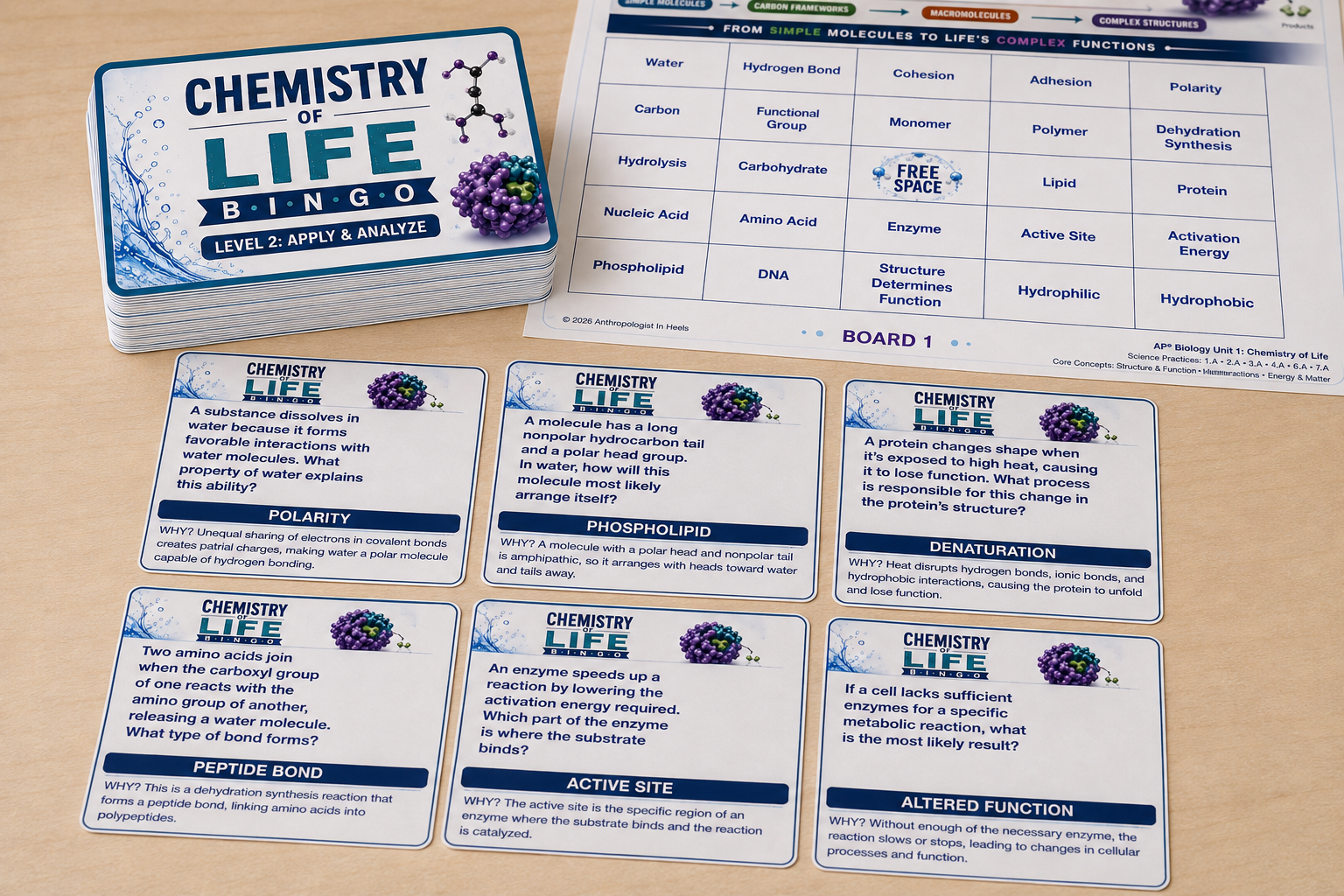 Image 5 of 7
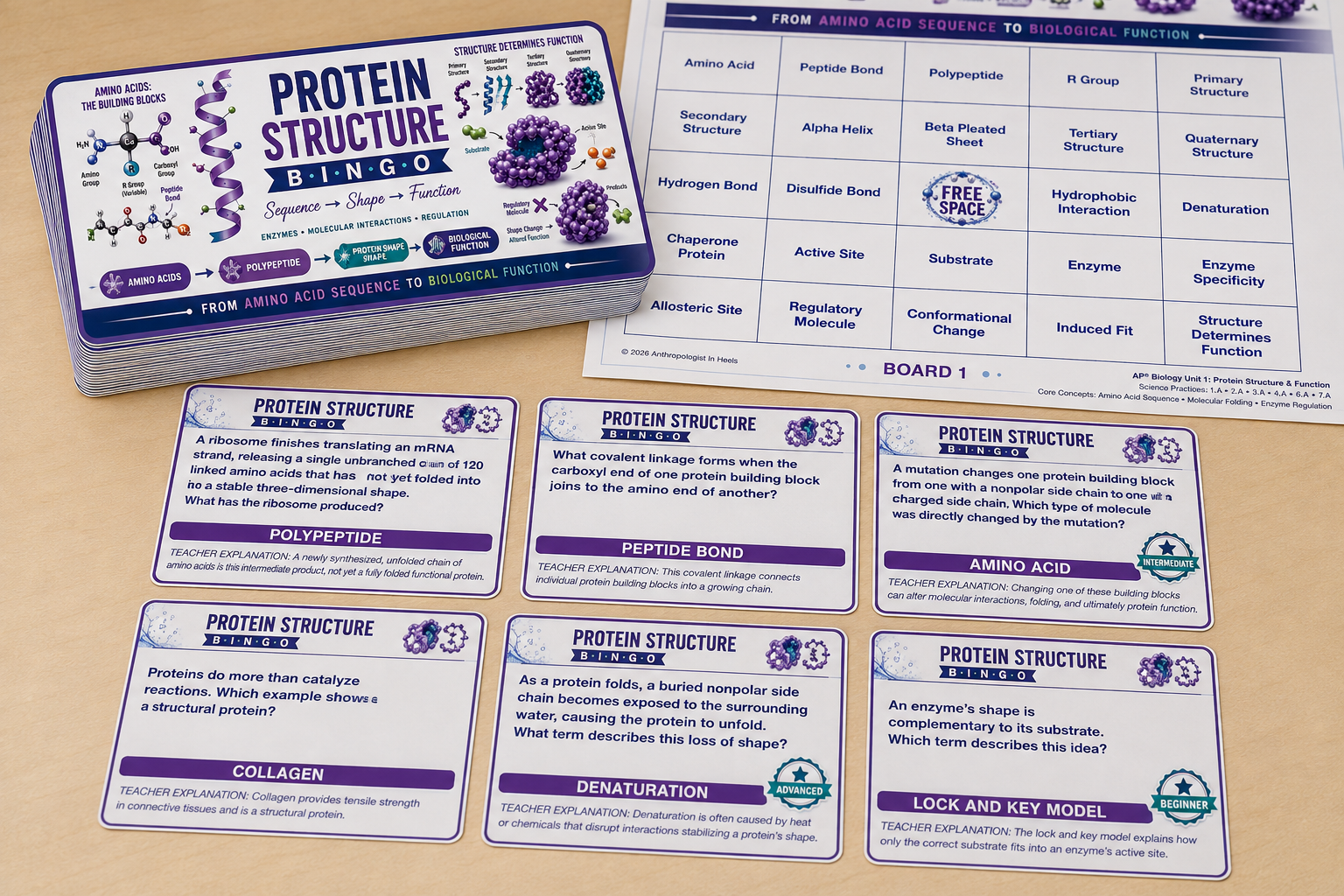 Image 6 of 7
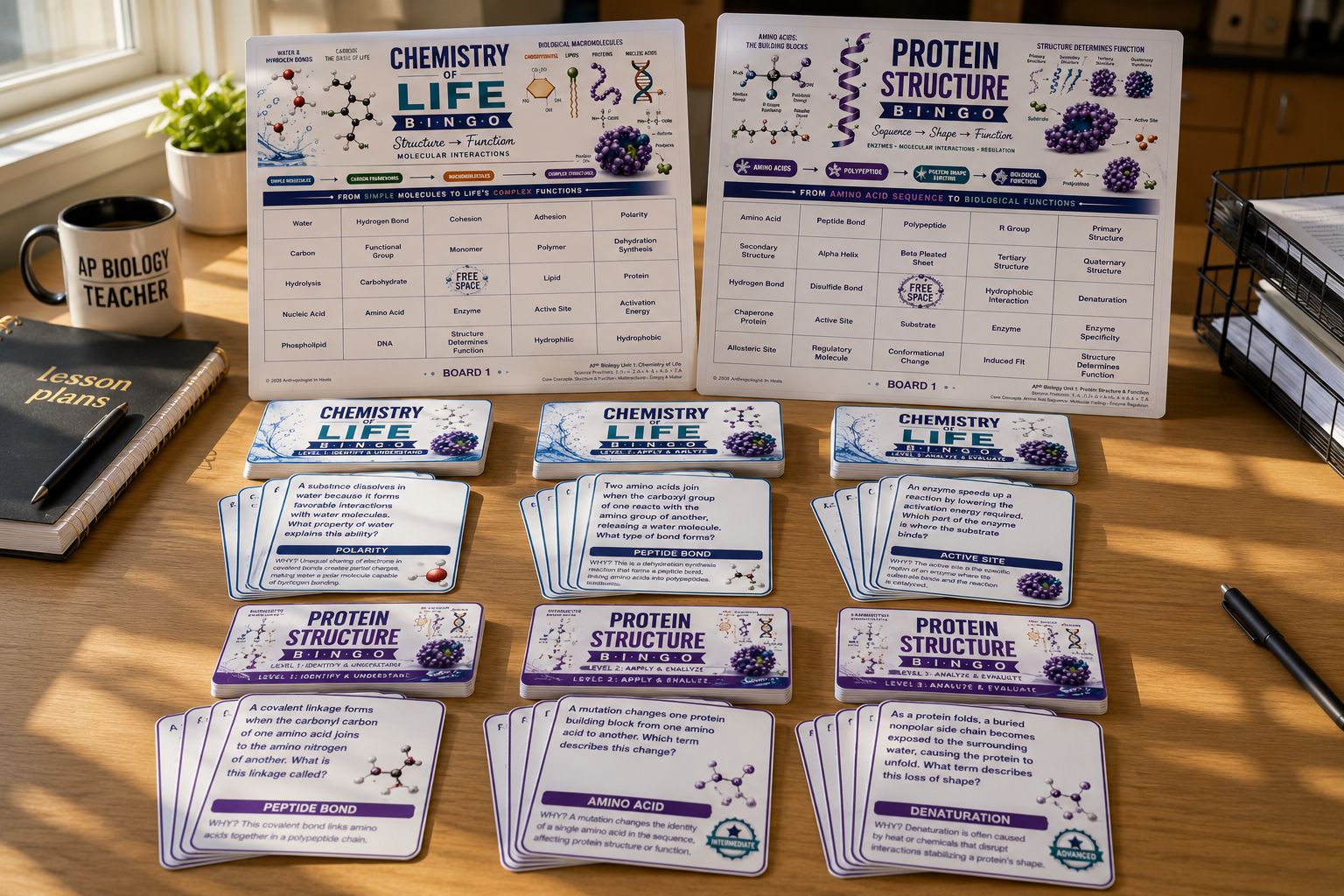 Image 7 of 7
AP Biology Unit 1 Chemistry of Life Review Game Bingo Proteins & Enzymes
Make AP Biology Unit 1 Chemistry of Life review active, rigorous, and engaging with two complete Bingo games covering biomolecules, water properties, protein structure and function, enzymes, and molecular interactions.
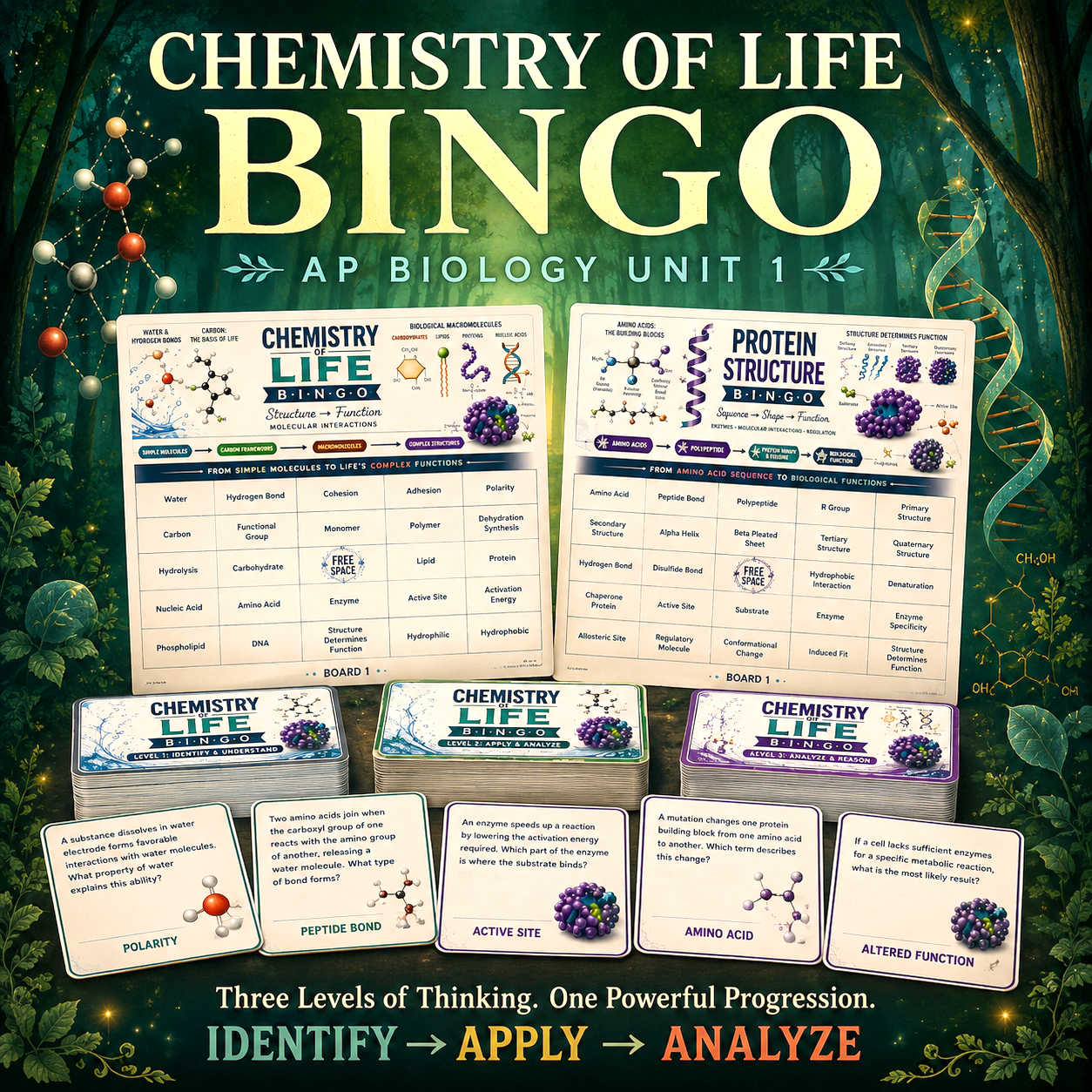
This isn't traditional vocabulary Bingo. Students progress through three levels of thinking—Identify, Apply, and Analyze—using the same concepts at increasing levels of rigor. With 60 unique Bingo boards, 6 differentiated calling-card decks, and 144 calling cards, you can use this resource for foundational review, application practice, differentiation, and AP-level scientific reasoning.
⭐ WHAT'S INCLUDED
This complete AP Biology review bundle includes:
2 complete AP Biology Bingo games
60 unique 5×5 Bingo boards — 30 per game
6 complete calling-card decks — 3 levels per game
24 calling cards in each deck
144 calling cards total
3 levels of rigor: Identify → Apply → Analyze
Center FREE SPACE on every Bingo board
Questions, answers, and teacher explanations on the calling cards
Comprehensive Teacher Guide
Classroom preparation and implementation instructions
Differentiation and pacing suggestions
AP Biology Unit 1 alignment information
NGSS connections
Terms of Use
With 30 different boards for each game, an entire class can play at the same time without every student having an identical board.
🧬 GAME ONE: CHEMISTRY OF LIFE BINGO
The first game focuses on the chemical foundations of life and helps students connect molecular properties to biological function.
Students review concepts including:
Water • Hydrogen Bonds • Cohesion • Adhesion • Polarity • Carbon • Functional Groups • Monomers • Polymers • Dehydration Synthesis • Hydrolysis • Carbohydrates • Lipids • Proteins • Nucleic Acids • Amino Acids • Enzymes • Active Sites • Activation Energy • Phospholipids • DNA • Hydrophilic • Hydrophobic • Structure Determines Function
The conceptual progression emphasizes:
Simple Molecules → Molecular Interactions → Macromolecules → Biological Function
Students don't simply memorize that water is polar or that hydrogen bonds occur between water molecules. The calling-card progression asks them to connect these molecular properties to biological phenomena and eventually use evidence to determine which concept best explains an observation.
🔬 GAME TWO: PROTEIN STRUCTURE AND FUNCTION BINGO
The second game takes students deeper into one of the central ideas of AP Biology:
Structure Determines Function
Students examine how amino acid sequence and molecular interactions influence protein shape—and how protein shape influences biological function.
Concepts include:
Amino Acid • R Group • Peptide Bond • Polypeptide • Primary Structure • Secondary Structure • Tertiary Structure • Quaternary Structure • Protein • Denaturation • Enzyme • Catalyst • Activation Energy • Substrate • Active Site • Induced Fit • Competitive Inhibition • Noncompetitive Inhibition • Allosteric Regulation • Feedback Inhibition • Molecular Shape • Molecular Interactions • Structure Determines Function • Emergent Properties
The conceptual progression is:
Sequence → Shape → Interaction → Function
Students encounter protein folding, mutations, R-group properties, molecular interactions, enzyme-substrate relationships, environmental effects on proteins, inhibition, regulation, and the consequences of changes in molecular structure.
🎯 THREE CALLING-CARD DECKS = THREE LEVELS OF THINKING
Each Bingo game includes three separate sets of 24 calling cards.
That means you can reuse the same Bingo boards while completely changing the level of thinking required from students.
DECK ONE — IDENTIFY & UNDERSTAND
Start with foundational understanding.
Instead of simply calling out the answer, the teacher reads a scientific description or conceptual clue.
Students must determine which concept is being described before finding it on their board.
This level is ideal for:
Vocabulary Reinforcement • Initial Unit Review • Formative Assessment • Intervention • Foundational Practice
Students ask: What is it?
DECK TWO — APPLY: STRUCTURE → FUNCTION
Now students have to use what they know.
Calling cards present biological scenarios involving molecular properties, protein folding, environmental changes, mutations, enzyme behavior, binding, inhibition, and structure–function relationships.
Students determine which concept best explains the situation.
This level is ideal for:
Application Practice • Mid-Unit Review • Collaborative Learning • Test Preparation • Differentiation
Students ask: How does it work, and what happens when something changes?
DECK THREE — AP CHALLENGE: ANALYZE & REASON
The highest-level deck moves students toward evidence-based scientific reasoning.
Students may encounter short experimental scenarios, data, molecular models, mutations, protein sequences, enzyme-rate patterns, inhibitor experiments, or other evidence.
Rather than recalling a definition, students must determine:
What does the evidence tell me?
This level is ideal for:
AP Biology Review • End-of-Unit Review • AP Exam Preparation • Enrichment • Advanced Students • Evidence-Based Reasoning Practice
The result is a deliberate progression:
IDENTIFY → APPLY → ANALYZE
💡 THIS IS MORE THAN VOCABULARY BINGO
Traditional Bingo might call:
“Tertiary Structure.”
Students find tertiary structure and cover the square.
In this resource, students don't hear the answer.
Instead, they might encounter evidence that a change in pH disrupted interactions among side chains within a single polypeptide, changing its three-dimensional form.
Students must reason their way to:
Tertiary Structure
Then they locate the term on their Bingo board.
That changes the task from:
Hear → Find
to:
Think → Connect → Determine → Find → Explain
The calling cards also provide the correct answer and a concise teacher explanation, making every question an opportunity for immediate feedback and discussion.
👩🏫 DIFFERENTIATE WITHOUT PREPARING THREE DIFFERENT ACTIVITIES
One of the biggest advantages of the three-deck design is flexibility.
Use Deck One with students who need additional conceptual support.
Use Deck Two when students are ready to apply their knowledge.
Use Deck Three when students are ready for greater AP-level reasoning.
Or use the decks sequentially as students progress through the unit.
One set of boards. Three levels of challenge.
You can even use different decks with different groups during the same class period.
🧠 BUILT FOR DISCUSSION, NOT JUST WINNING BINGO
For greater rigor, require students to justify their answer before marking the square.
Ask:
What evidence in the question led you to that answer?
Students can think independently, discuss with a partner, reach consensus in a team, or explain their reasoning to the class.
The teacher explanation on each calling card makes it easy to provide immediate clarification before moving to the next question.
🏫 USE IT YOUR WAY
The two games can be used for:
AP Biology Unit 1 Review • Chemistry of Life Review • Test Prep • AP Exam Review • Biology Review Games • Stations • Small Groups • Whole-Class Review • Formative Assessment • Intervention • Enrichment • Collaborative Learning • Spiral Review • Substitute Plans
Play traditional Bingo or try:
Explain Before You Mark — Students justify the answer before covering the square.
Think–Pair–Share Bingo — Students reason independently, discuss with a partner, and then select an answer.
Team Bingo — Groups must reach consensus before marking their board.
Differentiated Bingo — Different groups use different calling-card levels.
AP Challenge Bingo — Use Deck Three and require students to defend answers using evidence from the prompt.
⏱️ FLEXIBLE FOR REAL CLASS PERIODS
Use the resource for a quick 15–20 minute review, a standard 25–35 minute activity, or an extended review period with multiple rounds and student explanations.
Because each game contains three completely different calling-card decks, the boards can be reused rather than becoming a one-and-done activity.
📚 AP BIOLOGY UNIT 1: CHEMISTRY OF LIFE
This resource was developed specifically to reinforce concepts associated with AP Biology Unit 1: Chemistry of Life, particularly relationships among molecular structure, molecular interactions, biological macromolecules, proteins, enzymes, and biological function.
Students work with concepts involving:
Water Properties • Hydrogen Bonding • Carbon • Biological Macromolecules • Molecular Interactions • Amino Acid Sequence • Protein Folding • Protein Structure • Enzyme Function • Activation Energy • Enzyme Regulation • Structure and Function
The resource also reinforces broader AP Biology reasoning involving concept explanation, visual and molecular representations, experimental situations, data interpretation, and evidence-based justification.
🔄 BUILDS FOUNDATIONS FOR LATER AP BIOLOGY UNITS
Chemistry of Life concepts don't disappear after Unit 1.
The molecular reasoning reinforced in these games provides important foundations for later work involving:
Cell Membranes • Transport • Cellular Energetics • Cell Communication • Signal Transduction • Gene Expression • Mutations • Heredity • Natural Selection
That makes the games useful for both Unit 1 instruction and later spiral review.
🔎 NGSS CONNECTIONS
The resource also supports concepts and practices associated with high school NGSS, particularly:
HS-LS1-6 — Carbon-based biological molecules and the formation of larger molecules
HS-PS1-3 — Molecular interactions and properties resulting from electrical forces between particles
HS-PS1-4 — Chemical reactions, molecular rearrangements, and energy-related concepts
Relevant Science and Engineering Practices and Crosscutting Concepts include:
Developing and Using Models • Analyzing and Interpreting Data • Constructing Explanations • Engaging in Argument from Evidence • Structure and Function • Cause and Effect • Energy and Matter • Systems and System Models
This resource supports these NGSS concepts and practices but is not intended to replace a complete three-dimensional NGSS instructional sequence.
✂️ EASY CLASSROOM PREP
For repeated classroom use:
Print the Bingo boards on cardstock.
Laminate if desired.
Print the calling-card decks on cardstock.
Cut along the provided dashed cutting lines.
Keep Deck One, Deck Two, and Deck Three separated.
Give students Bingo markers, counters, or dry-erase markers.
Choose your game and level of rigor—and play!
Each calling-card page is clearly identified by deck to make organization easier.
⭐ WHY TEACHERS MAY LOVE THIS FORMAT
You're not purchasing a Bingo activity students can use only once.
You're getting:
2 complete games
60 unique Bingo boards
144 calling cards
6 complete decks
3 levels of rigor
Foundational + Application + Analysis practice
Teacher explanations built into the cards
and multiple ways to use the resource throughout AP Biology.
The same game structure moves students from:
“I recognize this term.”
to:
“I can apply this concept.”
to:
“I can use evidence to determine which biological mechanism explains what I'm seeing.”
🧬 GREAT FOR
AP Biology
High School Biology
Honors Biology
AP Biology Unit 1
Chemistry of Life
Biochemistry
Biological Macromolecules
Protein Structure and Function
Enzymes
Structure and Function
AP Biology Review
AP Biology Test Prep
AP Biology Exam Review
📄 PLEASE NOTE
This is a printable educational resource. Please review the product preview to see the Bingo boards, calling-card format, levels of questioning, and included materials before purchasing.
AP® is a trademark registered by the College Board, which is not affiliated with and does not endorse this resource.
© 2026 Anthropologist In Heels
Make AP Biology Unit 1 Chemistry of Life review active, rigorous, and engaging with two complete Bingo games covering biomolecules, water properties, protein structure and function, enzymes, and molecular interactions.
This isn't traditional vocabulary Bingo. Students progress through three levels of thinking—Identify, Apply, and Analyze—using the same concepts at increasing levels of rigor. With 60 unique Bingo boards, 6 differentiated calling-card decks, and 144 calling cards, you can use this resource for foundational review, application practice, differentiation, and AP-level scientific reasoning.
⭐ WHAT'S INCLUDED
This complete AP Biology review bundle includes:
2 complete AP Biology Bingo games
60 unique 5×5 Bingo boards — 30 per game
6 complete calling-card decks — 3 levels per game
24 calling cards in each deck
144 calling cards total
3 levels of rigor: Identify → Apply → Analyze
Center FREE SPACE on every Bingo board
Questions, answers, and teacher explanations on the calling cards
Comprehensive Teacher Guide
Classroom preparation and implementation instructions
Differentiation and pacing suggestions
AP Biology Unit 1 alignment information
NGSS connections
Terms of Use
With 30 different boards for each game, an entire class can play at the same time without every student having an identical board.
🧬 GAME ONE: CHEMISTRY OF LIFE BINGO
The first game focuses on the chemical foundations of life and helps students connect molecular properties to biological function.
Students review concepts including:
Water • Hydrogen Bonds • Cohesion • Adhesion • Polarity • Carbon • Functional Groups • Monomers • Polymers • Dehydration Synthesis • Hydrolysis • Carbohydrates • Lipids • Proteins • Nucleic Acids • Amino Acids • Enzymes • Active Sites • Activation Energy • Phospholipids • DNA • Hydrophilic • Hydrophobic • Structure Determines Function
The conceptual progression emphasizes:
Simple Molecules → Molecular Interactions → Macromolecules → Biological Function
Students don't simply memorize that water is polar or that hydrogen bonds occur between water molecules. The calling-card progression asks them to connect these molecular properties to biological phenomena and eventually use evidence to determine which concept best explains an observation.
🔬 GAME TWO: PROTEIN STRUCTURE AND FUNCTION BINGO
The second game takes students deeper into one of the central ideas of AP Biology:
Structure Determines Function
Students examine how amino acid sequence and molecular interactions influence protein shape—and how protein shape influences biological function.
Concepts include:
Amino Acid • R Group • Peptide Bond • Polypeptide • Primary Structure • Secondary Structure • Tertiary Structure • Quaternary Structure • Protein • Denaturation • Enzyme • Catalyst • Activation Energy • Substrate • Active Site • Induced Fit • Competitive Inhibition • Noncompetitive Inhibition • Allosteric Regulation • Feedback Inhibition • Molecular Shape • Molecular Interactions • Structure Determines Function • Emergent Properties
The conceptual progression is:
Sequence → Shape → Interaction → Function
Students encounter protein folding, mutations, R-group properties, molecular interactions, enzyme-substrate relationships, environmental effects on proteins, inhibition, regulation, and the consequences of changes in molecular structure.
🎯 THREE CALLING-CARD DECKS = THREE LEVELS OF THINKING
Each Bingo game includes three separate sets of 24 calling cards.
That means you can reuse the same Bingo boards while completely changing the level of thinking required from students.
DECK ONE — IDENTIFY & UNDERSTAND
Start with foundational understanding.
Instead of simply calling out the answer, the teacher reads a scientific description or conceptual clue.
Students must determine which concept is being described before finding it on their board.
This level is ideal for:
Vocabulary Reinforcement • Initial Unit Review • Formative Assessment • Intervention • Foundational Practice
Students ask: What is it?
DECK TWO — APPLY: STRUCTURE → FUNCTION
Now students have to use what they know.
Calling cards present biological scenarios involving molecular properties, protein folding, environmental changes, mutations, enzyme behavior, binding, inhibition, and structure–function relationships.
Students determine which concept best explains the situation.
This level is ideal for:
Application Practice • Mid-Unit Review • Collaborative Learning • Test Preparation • Differentiation
Students ask: How does it work, and what happens when something changes?
DECK THREE — AP CHALLENGE: ANALYZE & REASON
The highest-level deck moves students toward evidence-based scientific reasoning.
Students may encounter short experimental scenarios, data, molecular models, mutations, protein sequences, enzyme-rate patterns, inhibitor experiments, or other evidence.
Rather than recalling a definition, students must determine:
What does the evidence tell me?
This level is ideal for:
AP Biology Review • End-of-Unit Review • AP Exam Preparation • Enrichment • Advanced Students • Evidence-Based Reasoning Practice
The result is a deliberate progression:
IDENTIFY → APPLY → ANALYZE
💡 THIS IS MORE THAN VOCABULARY BINGO
Traditional Bingo might call:
“Tertiary Structure.”
Students find tertiary structure and cover the square.
In this resource, students don't hear the answer.
Instead, they might encounter evidence that a change in pH disrupted interactions among side chains within a single polypeptide, changing its three-dimensional form.
Students must reason their way to:
Tertiary Structure
Then they locate the term on their Bingo board.
That changes the task from:
Hear → Find
to:
Think → Connect → Determine → Find → Explain
The calling cards also provide the correct answer and a concise teacher explanation, making every question an opportunity for immediate feedback and discussion.
👩🏫 DIFFERENTIATE WITHOUT PREPARING THREE DIFFERENT ACTIVITIES
One of the biggest advantages of the three-deck design is flexibility.
Use Deck One with students who need additional conceptual support.
Use Deck Two when students are ready to apply their knowledge.
Use Deck Three when students are ready for greater AP-level reasoning.
Or use the decks sequentially as students progress through the unit.
One set of boards. Three levels of challenge.
You can even use different decks with different groups during the same class period.
🧠 BUILT FOR DISCUSSION, NOT JUST WINNING BINGO
For greater rigor, require students to justify their answer before marking the square.
Ask:
What evidence in the question led you to that answer?
Students can think independently, discuss with a partner, reach consensus in a team, or explain their reasoning to the class.
The teacher explanation on each calling card makes it easy to provide immediate clarification before moving to the next question.
🏫 USE IT YOUR WAY
The two games can be used for:
AP Biology Unit 1 Review • Chemistry of Life Review • Test Prep • AP Exam Review • Biology Review Games • Stations • Small Groups • Whole-Class Review • Formative Assessment • Intervention • Enrichment • Collaborative Learning • Spiral Review • Substitute Plans
Play traditional Bingo or try:
Explain Before You Mark — Students justify the answer before covering the square.
Think–Pair–Share Bingo — Students reason independently, discuss with a partner, and then select an answer.
Team Bingo — Groups must reach consensus before marking their board.
Differentiated Bingo — Different groups use different calling-card levels.
AP Challenge Bingo — Use Deck Three and require students to defend answers using evidence from the prompt.
⏱️ FLEXIBLE FOR REAL CLASS PERIODS
Use the resource for a quick 15–20 minute review, a standard 25–35 minute activity, or an extended review period with multiple rounds and student explanations.
Because each game contains three completely different calling-card decks, the boards can be reused rather than becoming a one-and-done activity.
📚 AP BIOLOGY UNIT 1: CHEMISTRY OF LIFE
This resource was developed specifically to reinforce concepts associated with AP Biology Unit 1: Chemistry of Life, particularly relationships among molecular structure, molecular interactions, biological macromolecules, proteins, enzymes, and biological function.
Students work with concepts involving:
Water Properties • Hydrogen Bonding • Carbon • Biological Macromolecules • Molecular Interactions • Amino Acid Sequence • Protein Folding • Protein Structure • Enzyme Function • Activation Energy • Enzyme Regulation • Structure and Function
The resource also reinforces broader AP Biology reasoning involving concept explanation, visual and molecular representations, experimental situations, data interpretation, and evidence-based justification.
🔄 BUILDS FOUNDATIONS FOR LATER AP BIOLOGY UNITS
Chemistry of Life concepts don't disappear after Unit 1.
The molecular reasoning reinforced in these games provides important foundations for later work involving:
Cell Membranes • Transport • Cellular Energetics • Cell Communication • Signal Transduction • Gene Expression • Mutations • Heredity • Natural Selection
That makes the games useful for both Unit 1 instruction and later spiral review.
🔎 NGSS CONNECTIONS
The resource also supports concepts and practices associated with high school NGSS, particularly:
HS-LS1-6 — Carbon-based biological molecules and the formation of larger molecules
HS-PS1-3 — Molecular interactions and properties resulting from electrical forces between particles
HS-PS1-4 — Chemical reactions, molecular rearrangements, and energy-related concepts
Relevant Science and Engineering Practices and Crosscutting Concepts include:
Developing and Using Models • Analyzing and Interpreting Data • Constructing Explanations • Engaging in Argument from Evidence • Structure and Function • Cause and Effect • Energy and Matter • Systems and System Models
This resource supports these NGSS concepts and practices but is not intended to replace a complete three-dimensional NGSS instructional sequence.
✂️ EASY CLASSROOM PREP
For repeated classroom use:
Print the Bingo boards on cardstock.
Laminate if desired.
Print the calling-card decks on cardstock.
Cut along the provided dashed cutting lines.
Keep Deck One, Deck Two, and Deck Three separated.
Give students Bingo markers, counters, or dry-erase markers.
Choose your game and level of rigor—and play!
Each calling-card page is clearly identified by deck to make organization easier.
⭐ WHY TEACHERS MAY LOVE THIS FORMAT
You're not purchasing a Bingo activity students can use only once.
You're getting:
2 complete games
60 unique Bingo boards
144 calling cards
6 complete decks
3 levels of rigor
Foundational + Application + Analysis practice
Teacher explanations built into the cards
and multiple ways to use the resource throughout AP Biology.
The same game structure moves students from:
“I recognize this term.”
to:
“I can apply this concept.”
to:
“I can use evidence to determine which biological mechanism explains what I'm seeing.”
🧬 GREAT FOR
AP Biology
High School Biology
Honors Biology
AP Biology Unit 1
Chemistry of Life
Biochemistry
Biological Macromolecules
Protein Structure and Function
Enzymes
Structure and Function
AP Biology Review
AP Biology Test Prep
AP Biology Exam Review
📄 PLEASE NOTE
This is a printable educational resource. Please review the product preview to see the Bingo boards, calling-card format, levels of questioning, and included materials before purchasing.
AP® is a trademark registered by the College Board, which is not affiliated with and does not endorse this resource.
© 2026 Anthropologist In Heels