Make AP Psychology Unit 2: Cognition memory review active, engaging, and rigorous with this printable Memory Bingo Review Game! Instead of simply memorizing vocabulary, students identify psychological concepts from questions and scenarios, then locate the correct terms on their Bingo boards.
This resource includes TWO complete memory Bingo games, each with TWO levels of calling cards. Start with foundational concept recognition, then replay with scenario-based questions that ask students to apply what they know—giving you 4 calling-card decks and a natural progression from vocabulary review to AP-style concept application.
🧠 TWO MEMORY BINGO GAMES INCLUDED
GAME 1: Memory Systems & Encoding
Students review how memories get IN and become established, including memory systems, encoding, storage, types of memory, memory strategies, and biological foundations.
Concepts include encoding, storage, retrieval, sensory memory, iconic memory, echoic memory, short-term memory, working memory, explicit and implicit memory, episodic memory, semantic memory, procedural memory, prospective memory, chunking, rehearsal, mnemonic devices, hippocampus, long-term potentiation, and more.
GAME 2: Retrieval, Forgetting & Memory Distortion
Students explore what happens when we try to get memories OUT—and why memories can be forgotten, interfered with, or reconstructed.
Concepts include recall, recognition, relearning, retrieval cues, priming, context-dependent memory, state-dependent memory, mood-congruent memory, serial position effect, primacy and recency effects, spacing effect, testing effect, forgetting curve, proactive and retroactive interference, encoding and retrieval failure, amnesia, misinformation effect, source amnesia, reconsolidation, and more.
⭐ TWO LEVELS OF RIGOR
This isn't just a vocabulary Bingo game.
Deck One — Concept Foundations
Identify → Define → Distinguish
Students build confidence with core terminology and distinguish closely related memory concepts.
Deck Two — AP Exam Application
Apply → Analyze → Interpret
Students encounter familiar concepts again, but now through behaviors, learning situations, research examples, and scenarios that require them to determine which psychological concept best explains the evidence.
For example, rather than only identifying working memory from a definition, an application card describes a student mentally calculating 27 × 4 while holding and manipulating intermediate numbers and asks students to determine which memory system is being used.
📚 WHAT'S INCLUDED
2 complete AP Psychology Memory Bingo games
30 unique Bingo boards for Game 1
30 unique Bingo boards for Game 2
Deck One: Concept Foundations calling cards for each game
Deck Two: AP Exam Application calling cards for each game
Questions, answers, and brief explanations directly on the calling cards
Teacher guide with setup and gameplay instructions
Multiple suggested winning patterns
AP Psychology alignment information
Printable, classroom-ready PDF format
The boards are designed for easy classroom use: print, cut, and play. For repeated use, laminate the boards and calling cards and have students play with dry-erase markers, Bingo chips, counters, or other classroom markers.
🎯 BUILT FOR AP PSYCHOLOGY UNIT 2: COGNITION
The two games support the memory sequence associated with Topics 2.3–2.7 in the current AP Psychology Course and Exam Description: Introduction to Memory, Encoding Memories, Storing Memories, Retrieving Memories, and Forgetting and Other Memory Challenges. The current College Board framework also explicitly connects memory content with applying psychological concepts to scenarios, making the two-deck progression especially useful for moving beyond simple definition recall. (AP Central)
💡 MULTIPLE WAYS TO USE IT
Use Game 1 → Game 2 as students learn the memory unit, play Deck One first and Deck Two later for increasing rigor, or combine selected application cards from both games for a cumulative memory review. The set works especially well for AP Psychology Unit 2 test review, formative assessment, vocabulary reinforcement, small groups, whole-class review, early finishers, or AP Exam review.
Students see the same important concepts more than once—but the thinking required changes.
FORM & STORE → RETRIEVE → FORGET → RECONSTRUCT
Turn your next AP Psych Unit 2 memory review into an activity students can participate in while still practicing the terminology and concept application they need for AP Psychology.
Print. Cut. Play. Review. Apply. BINGO!
AP® and Advanced Placement® are registered trademarks of the College Board. This independently created resource is not affiliated with, endorsed by, or sponsored by the College Board.
Make AP Psychology Unit 2: Cognition memory review active, engaging, and rigorous with this printable Memory Bingo Review Game! Instead of simply memorizing vocabulary, students identify psychological concepts from questions and scenarios, then locate the correct terms on their Bingo boards.
This resource includes TWO complete memory Bingo games, each with TWO levels of calling cards. Start with foundational concept recognition, then replay with scenario-based questions that ask students to apply what they know—giving you 4 calling-card decks and a natural progression from vocabulary review to AP-style concept application.
🧠 TWO MEMORY BINGO GAMES INCLUDED
GAME 1: Memory Systems & Encoding
Students review how memories get IN and become established, including memory systems, encoding, storage, types of memory, memory strategies, and biological foundations.
Concepts include encoding, storage, retrieval, sensory memory, iconic memory, echoic memory, short-term memory, working memory, explicit and implicit memory, episodic memory, semantic memory, procedural memory, prospective memory, chunking, rehearsal, mnemonic devices, hippocampus, long-term potentiation, and more.
GAME 2: Retrieval, Forgetting & Memory Distortion
Students explore what happens when we try to get memories OUT—and why memories can be forgotten, interfered with, or reconstructed.
Concepts include recall, recognition, relearning, retrieval cues, priming, context-dependent memory, state-dependent memory, mood-congruent memory, serial position effect, primacy and recency effects, spacing effect, testing effect, forgetting curve, proactive and retroactive interference, encoding and retrieval failure, amnesia, misinformation effect, source amnesia, reconsolidation, and more.
⭐ TWO LEVELS OF RIGOR
This isn't just a vocabulary Bingo game.
Deck One — Concept Foundations
Identify → Define → Distinguish
Students build confidence with core terminology and distinguish closely related memory concepts.
Deck Two — AP Exam Application
Apply → Analyze → Interpret
Students encounter familiar concepts again, but now through behaviors, learning situations, research examples, and scenarios that require them to determine which psychological concept best explains the evidence.
For example, rather than only identifying working memory from a definition, an application card describes a student mentally calculating 27 × 4 while holding and manipulating intermediate numbers and asks students to determine which memory system is being used.
📚 WHAT'S INCLUDED
2 complete AP Psychology Memory Bingo games
30 unique Bingo boards for Game 1
30 unique Bingo boards for Game 2
Deck One: Concept Foundations calling cards for each game
Deck Two: AP Exam Application calling cards for each game
Questions, answers, and brief explanations directly on the calling cards
Teacher guide with setup and gameplay instructions
Multiple suggested winning patterns
AP Psychology alignment information
Printable, classroom-ready PDF format
The boards are designed for easy classroom use: print, cut, and play. For repeated use, laminate the boards and calling cards and have students play with dry-erase markers, Bingo chips, counters, or other classroom markers.
🎯 BUILT FOR AP PSYCHOLOGY UNIT 2: COGNITION
The two games support the memory sequence associated with Topics 2.3–2.7 in the current AP Psychology Course and Exam Description: Introduction to Memory, Encoding Memories, Storing Memories, Retrieving Memories, and Forgetting and Other Memory Challenges. The current College Board framework also explicitly connects memory content with applying psychological concepts to scenarios, making the two-deck progression especially useful for moving beyond simple definition recall. (AP Central)
💡 MULTIPLE WAYS TO USE IT
Use Game 1 → Game 2 as students learn the memory unit, play Deck One first and Deck Two later for increasing rigor, or combine selected application cards from both games for a cumulative memory review. The set works especially well for AP Psychology Unit 2 test review, formative assessment, vocabulary reinforcement, small groups, whole-class review, early finishers, or AP Exam review.
Students see the same important concepts more than once—but the thinking required changes.
FORM & STORE → RETRIEVE → FORGET → RECONSTRUCT
Turn your next AP Psych Unit 2 memory review into an activity students can participate in while still practicing the terminology and concept application they need for AP Psychology.
Print. Cut. Play. Review. Apply. BINGO!
AP® and Advanced Placement® are registered trademarks of the College Board. This independently created resource is not affiliated with, endorsed by, or sponsored by the College Board.

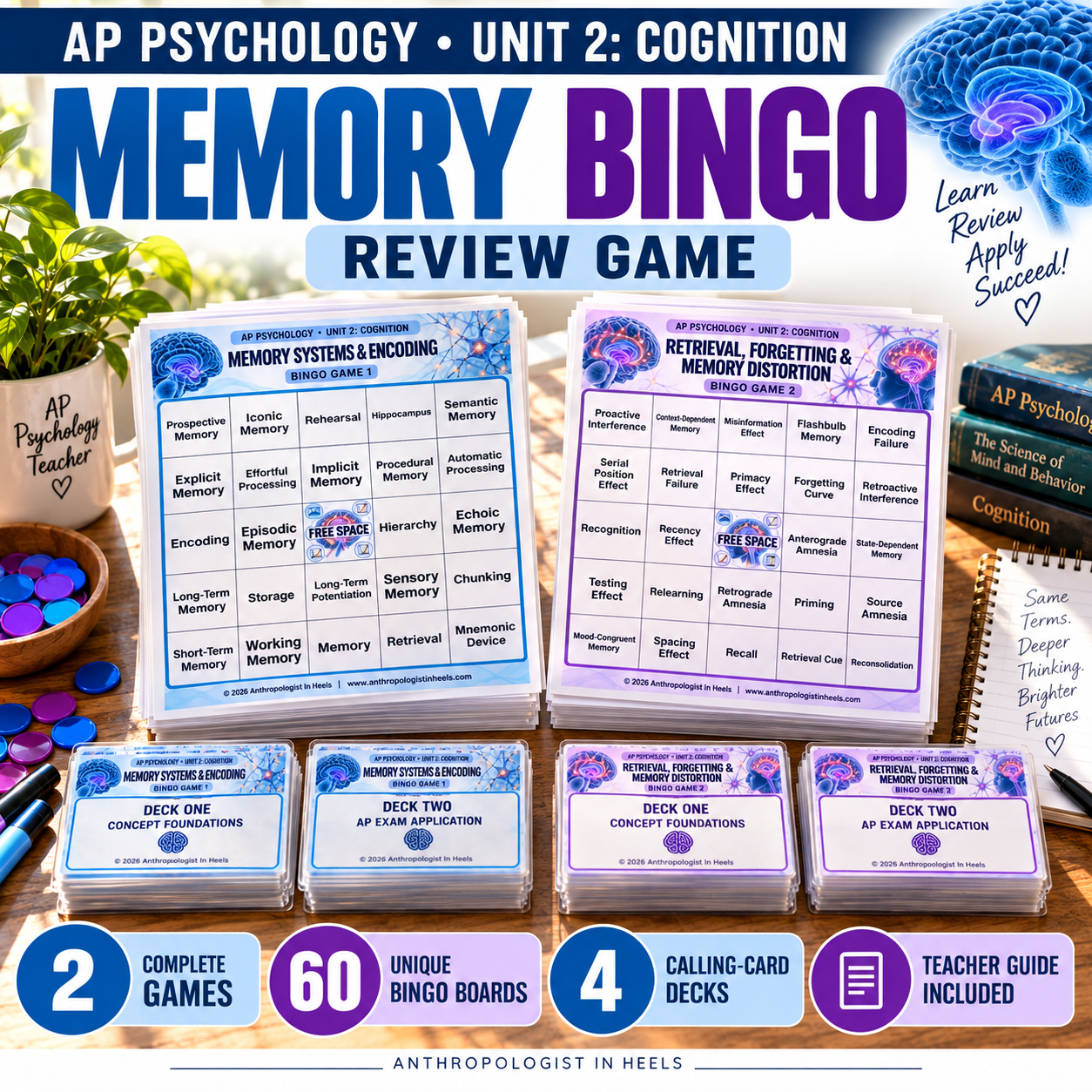 Image 1 of 7
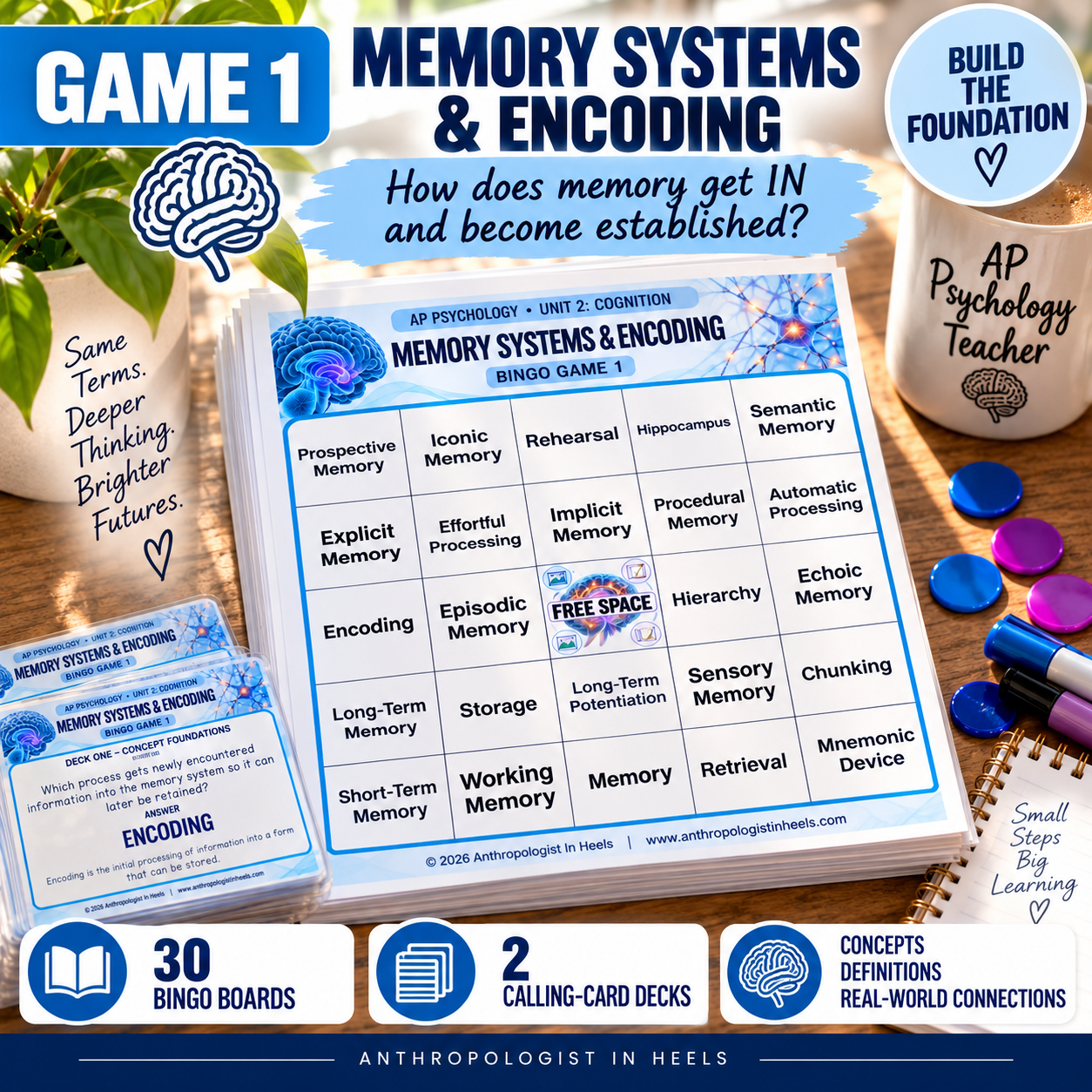 Image 2 of 7
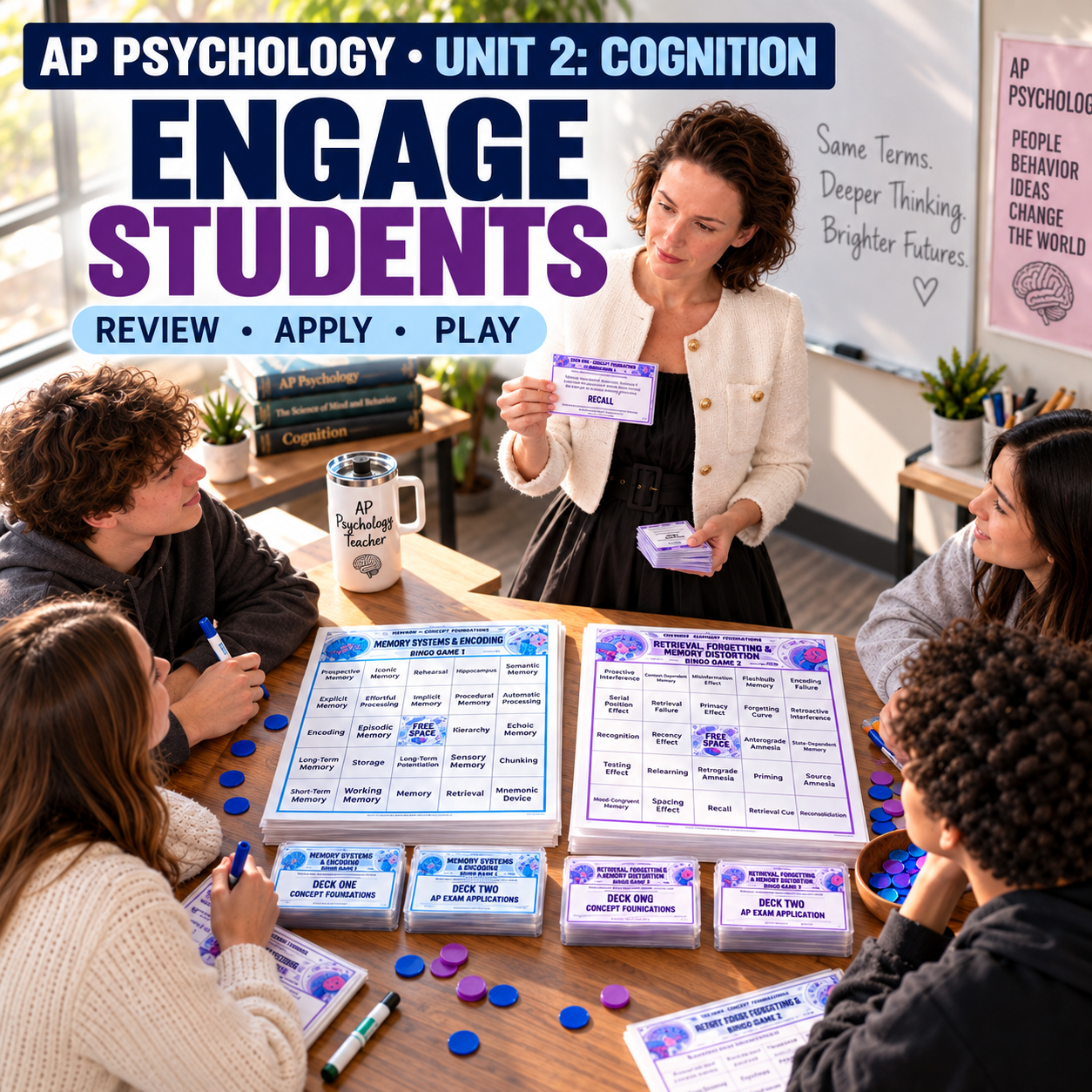 Image 3 of 7
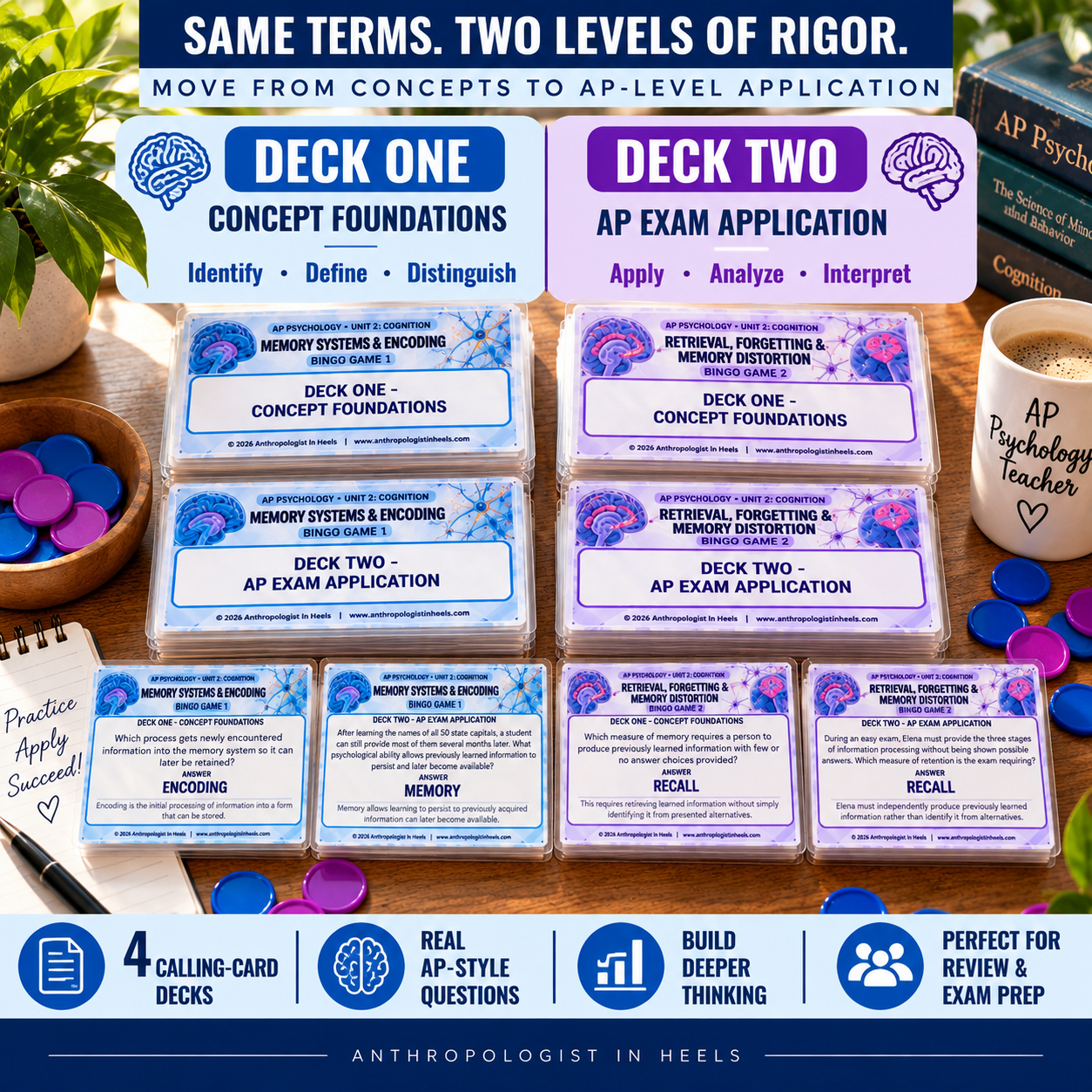 Image 4 of 7
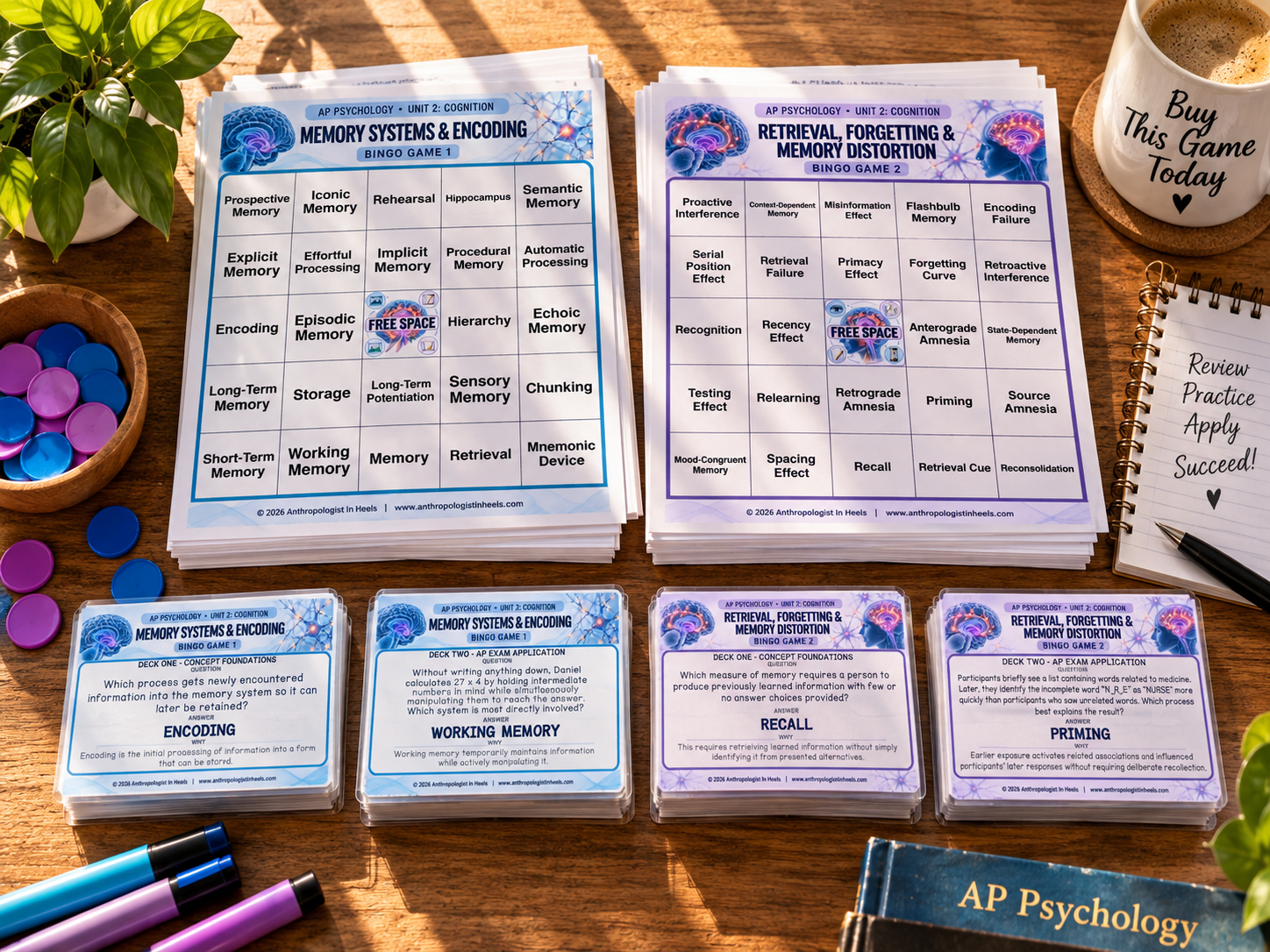 Image 5 of 7
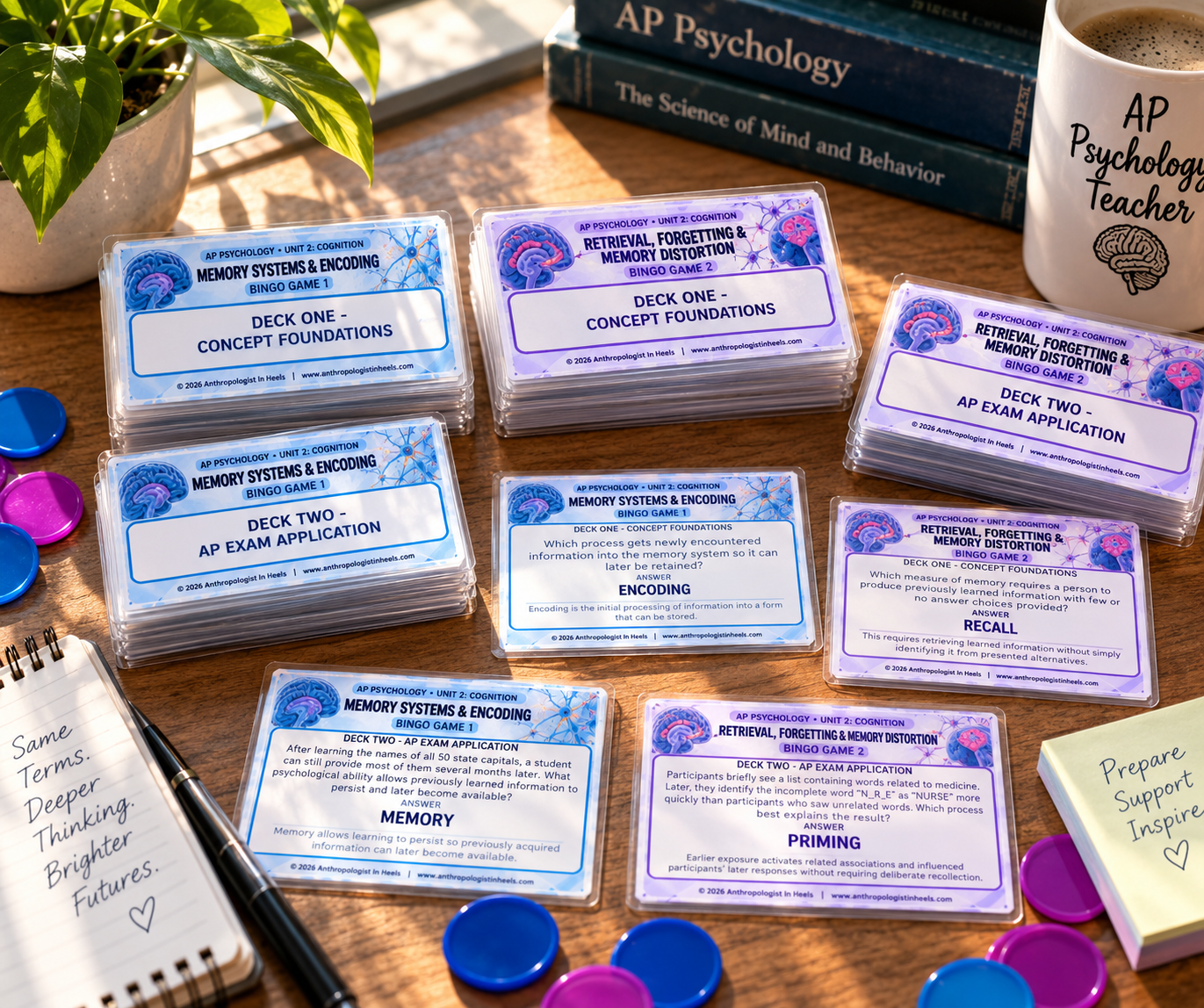 Image 6 of 7
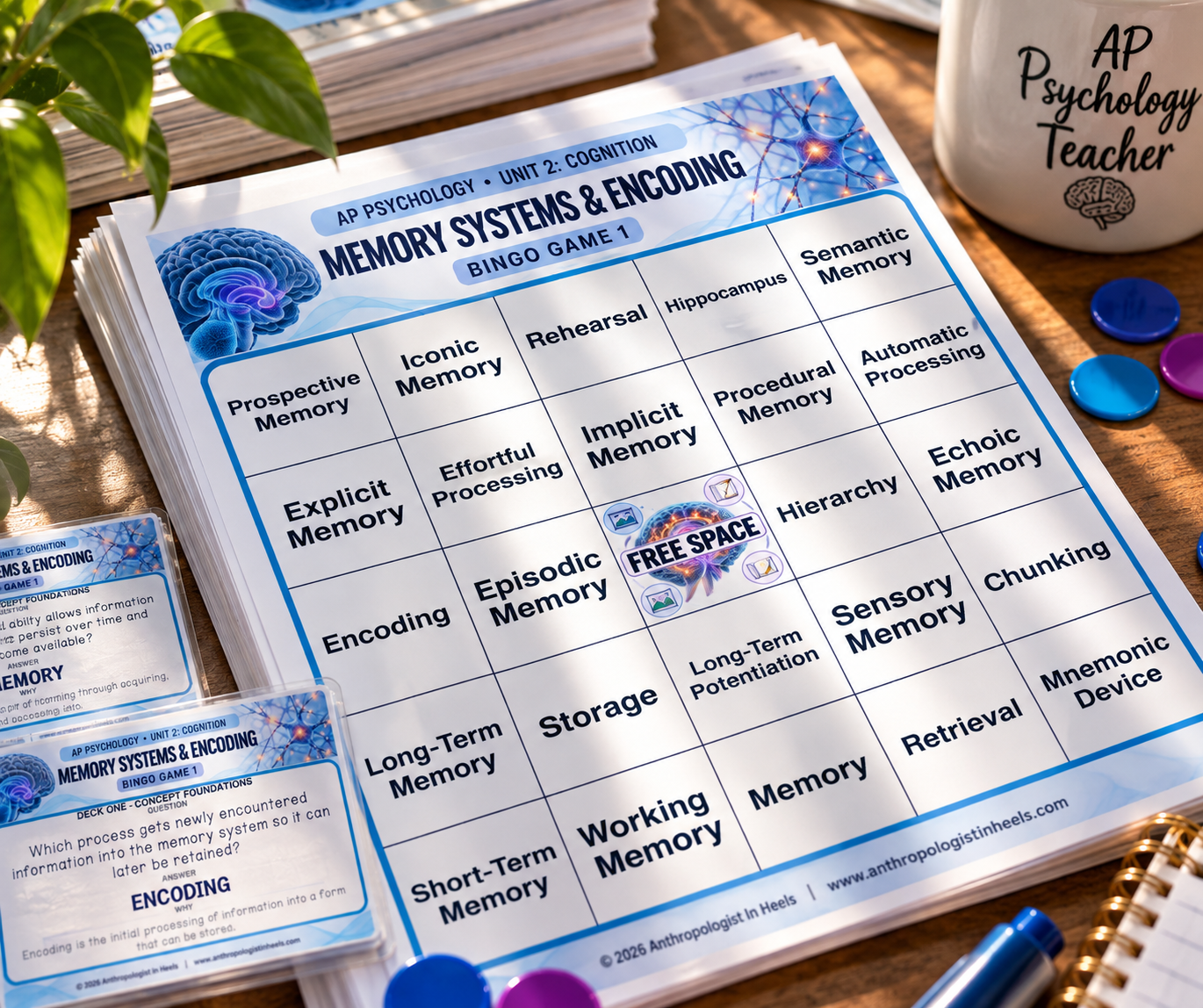 Image 7 of 7