
 Image 1 of 4
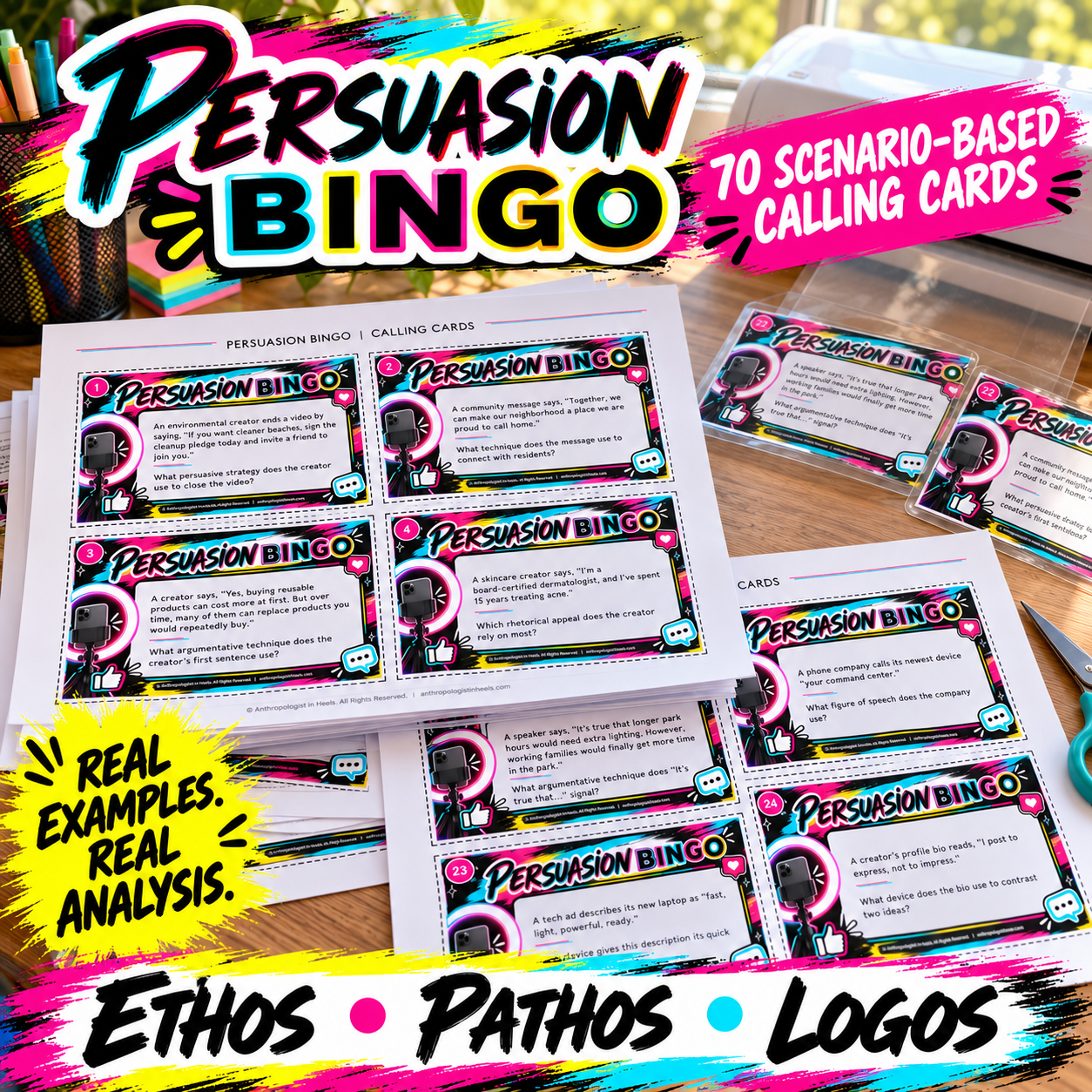 Image 2 of 4
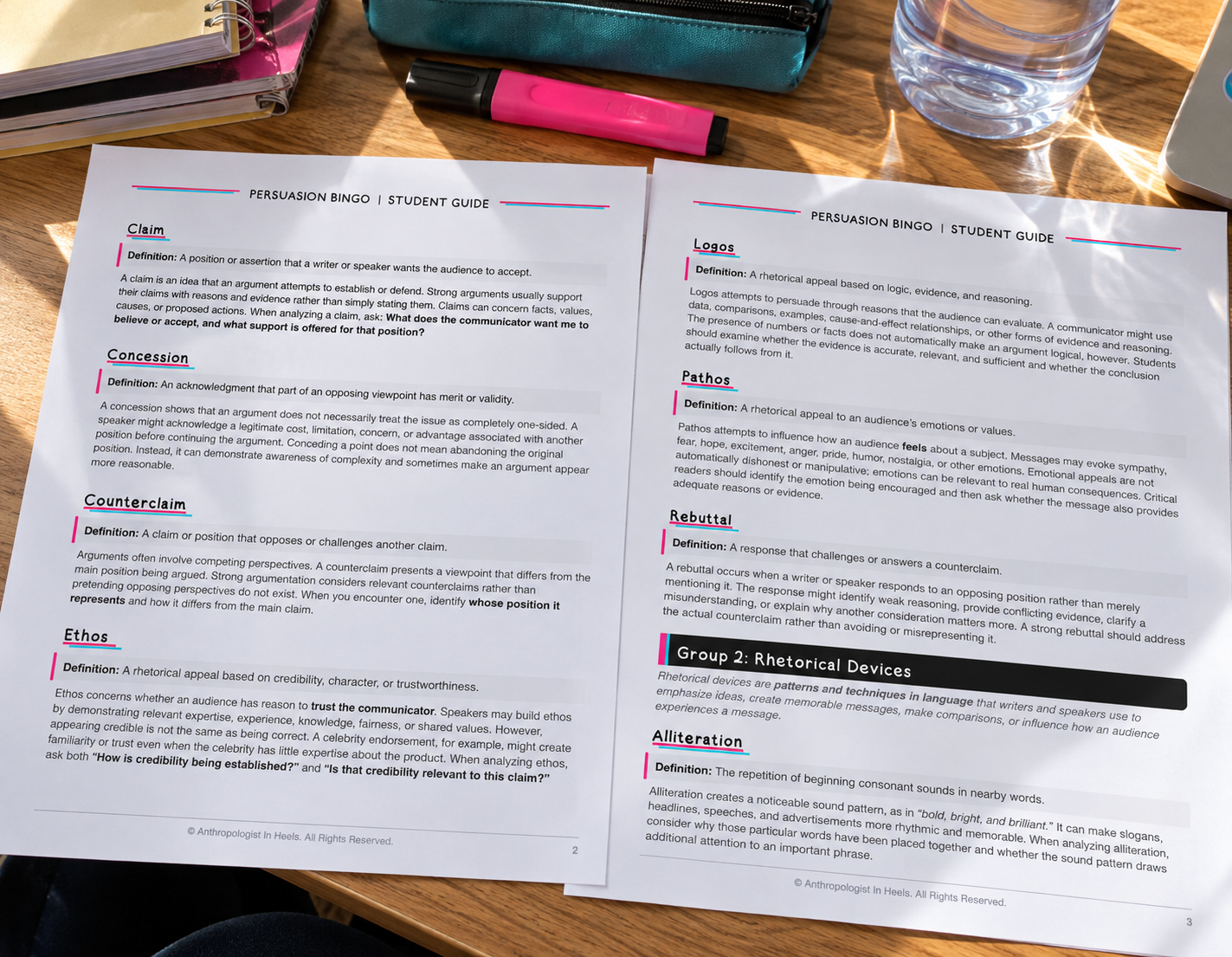 Image 3 of 4
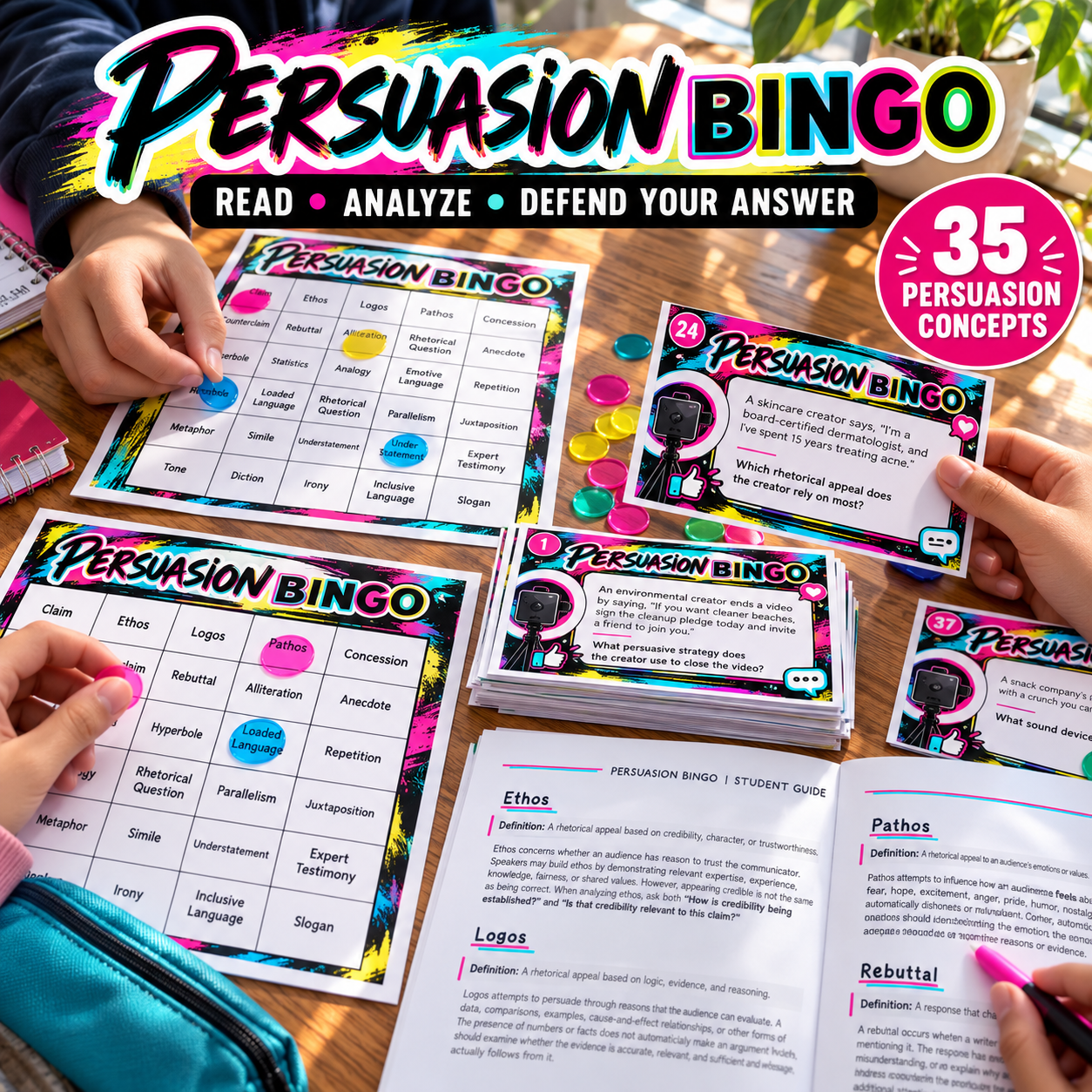 Image 4 of 4
Ethos Pathos Logos Rhetoric Bingo Printable | Persuasion & Rhetorical Devices
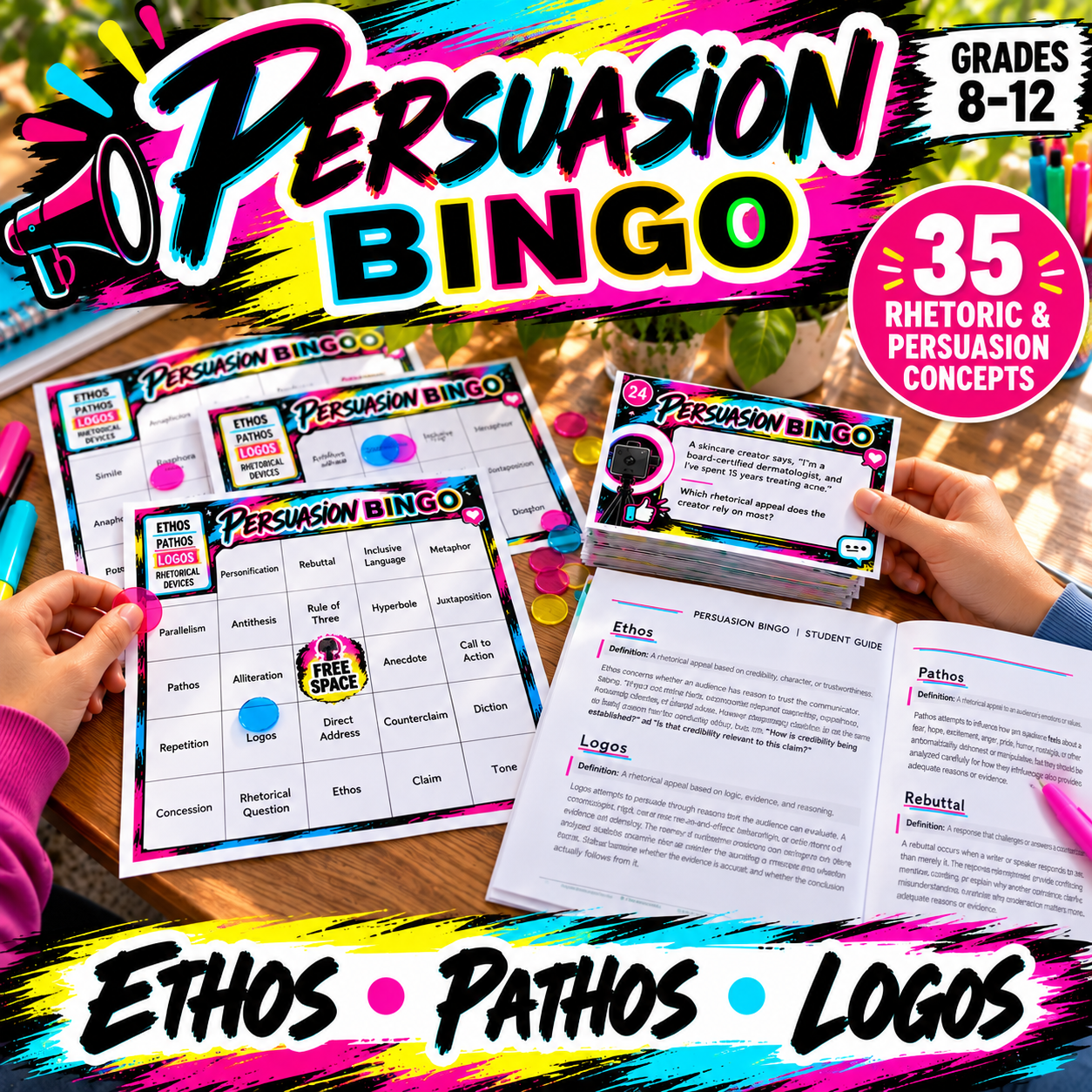
Make rhetorical analysis active, visual, and genuinely engaging with this Ethos Pathos Logos Rhetoric Bingo Printable! Designed for grades 8–12, Persuasion Bingo gives students meaningful practice identifying ethos, pathos, logos, rhetorical devices, argument techniques, and rhetorical choices through realistic advertising, social media, influencer, community, and everyday communication scenarios.
This isn't a bingo game where students simply listen for vocabulary words and mark a square.
Students have to read, think, analyze, and decide.
Each calling card presents a short scenario and asks students to determine what the communicator is doing. Students identify the rhetorical appeal, rhetorical device, or argumentative technique being used before marking the corresponding term on their Bingo board.
What’s Included
30 unique printable 5×5 Bingo boards
24 rhetoric and persuasion terms + FREE SPACE on each board
70 numbered calling cards
2 different scenario-based questions for each of the 35 concepts
18 pages of calling cards, with 4 cards per landscape page
Student Guide with definitions and deeper explanations
Teacher Quick Answer Key for fast Bingo verification
Calling Tracker organized by term and card number
Detailed Teacher Answer Key with the correct answer and reasoning
Teacher instructions
Multiple gameplay variations
35 Rhetoric & Persuasion Concepts
Students work with 35 different rhetoric and persuasion terms, including:
Ethos • Pathos • Logos • Claim • Counterclaim • Rebuttal • Call to Action • Concession • Rhetorical Question • Repetition • Parallelism • Rule of Three • Alliteration • Metaphor • Simile • Analogy • Allusion • Hyperbole • Understatement • Irony • Personification • Imagery • Juxtaposition • Antithesis • Anaphora • Epistrophe • Asyndeton • Polysyndeton • Diction • Syntax • Tone • Anecdote • Direct Address • Inclusive Language • Imperative
Each concept appears on two different calling cards, giving students multiple opportunities to recognize the same technique in different contexts.
Instead of learning that ethos means credibility and stopping there, students have to recognize when a communicator is actually building credibility.
Instead of simply defining juxtaposition, students see contrasting ideas or images placed together and determine why that technique is being used.
That distinction is what makes the game useful for real rhetorical analysis.
70 Scenario-Based Calling Cards
The 70 numbered calling cards are the heart of the activity.
Rather than displaying the answer, each card gives students a short example followed by an analysis question. Scenarios draw from contexts students are likely to recognize, including advertising, creators, social media, product marketing, community messages, public arguments, slogans, and everyday persuasion.
Students might analyze a skincare creator establishing professional expertise, a slogan using alliteration, an advertisement creating vivid imagery, or a speaker acknowledging an opposing point before responding to it.
Students must decide:
What is the communicator doing?
Which rhetorical concept best describes it?
What evidence supports that answer?
This creates a natural progression from:
Learn the concept → Recognize the technique → Analyze the evidence → Explain the reasoning
Student Informational Text Is Included
Some of these concepts are challenging, especially when students are encountering rhetoric for the first time. That is why this resource includes a Student Guide rather than expecting students to memorize 35 terms before they can play.
The informational text provides definitions and deeper explanations to help students understand what each concept means, how it functions, and what they should look for when analyzing communication.
Students are encouraged to think beyond identification and ask:
What is the communicator doing? Why might they have chosen this technique? How could it affect the audience?
The Student Guide can remain available during gameplay as a reference or be removed when students are ready for a more challenging review.
No two student Bingo boards are alike.
More Than Vocabulary Review
Students aren't simply being asked:
“What is ethos?”
Instead, they might encounter a skincare creator who explains that she is a board-certified dermatologist with 15 years of experience treating acne. Students must recognize that the creator is establishing ethos through professional credibility.
Another card might describe a slogan built around repeated consonant sounds. Students identify alliteration.
Another might place two sharply contrasting images side by side. Students determine that the technique is juxtaposition.
Another might acknowledge a legitimate opposing concern before responding to it. Students identify concession or rebuttal, depending on what the question asks them to analyze.
Students repeatedly practice connecting examples, evidence, and rhetorical terminology.
Easy to Differentiate
This game can be adjusted depending on where students are in their learning.
When students are first learning rhetoric, allow them to use the Student Guide while playing. They can look up unfamiliar concepts, compare definitions, and discuss possible answers with a partner.
When students are ready for a greater challenge, remove the reference material and require them to identify the technique independently.
You can also pause after each calling card and have students turn and talk, defend their answer, or identify the evidence that led them to their conclusion before revealing the correct response.
Multiple Ways to Play
Use traditional Bingo or change the winning pattern to keep repeated gameplay fresh.
Try:
Traditional Bingo • Four Corners • X-Pattern • Blackout
Because the set includes 70 calling cards and two different scenarios for every concept, the same resource can be used more than once without students encountering exactly the same game each time.
Great for Grades 8–12
Persuasion Bingo works well for:
ELA • Rhetoric • Persuasive Writing • Argumentation • Media Literacy • Speech & Debate • Critical Thinking • Test Review
Use it as an introduction to rhetorical analysis, guided practice, whole-class review, partner activity, assessment review, or an engaging way to revisit rhetoric later in the year.
Why Persuasion Bingo Is Different
Persuasion Bingo combines the energy of a classroom game with meaningful rhetorical analysis.
Students aren't memo
rizing ethos, pathos, logos, and rhetorical devices in isolation. They repeatedly encounter rhetoric in context, determine which concept best explains what they see, and connect their answer to evidence.
They are playing Bingo—but they are also reading closely, analyzing communication, applying academic vocabulary, and defending their reasoning.
Print the boards. Cut the cards. Start analyzing rhetoric. 🌹🌹
Make rhetorical analysis active, visual, and genuinely engaging with this Ethos Pathos Logos Rhetoric Bingo Printable! Designed for grades 8–12, Persuasion Bingo gives students meaningful practice identifying ethos, pathos, logos, rhetorical devices, argument techniques, and rhetorical choices through realistic advertising, social media, influencer, community, and everyday communication scenarios.
This isn't a bingo game where students simply listen for vocabulary words and mark a square.
Students have to read, think, analyze, and decide.
Each calling card presents a short scenario and asks students to determine what the communicator is doing. Students identify the rhetorical appeal, rhetorical device, or argumentative technique being used before marking the corresponding term on their Bingo board.
What’s Included
30 unique printable 5×5 Bingo boards
24 rhetoric and persuasion terms + FREE SPACE on each board
70 numbered calling cards
2 different scenario-based questions for each of the 35 concepts
18 pages of calling cards, with 4 cards per landscape page
Student Guide with definitions and deeper explanations
Teacher Quick Answer Key for fast Bingo verification
Calling Tracker organized by term and card number
Detailed Teacher Answer Key with the correct answer and reasoning
Teacher instructions
Multiple gameplay variations
35 Rhetoric & Persuasion Concepts
Students work with 35 different rhetoric and persuasion terms, including:
Ethos • Pathos • Logos • Claim • Counterclaim • Rebuttal • Call to Action • Concession • Rhetorical Question • Repetition • Parallelism • Rule of Three • Alliteration • Metaphor • Simile • Analogy • Allusion • Hyperbole • Understatement • Irony • Personification • Imagery • Juxtaposition • Antithesis • Anaphora • Epistrophe • Asyndeton • Polysyndeton • Diction • Syntax • Tone • Anecdote • Direct Address • Inclusive Language • Imperative
Each concept appears on two different calling cards, giving students multiple opportunities to recognize the same technique in different contexts.
Instead of learning that ethos means credibility and stopping there, students have to recognize when a communicator is actually building credibility.
Instead of simply defining juxtaposition, students see contrasting ideas or images placed together and determine why that technique is being used.
That distinction is what makes the game useful for real rhetorical analysis.
70 Scenario-Based Calling Cards
The 70 numbered calling cards are the heart of the activity.
Rather than displaying the answer, each card gives students a short example followed by an analysis question. Scenarios draw from contexts students are likely to recognize, including advertising, creators, social media, product marketing, community messages, public arguments, slogans, and everyday persuasion.
Students might analyze a skincare creator establishing professional expertise, a slogan using alliteration, an advertisement creating vivid imagery, or a speaker acknowledging an opposing point before responding to it.
Students must decide:
What is the communicator doing?
Which rhetorical concept best describes it?
What evidence supports that answer?
This creates a natural progression from:
Learn the concept → Recognize the technique → Analyze the evidence → Explain the reasoning
Student Informational Text Is Included
Some of these concepts are challenging, especially when students are encountering rhetoric for the first time. That is why this resource includes a Student Guide rather than expecting students to memorize 35 terms before they can play.
The informational text provides definitions and deeper explanations to help students understand what each concept means, how it functions, and what they should look for when analyzing communication.
Students are encouraged to think beyond identification and ask:
What is the communicator doing? Why might they have chosen this technique? How could it affect the audience?
The Student Guide can remain available during gameplay as a reference or be removed when students are ready for a more challenging review.
No two student Bingo boards are alike.
More Than Vocabulary Review
Students aren't simply being asked:
“What is ethos?”
Instead, they might encounter a skincare creator who explains that she is a board-certified dermatologist with 15 years of experience treating acne. Students must recognize that the creator is establishing ethos through professional credibility.
Another card might describe a slogan built around repeated consonant sounds. Students identify alliteration.
Another might place two sharply contrasting images side by side. Students determine that the technique is juxtaposition.
Another might acknowledge a legitimate opposing concern before responding to it. Students identify concession or rebuttal, depending on what the question asks them to analyze.
Students repeatedly practice connecting examples, evidence, and rhetorical terminology.
Easy to Differentiate
This game can be adjusted depending on where students are in their learning.
When students are first learning rhetoric, allow them to use the Student Guide while playing. They can look up unfamiliar concepts, compare definitions, and discuss possible answers with a partner.
When students are ready for a greater challenge, remove the reference material and require them to identify the technique independently.
You can also pause after each calling card and have students turn and talk, defend their answer, or identify the evidence that led them to their conclusion before revealing the correct response.
Multiple Ways to Play
Use traditional Bingo or change the winning pattern to keep repeated gameplay fresh.
Try:
Traditional Bingo • Four Corners • X-Pattern • Blackout
Because the set includes 70 calling cards and two different scenarios for every concept, the same resource can be used more than once without students encountering exactly the same game each time.
Great for Grades 8–12
Persuasion Bingo works well for:
ELA • Rhetoric • Persuasive Writing • Argumentation • Media Literacy • Speech & Debate • Critical Thinking • Test Review
Use it as an introduction to rhetorical analysis, guided practice, whole-class review, partner activity, assessment review, or an engaging way to revisit rhetoric later in the year.
Why Persuasion Bingo Is Different
Persuasion Bingo combines the energy of a classroom game with meaningful rhetorical analysis.
Students aren't memo
rizing ethos, pathos, logos, and rhetorical devices in isolation. They repeatedly encounter rhetoric in context, determine which concept best explains what they see, and connect their answer to evidence.
They are playing Bingo—but they are also reading closely, analyzing communication, applying academic vocabulary, and defending their reasoning.
Print the boards. Cut the cards. Start analyzing rhetoric. 🌹🌹