Help students think more intentionally about money with this Financial Literacy Bingo Game | Money Mindset & Financial Decision-Making Activity designed for Grades 9–12. This Financial Literacy Bingo Game teaches Money Mindset & Financial Decision-Making through engaging personal finance questions and realistic scenarios involving spending habits, impulse buying, emotional spending, opportunity cost, financial trade-offs, lifestyle inflation, calculated risk, multiple income streams, and financial independence.
Rather than telling students that spending money is simply “good” or “bad,” this activity challenges them to examine why people make financial choices, what influences those choices, and how short-term decisions can affect long-term financial goals.
The game creates a practical progression:
RECOGNIZE → PAUSE → EVALUATE → DECIDE → BUILD INDEPENDENCE
WHAT MAKES THIS FINANCIAL LITERACY GAME DIFFERENT?
Students work with the same 24 personal finance concepts through two different calling-card decks, moving from foundational understanding to realistic financial decision-making.
Deck 1 — Foundations
24 calling cards introduce and reinforce important concepts related to money mindset, spending behavior, decision-making, financial trade-offs, income, and long-term financial thinking.
Deck 2 — Real-World Application
24 additional calling cards place those concepts into realistic situations students may encounter now or in the future. Students must analyze the situation and determine which financial concept best explains the behavior or decision.
Every calling card includes the correct answer plus a brief “WHY?” explanation, making it easy to reinforce the concept, encourage discussion, and turn each Bingo call into a quick financial literacy teaching moment.
24 FINANCIAL LITERACY CONCEPTS
Calculated Risk • Delayed Gratification • Side Hustle • Financial Trade-Off • Expense Audit • True Cost • Bootstrapping • Spending Trigger • Subscription Creep • Present Bias • Emotional Spending • Cooling-Off Period • Financial Independence • Needs vs. Wants • Time Value • Impulse Buying • Sunk Cost • Scarcity Mindset • Multiple Income Streams • Cost-Benefit Analysis • Opportunity Cost • Money Mindset • Lifestyle Inflation • Self-Investment
These concepts help students explore the behavioral side of personal finance—the habits, emotions, incentives, trade-offs, and thought processes that influence everyday money decisions.
WHAT’S INCLUDED?
✓ 30 unique 5×5 Bingo boards — enough for whole-class play
✓ 24 money mindset and financial decision-making concepts + center FREE SPACE
✓ 24 Deck 1 Foundations calling cards
✓ 24 Deck 2 Real-World Application calling cards
✓ 48 calling cards total
✓ Correct answers included on every calling card
✓ Brief “WHY?” explanations to reinforce understanding
✓ Printable, classroom-ready format
✓ Designed for Grades 9–12
Arrives as a ZIP File: ensure you can open a ZIP before purchase
PERFECT FOR
Financial Literacy • Personal Finance • Money Management • Financial Decision-Making • Economics • Consumer Math • Life Skills • Business • CTE • Career Readiness
Use this Financial Literacy Bingo game for personal finance classes, financial literacy units, money management lessons, financial decision-making activities, behavioral finance discussions, end-of-unit review, test review, enrichment, early finishers, or an engaging alternative to another worksheet.
REAL-WORLD FINANCIAL DECISION-MAKING
Students encounter situations that encourage them to think about questions such as:
Why are we sometimes tempted to buy something immediately instead of waiting?
How can emotions influence spending decisions?
When does a subscription stop providing enough value to justify its cost?
Why shouldn't money already spent always determine what we do next?
What are we giving up when we choose one financial option over another?
When can taking a calculated financial risk make sense?
How can investing in your own skills increase future opportunities?
These scenarios encourage students to recognize that personal finance isn't only about knowing financial terms—it's also about making thoughtful choices when priorities, emotions, time, risk, and limited resources compete.
FROM MONEY KNOWLEDGE TO MONEY BEHAVIOR
Knowing what a budget, credit score, investment, or retirement account is doesn't automatically lead to good financial decisions.
Students also need to understand the behaviors behind money choices.
This game introduces concepts such as present bias, spending triggers, emotional spending, delayed gratification, lifestyle inflation, sunk costs, and scarcity mindset while connecting them to practical strategies such as cooling-off periods, expense audits, cost-benefit analysis, self-investment, and developing multiple income streams.
MORE THAN VOCABULARY BINGO
This isn't simply a definition-matching activity.
Students first understand the concept and then apply the concept.
That makes this Financial Literacy Bingo useful for reinforcing personal finance knowledge while encouraging students to think critically about the decisions and behaviors that shape their financial lives.
Print the boards. Choose a deck. Call the cards. Let students think, discuss, and play.
Game 4 of the High School Financial Literacy Bingo Series — bringing the series together by moving students from knowing how money works to thinking critically about how and why they make financial decisions.
🌹
Help students think more intentionally about money with this Financial Literacy Bingo Game | Money Mindset & Financial Decision-Making Activity designed for Grades 9–12. This Financial Literacy Bingo Game teaches Money Mindset & Financial Decision-Making through engaging personal finance questions and realistic scenarios involving spending habits, impulse buying, emotional spending, opportunity cost, financial trade-offs, lifestyle inflation, calculated risk, multiple income streams, and financial independence.
Rather than telling students that spending money is simply “good” or “bad,” this activity challenges them to examine why people make financial choices, what influences those choices, and how short-term decisions can affect long-term financial goals.
The game creates a practical progression:
RECOGNIZE → PAUSE → EVALUATE → DECIDE → BUILD INDEPENDENCE
WHAT MAKES THIS FINANCIAL LITERACY GAME DIFFERENT?
Students work with the same 24 personal finance concepts through two different calling-card decks, moving from foundational understanding to realistic financial decision-making.
Deck 1 — Foundations
24 calling cards introduce and reinforce important concepts related to money mindset, spending behavior, decision-making, financial trade-offs, income, and long-term financial thinking.
Deck 2 — Real-World Application
24 additional calling cards place those concepts into realistic situations students may encounter now or in the future. Students must analyze the situation and determine which financial concept best explains the behavior or decision.
Every calling card includes the correct answer plus a brief “WHY?” explanation, making it easy to reinforce the concept, encourage discussion, and turn each Bingo call into a quick financial literacy teaching moment.
24 FINANCIAL LITERACY CONCEPTS
Calculated Risk • Delayed Gratification • Side Hustle • Financial Trade-Off • Expense Audit • True Cost • Bootstrapping • Spending Trigger • Subscription Creep • Present Bias • Emotional Spending • Cooling-Off Period • Financial Independence • Needs vs. Wants • Time Value • Impulse Buying • Sunk Cost • Scarcity Mindset • Multiple Income Streams • Cost-Benefit Analysis • Opportunity Cost • Money Mindset • Lifestyle Inflation • Self-Investment
These concepts help students explore the behavioral side of personal finance—the habits, emotions, incentives, trade-offs, and thought processes that influence everyday money decisions.
WHAT’S INCLUDED?
✓ 30 unique 5×5 Bingo boards — enough for whole-class play
✓ 24 money mindset and financial decision-making concepts + center FREE SPACE
✓ 24 Deck 1 Foundations calling cards
✓ 24 Deck 2 Real-World Application calling cards
✓ 48 calling cards total
✓ Correct answers included on every calling card
✓ Brief “WHY?” explanations to reinforce understanding
✓ Printable, classroom-ready format
✓ Designed for Grades 9–12
Arrives as a ZIP File: ensure you can open a ZIP before purchase
PERFECT FOR
Financial Literacy • Personal Finance • Money Management • Financial Decision-Making • Economics • Consumer Math • Life Skills • Business • CTE • Career Readiness
Use this Financial Literacy Bingo game for personal finance classes, financial literacy units, money management lessons, financial decision-making activities, behavioral finance discussions, end-of-unit review, test review, enrichment, early finishers, or an engaging alternative to another worksheet.
REAL-WORLD FINANCIAL DECISION-MAKING
Students encounter situations that encourage them to think about questions such as:
Why are we sometimes tempted to buy something immediately instead of waiting?
How can emotions influence spending decisions?
When does a subscription stop providing enough value to justify its cost?
Why shouldn't money already spent always determine what we do next?
What are we giving up when we choose one financial option over another?
When can taking a calculated financial risk make sense?
How can investing in your own skills increase future opportunities?
These scenarios encourage students to recognize that personal finance isn't only about knowing financial terms—it's also about making thoughtful choices when priorities, emotions, time, risk, and limited resources compete.
FROM MONEY KNOWLEDGE TO MONEY BEHAVIOR
Knowing what a budget, credit score, investment, or retirement account is doesn't automatically lead to good financial decisions.
Students also need to understand the behaviors behind money choices.
This game introduces concepts such as present bias, spending triggers, emotional spending, delayed gratification, lifestyle inflation, sunk costs, and scarcity mindset while connecting them to practical strategies such as cooling-off periods, expense audits, cost-benefit analysis, self-investment, and developing multiple income streams.
MORE THAN VOCABULARY BINGO
This isn't simply a definition-matching activity.
Students first understand the concept and then apply the concept.
That makes this Financial Literacy Bingo useful for reinforcing personal finance knowledge while encouraging students to think critically about the decisions and behaviors that shape their financial lives.
Print the boards. Choose a deck. Call the cards. Let students think, discuss, and play.
Game 4 of the High School Financial Literacy Bingo Series — bringing the series together by moving students from knowing how money works to thinking critically about how and why they make financial decisions.
🌹

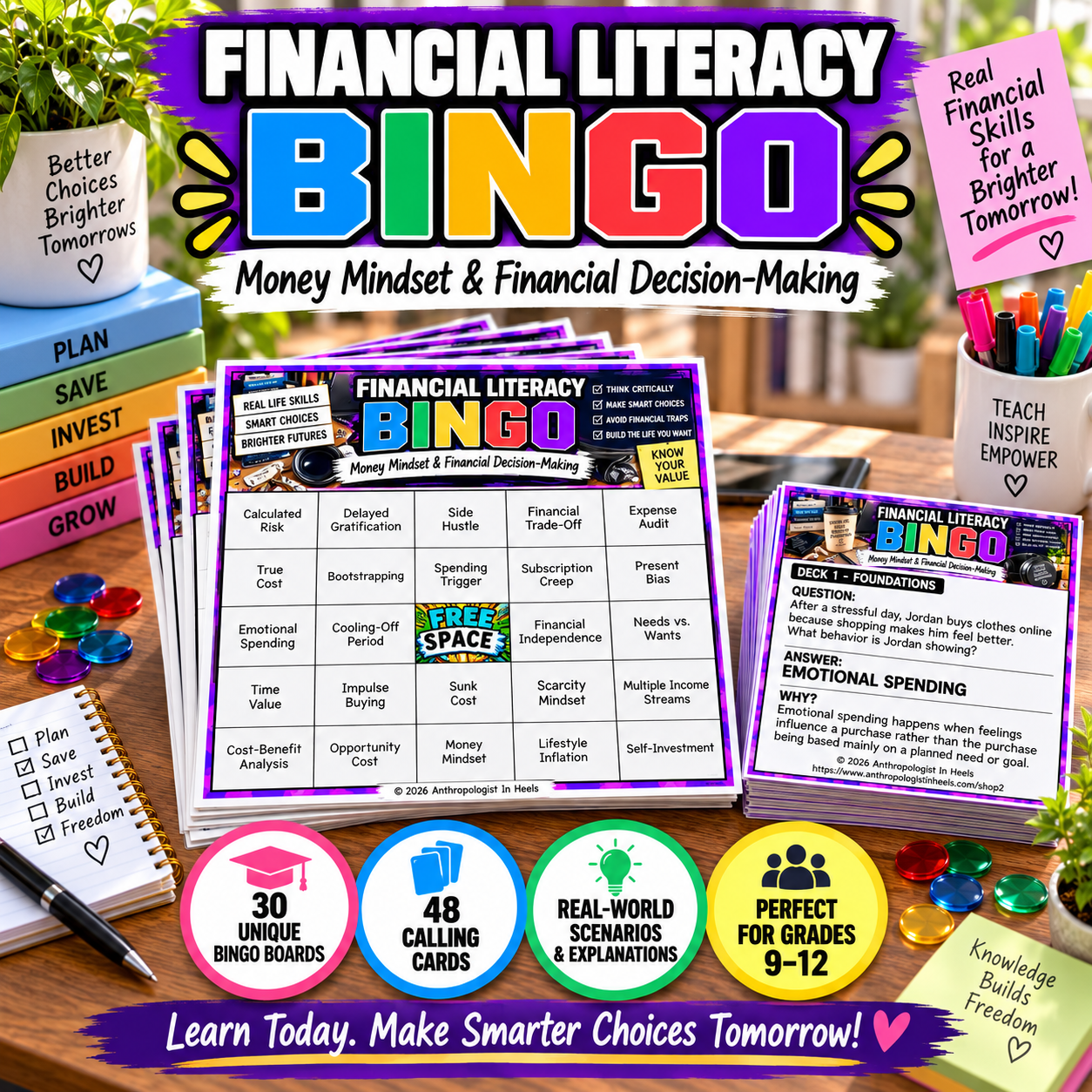 Image 1 of 7
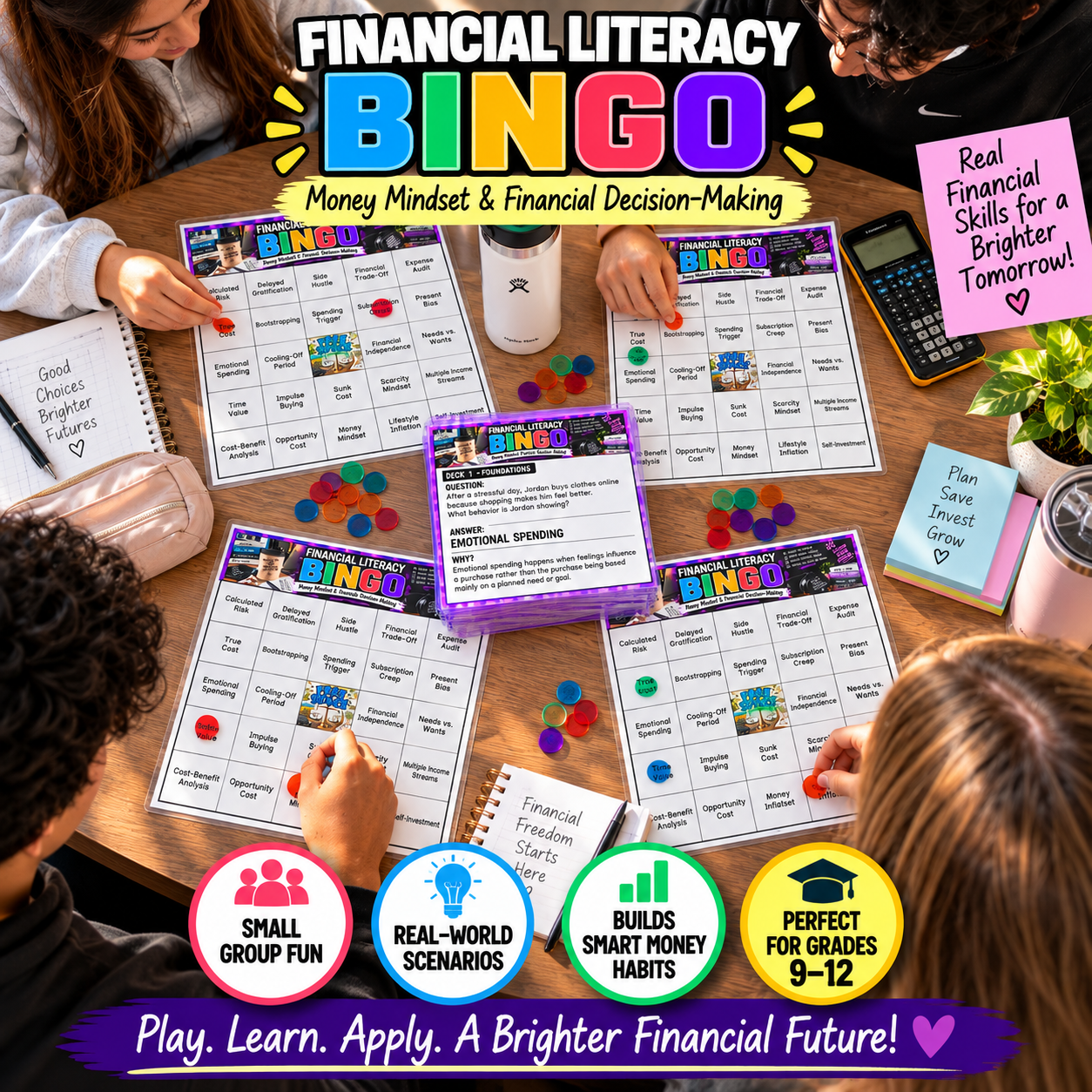 Image 2 of 7
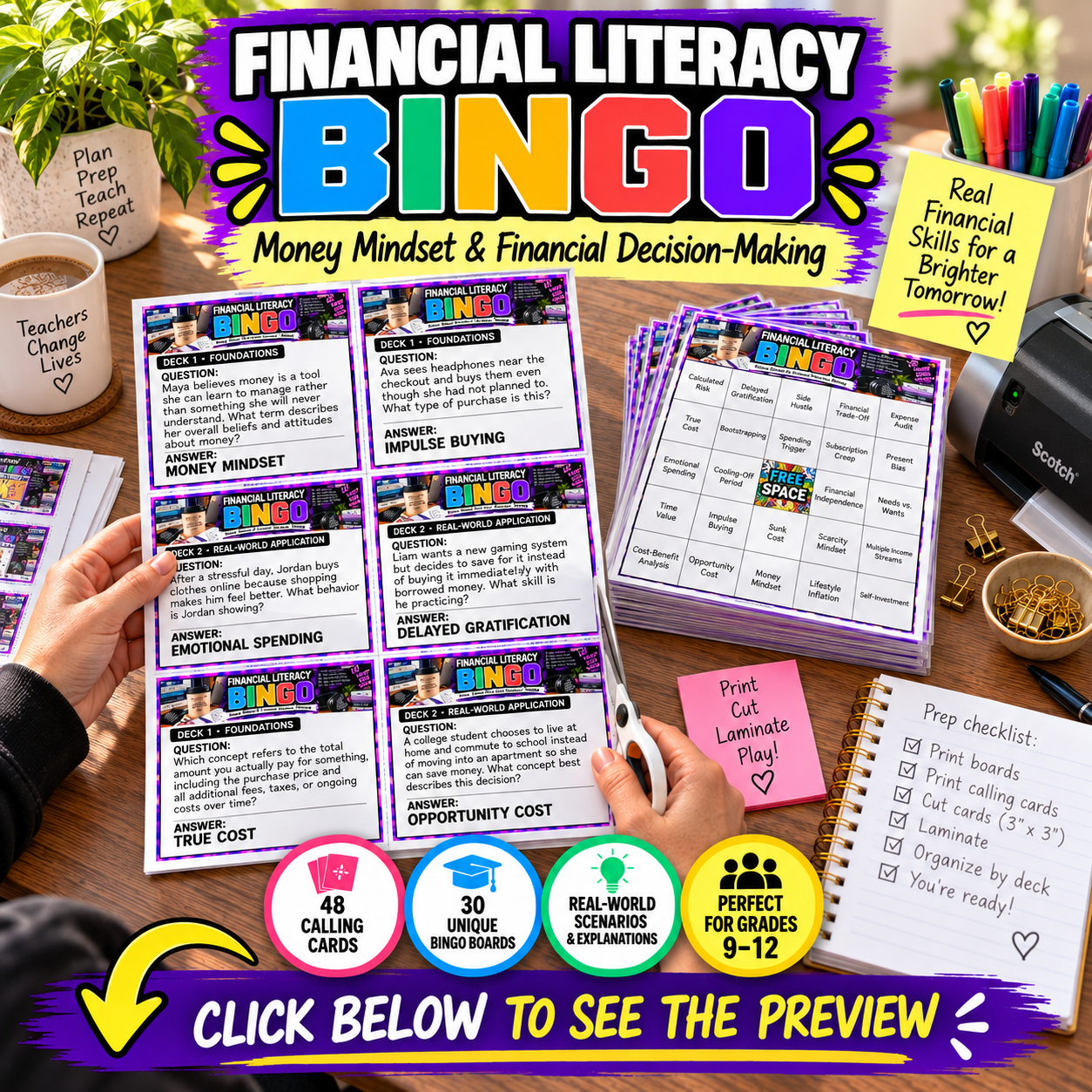 Image 3 of 7
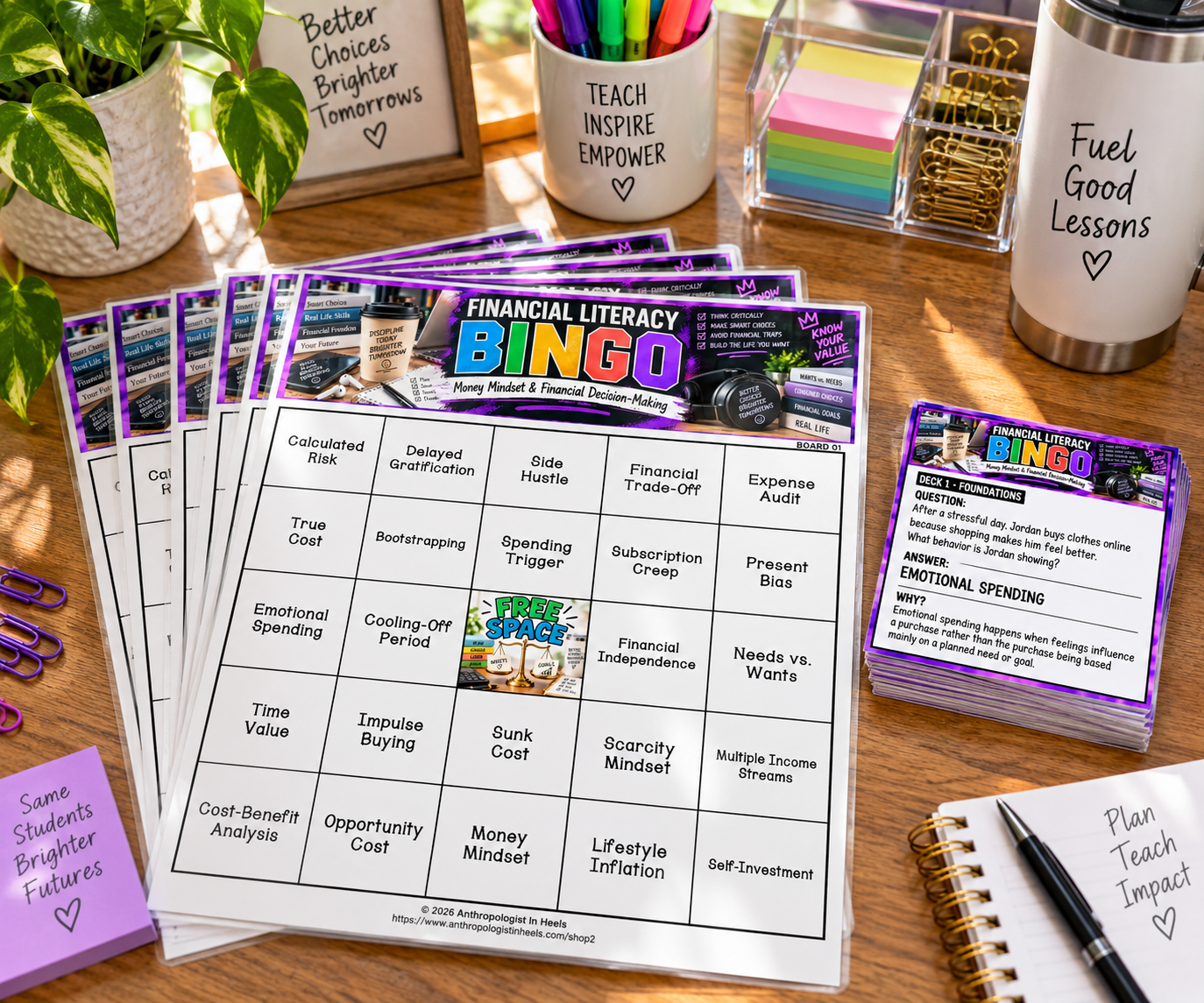 Image 4 of 7
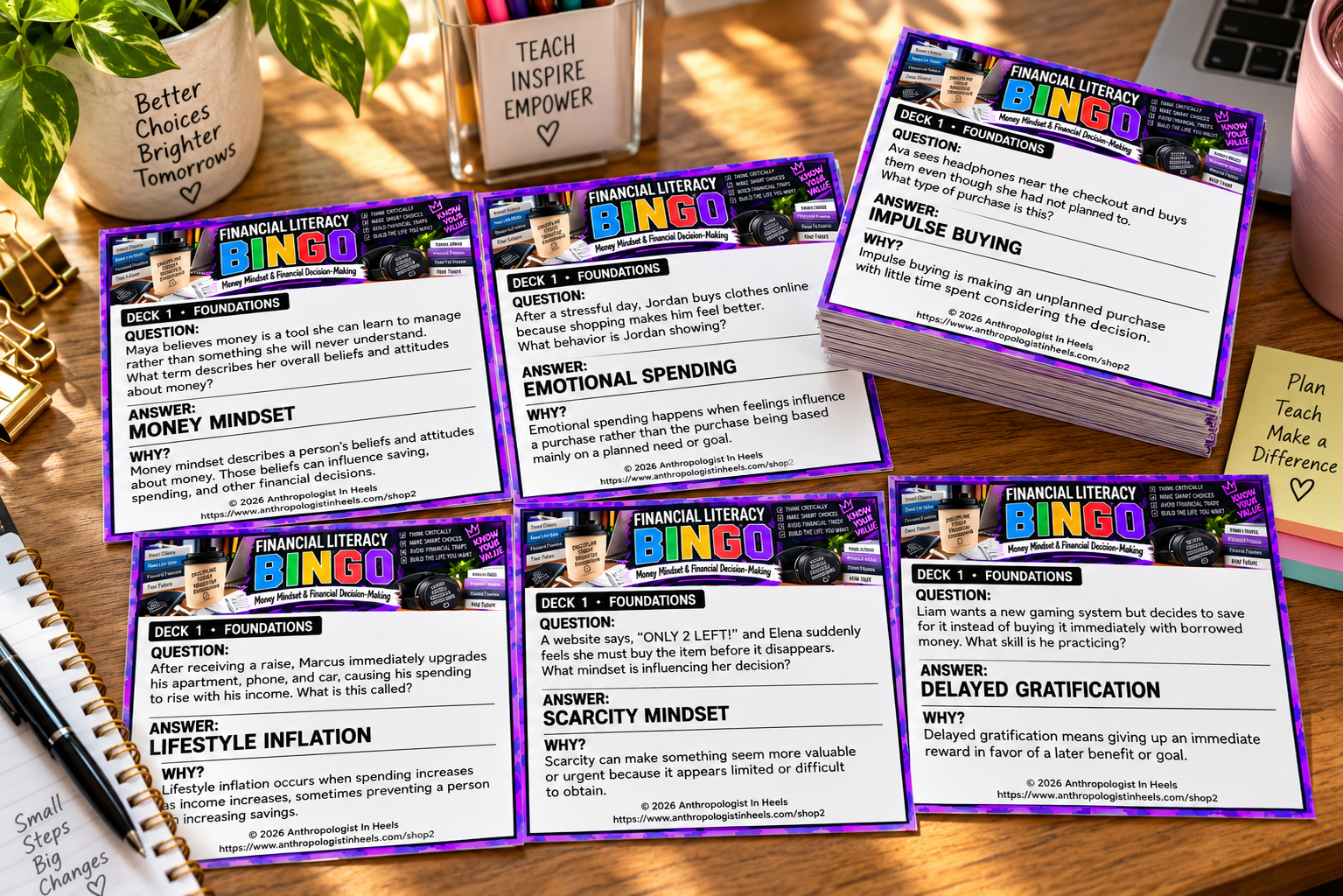 Image 5 of 7
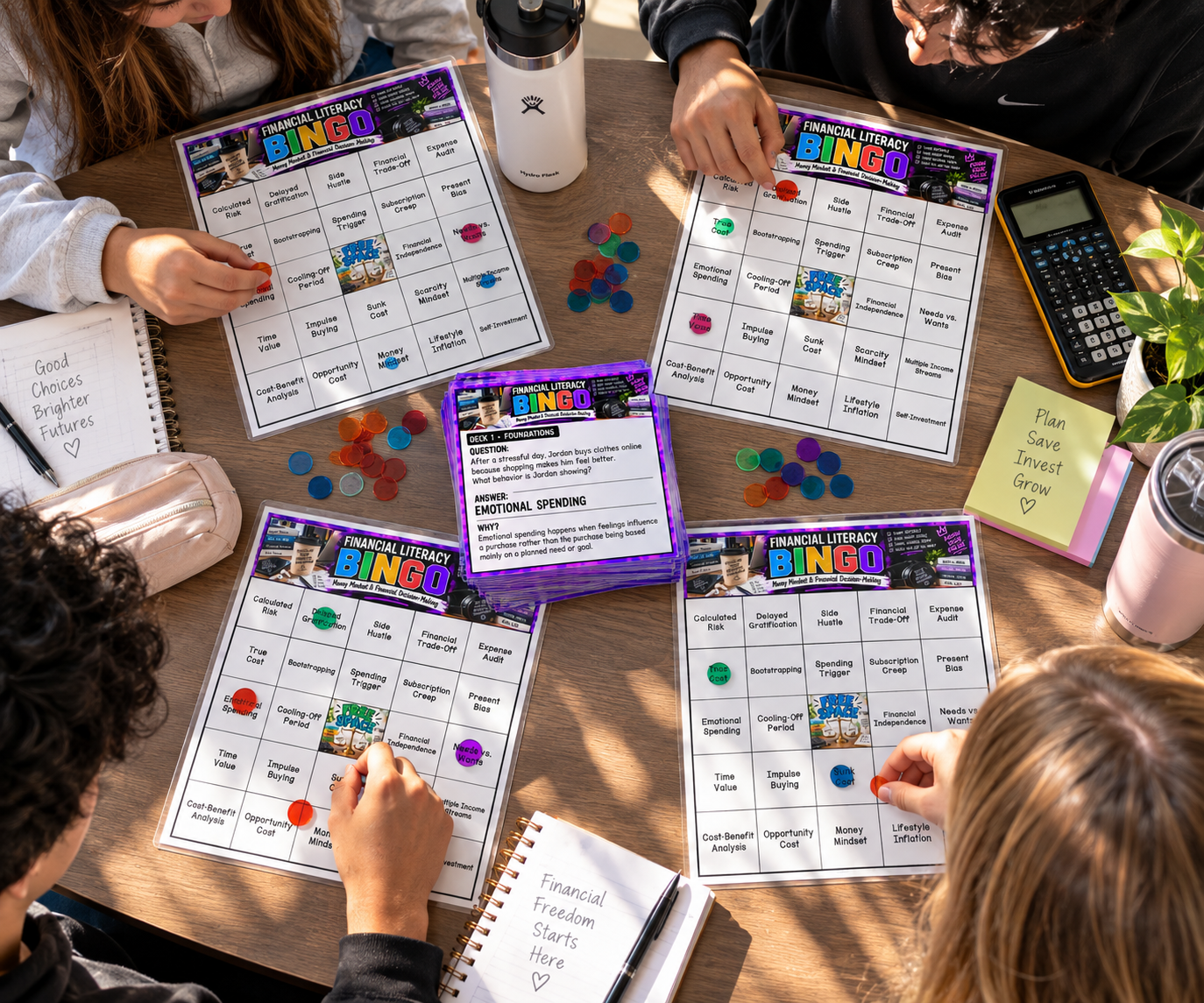 Image 6 of 7
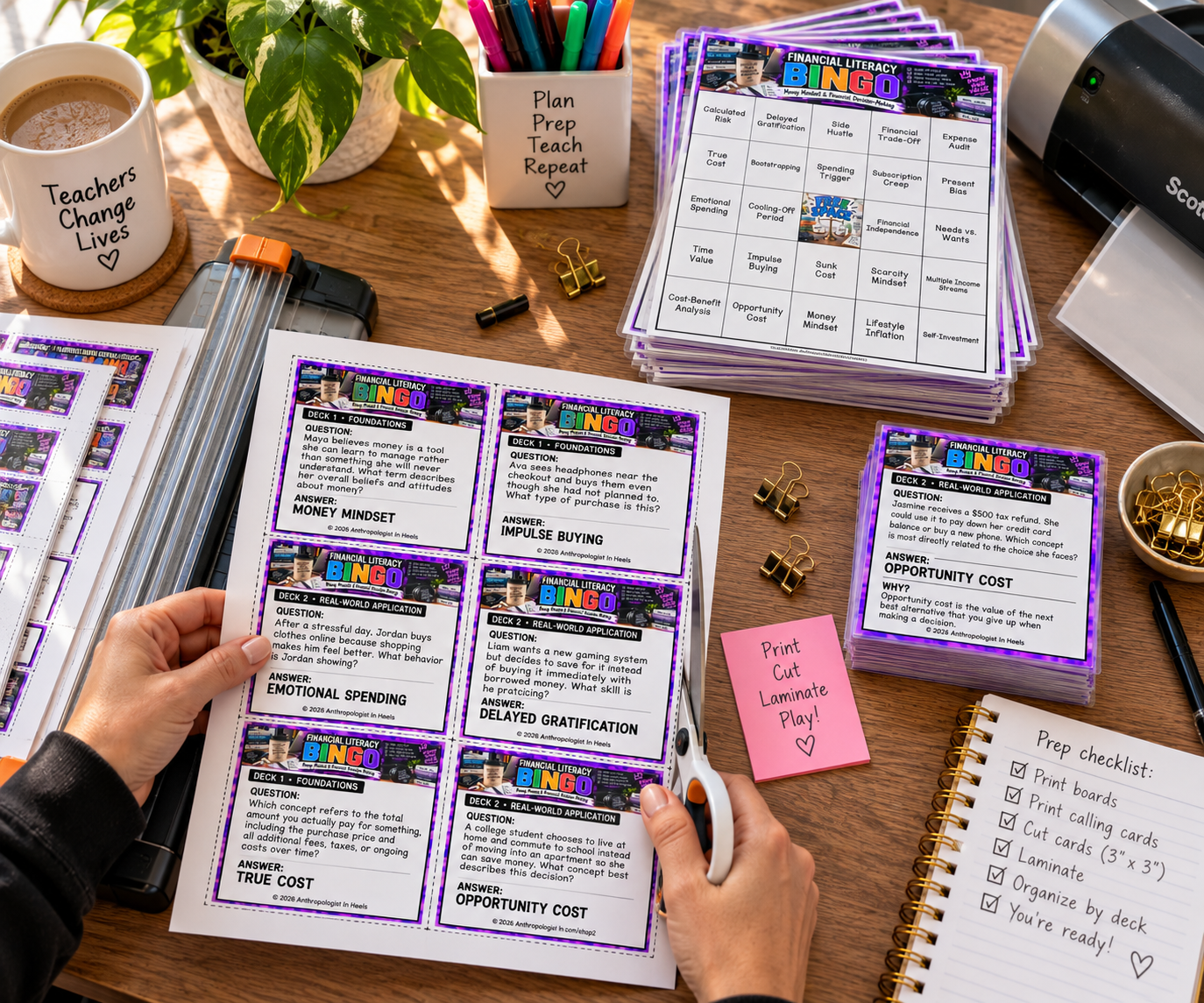 Image 7 of 7