
 Image 1 of 4
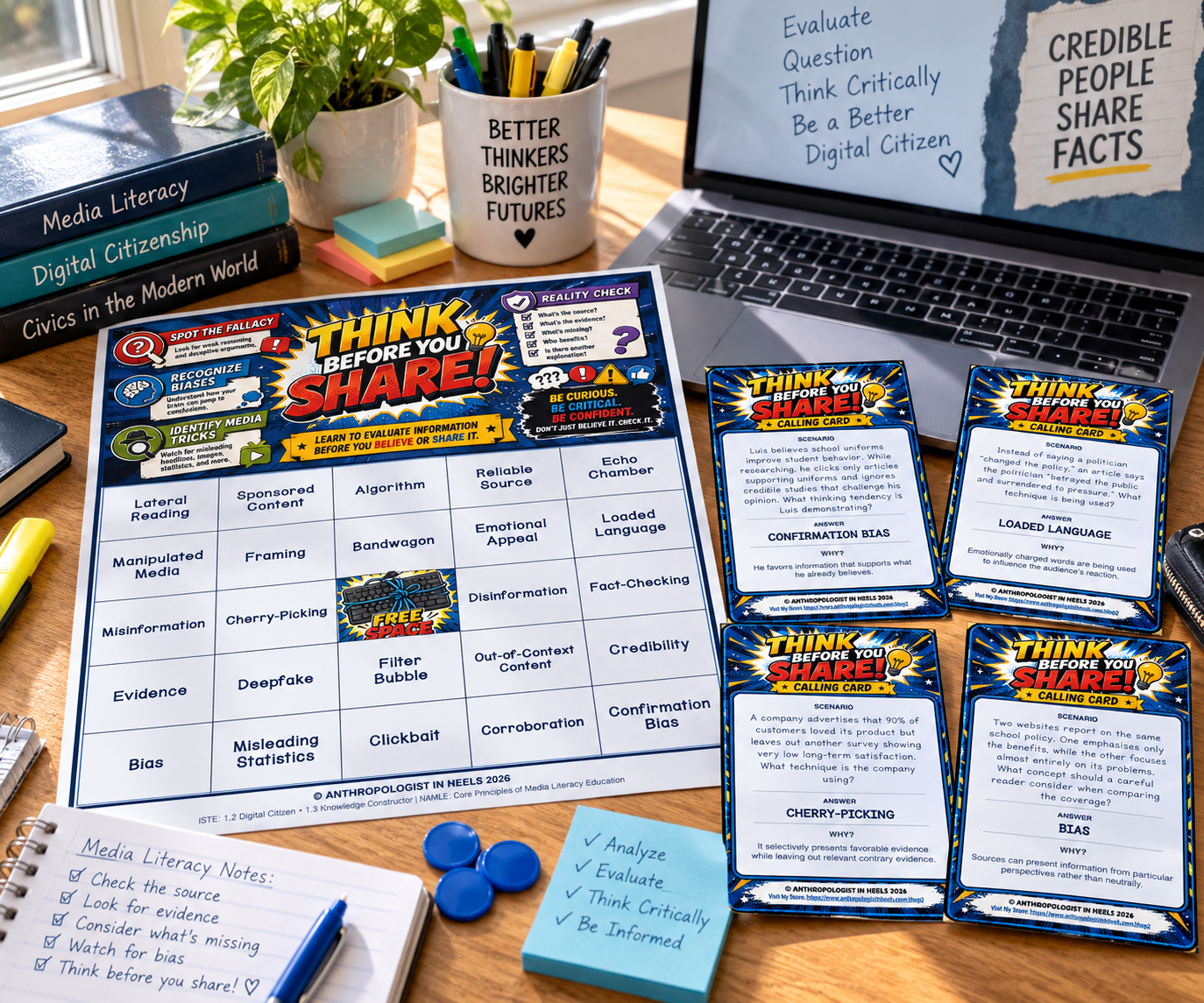 Image 2 of 4
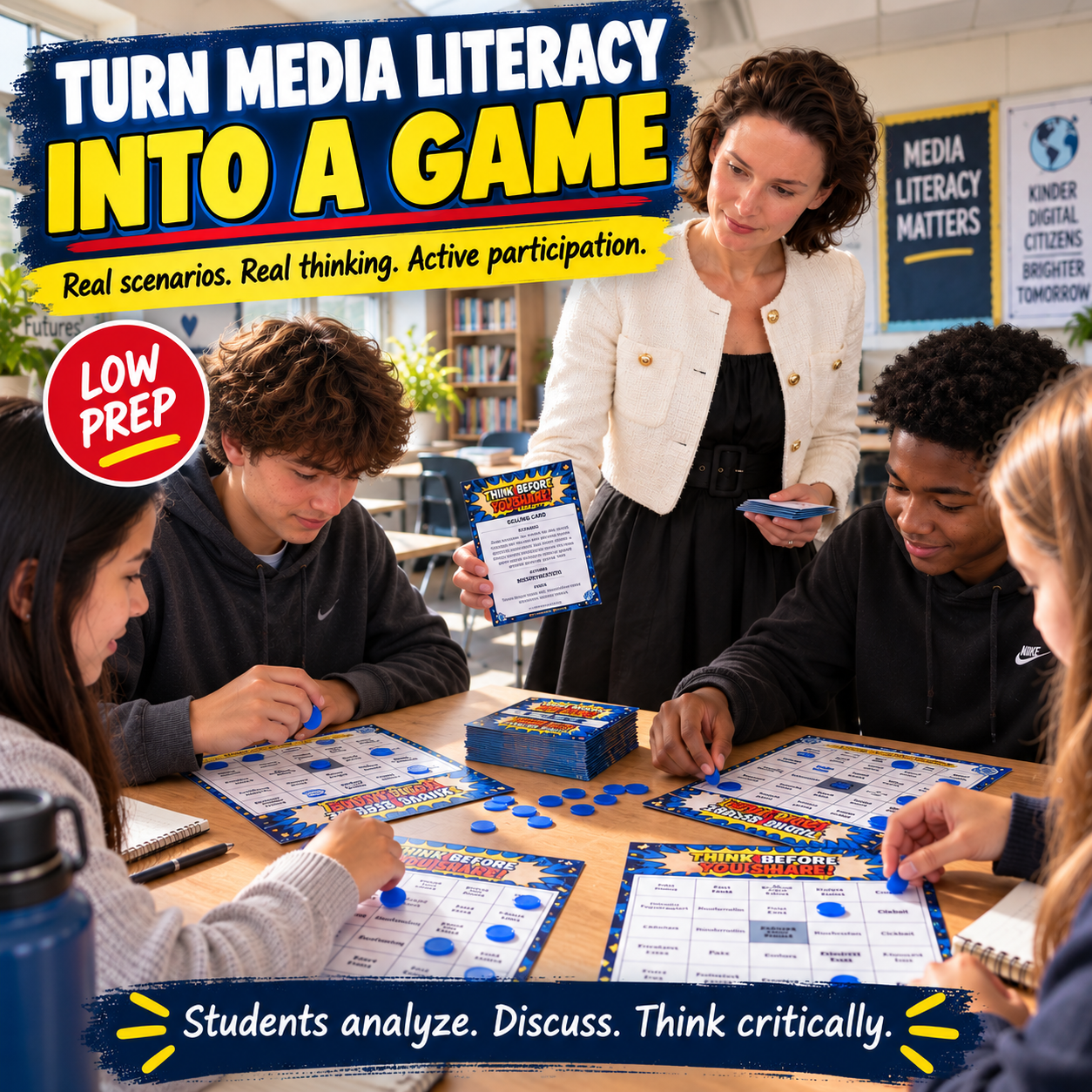 Image 3 of 4
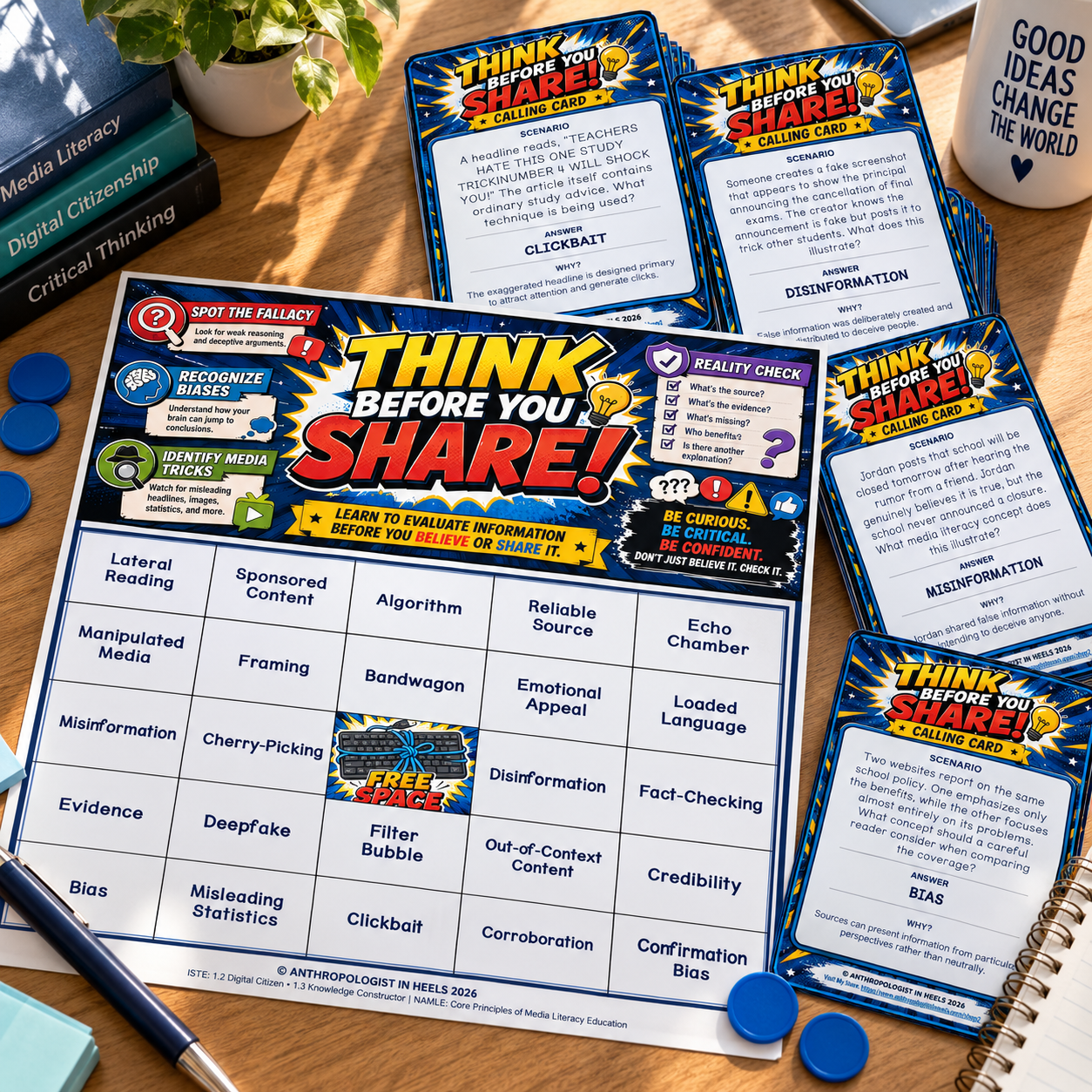 Image 4 of 4
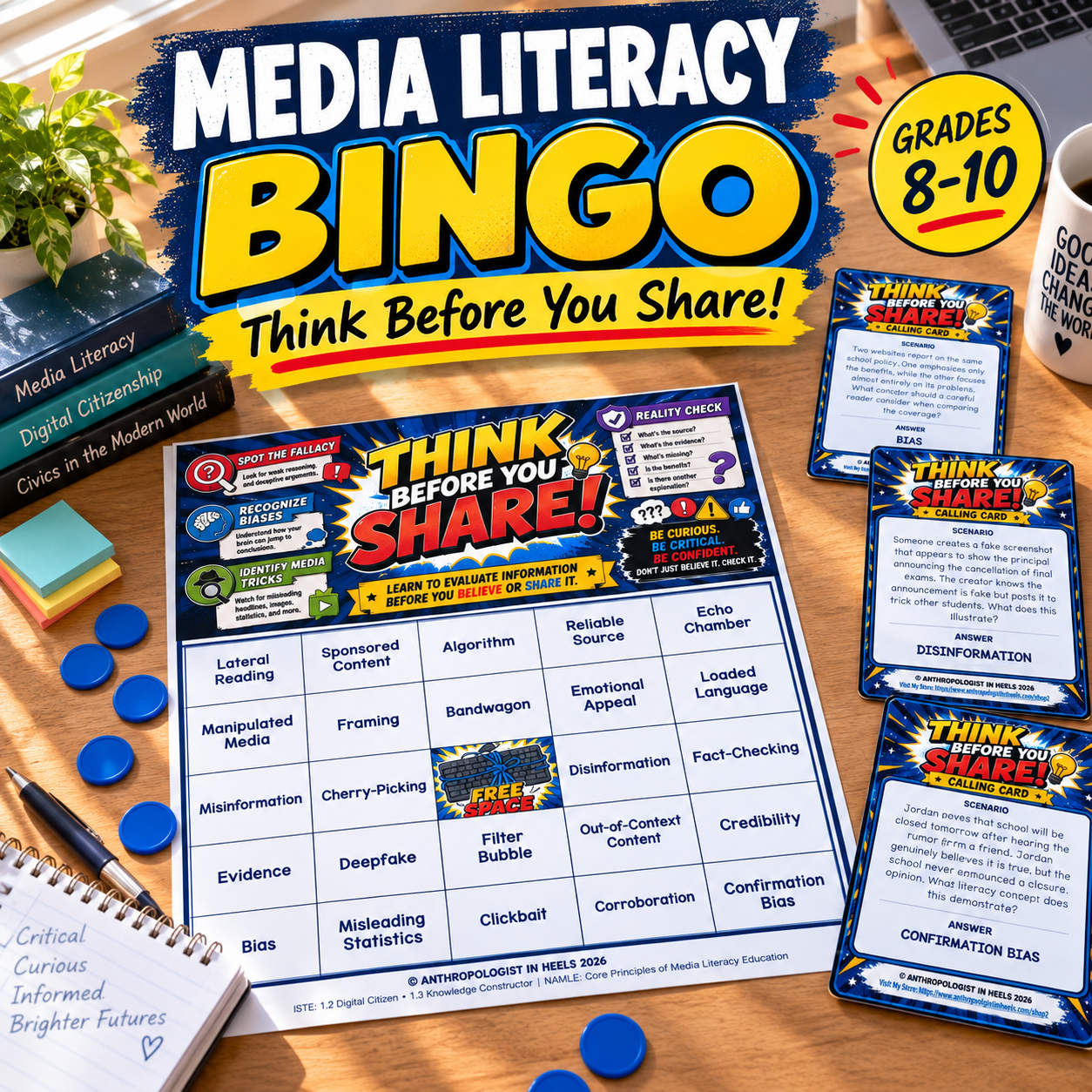
Make media literacy, fake news, bias, and digital citizenship review something students actually want to participate in! This Media Literacy Bingo Game turns essential media literacy concepts into an engaging, scenario-based activity designed for Grades 8–10.
Students don't just memorize vocabulary. They listen to realistic situations, analyze what is happening, identify the correct media literacy concept, and mark their Bingo boards. Built-in explanations make every calling card an opportunity for discussion and critical thinking.
What’s Included
This ready-to-use Media Literacy Bingo Game includes:
✅ 30 unique Bingo boards for easy whole-class play
✅ 48 scenario-based calling cards
✅ 24 essential media literacy concepts
✅ 2 different scenarios per concept
✅ Correct answer on every calling card
✅ Built-in “WHY?” explanation to reinforce student understanding
✅ FREE SPACE on every Bingo board
✅ Engaging, high-interest comic-inspired design
Students practice concepts including:
Misinformation • Disinformation • Clickbait • Bias • Confirmation Bias • Framing • Loaded Language • Cherry-Picking • Misleading Statistics • Emotional Appeal • Bandwagon • Sponsored Content • Deepfake • Manipulated Media • Out-of-Context Content • Credibility • Evidence • Reliable Source • Corroboration • Fact-Checking • Lateral Reading • Echo Chamber • Filter Bubble • Algorithm
How It Works in the Classroom
Give each student a Bingo board and read one of the included scenario cards.
Students must analyze the scenario and determine which media literacy concept it demonstrates before marking the corresponding square.
For example, students may need to distinguish between information accidentally shared as false and content deliberately created to deceive. Other scenarios challenge students to recognize clickbait, biased coverage, confirmation bias, misleading statistics, loaded language, and other techniques they encounter in real media.
After students answer, use the ANSWER + WHY? section on the calling card to quickly clarify the concept and spark discussion.
Use this resource for:
⭐ Whole-class review games
⭐ Media literacy lessons
⭐ Digital citizenship instruction
⭐ Small groups or stations
⭐ Critical thinking practice
⭐ Unit review
⭐ Early finishers
⭐ Before-break activities
⭐ End-of-unit reinforcement
Standards & Learning Goals
This fake news and digital citizenship activity helps students become more thoughtful consumers of information.
Students practice how to:
Identify misinformation and disinformation
Recognize bias and confirmation bias
Analyze persuasive and manipulative media techniques
Evaluate evidence, credibility, and reliable sources
Recognize clickbait and misleading statistics
Understand manipulated media and deepfakes
Apply fact-checking and lateral reading
Consider how algorithms, filter bubbles, and echo chambers shape information
Think critically before believing or sharing content
The resource identifies alignment with:
ISTE 1.2 — Digital Citizen
ISTE 1.3 — Knowledge Constructor
NAMLE — Core Principles of Media Literacy Education
Why Teachers Love It / Key Benefits
⭐ More than vocabulary practice — Students apply concepts to realistic situations.
⭐ Built-in teaching support — Every scenario includes the answer and an explanation of why it fits.
⭐ Relevant to students' digital lives — Topics include fake news, clickbait, deepfakes, algorithms, bias, and online information.
⭐ Encourages discussion — Pause after each scenario to ask students to defend their reasoning.
⭐ Whole-class friendly — 30 unique boards make it easy to involve an entire class.
⭐ Low-prep and reusable — Print, prepare, and bring it back whenever students need media literacy review.
⭐ Engagement with purpose — Students get the fun of Bingo while practicing analysis, evaluation, and digital citizenship.
Call to Action
Help your students become curious, critical, and confident consumers of information.
Add this Media Literacy Bingo Game | Fake News, Bias & Digital Citizenship Activity to your Grades 8–10 classroom for an engaging way to practice critical thinking, source evaluation, misinformation, bias, fact-checking, and responsible digital citizenship.
Think before you believe it. Think before you share it!
─────────────────
┊ ┊ ┊⋆。 ┊ ┊ ┊ ┊
┊ ⋆。 ┊ ┊ ┊ ┊⋆。┊ ༊*·˚
┊ ┊ ┊ ┊ ┊ ┊
┊ ‧₊ ༉ ┊ ˚✩ ┊ ๑՞.
┊ ₊˚.༄ ┊
✩₊̣̇. ੈ♡˳
✧.*ೃ༄
Thanks for visiting! Follow the store to see new products as they’re released 💛
Make media literacy, fake news, bias, and digital citizenship review something students actually want to participate in! This Media Literacy Bingo Game turns essential media literacy concepts into an engaging, scenario-based activity designed for Grades 8–10.
Students don't just memorize vocabulary. They listen to realistic situations, analyze what is happening, identify the correct media literacy concept, and mark their Bingo boards. Built-in explanations make every calling card an opportunity for discussion and critical thinking.
What’s Included
This ready-to-use Media Literacy Bingo Game includes:
✅ 30 unique Bingo boards for easy whole-class play
✅ 48 scenario-based calling cards
✅ 24 essential media literacy concepts
✅ 2 different scenarios per concept
✅ Correct answer on every calling card
✅ Built-in “WHY?” explanation to reinforce student understanding
✅ FREE SPACE on every Bingo board
✅ Engaging, high-interest comic-inspired design
Students practice concepts including:
Misinformation • Disinformation • Clickbait • Bias • Confirmation Bias • Framing • Loaded Language • Cherry-Picking • Misleading Statistics • Emotional Appeal • Bandwagon • Sponsored Content • Deepfake • Manipulated Media • Out-of-Context Content • Credibility • Evidence • Reliable Source • Corroboration • Fact-Checking • Lateral Reading • Echo Chamber • Filter Bubble • Algorithm
How It Works in the Classroom
Give each student a Bingo board and read one of the included scenario cards.
Students must analyze the scenario and determine which media literacy concept it demonstrates before marking the corresponding square.
For example, students may need to distinguish between information accidentally shared as false and content deliberately created to deceive. Other scenarios challenge students to recognize clickbait, biased coverage, confirmation bias, misleading statistics, loaded language, and other techniques they encounter in real media.
After students answer, use the ANSWER + WHY? section on the calling card to quickly clarify the concept and spark discussion.
Use this resource for:
⭐ Whole-class review games
⭐ Media literacy lessons
⭐ Digital citizenship instruction
⭐ Small groups or stations
⭐ Critical thinking practice
⭐ Unit review
⭐ Early finishers
⭐ Before-break activities
⭐ End-of-unit reinforcement
Standards & Learning Goals
This fake news and digital citizenship activity helps students become more thoughtful consumers of information.
Students practice how to:
Identify misinformation and disinformation
Recognize bias and confirmation bias
Analyze persuasive and manipulative media techniques
Evaluate evidence, credibility, and reliable sources
Recognize clickbait and misleading statistics
Understand manipulated media and deepfakes
Apply fact-checking and lateral reading
Consider how algorithms, filter bubbles, and echo chambers shape information
Think critically before believing or sharing content
The resource identifies alignment with:
ISTE 1.2 — Digital Citizen
ISTE 1.3 — Knowledge Constructor
NAMLE — Core Principles of Media Literacy Education
Why Teachers Love It / Key Benefits
⭐ More than vocabulary practice — Students apply concepts to realistic situations.
⭐ Built-in teaching support — Every scenario includes the answer and an explanation of why it fits.
⭐ Relevant to students' digital lives — Topics include fake news, clickbait, deepfakes, algorithms, bias, and online information.
⭐ Encourages discussion — Pause after each scenario to ask students to defend their reasoning.
⭐ Whole-class friendly — 30 unique boards make it easy to involve an entire class.
⭐ Low-prep and reusable — Print, prepare, and bring it back whenever students need media literacy review.
⭐ Engagement with purpose — Students get the fun of Bingo while practicing analysis, evaluation, and digital citizenship.
Call to Action
Help your students become curious, critical, and confident consumers of information.
Add this Media Literacy Bingo Game | Fake News, Bias & Digital Citizenship Activity to your Grades 8–10 classroom for an engaging way to practice critical thinking, source evaluation, misinformation, bias, fact-checking, and responsible digital citizenship.
Think before you believe it. Think before you share it!
─────────────────
┊ ┊ ┊⋆。 ┊ ┊ ┊ ┊
┊ ⋆。 ┊ ┊ ┊ ┊⋆。┊ ༊*·˚
┊ ┊ ┊ ┊ ┊ ┊
┊ ‧₊ ༉ ┊ ˚✩ ┊ ๑՞.
┊ ₊˚.༄ ┊
✩₊̣̇. ੈ♡˳
✧.*ೃ༄
Thanks for visiting! Follow the store to see new products as they’re released 💛