
 Image 1 of 4
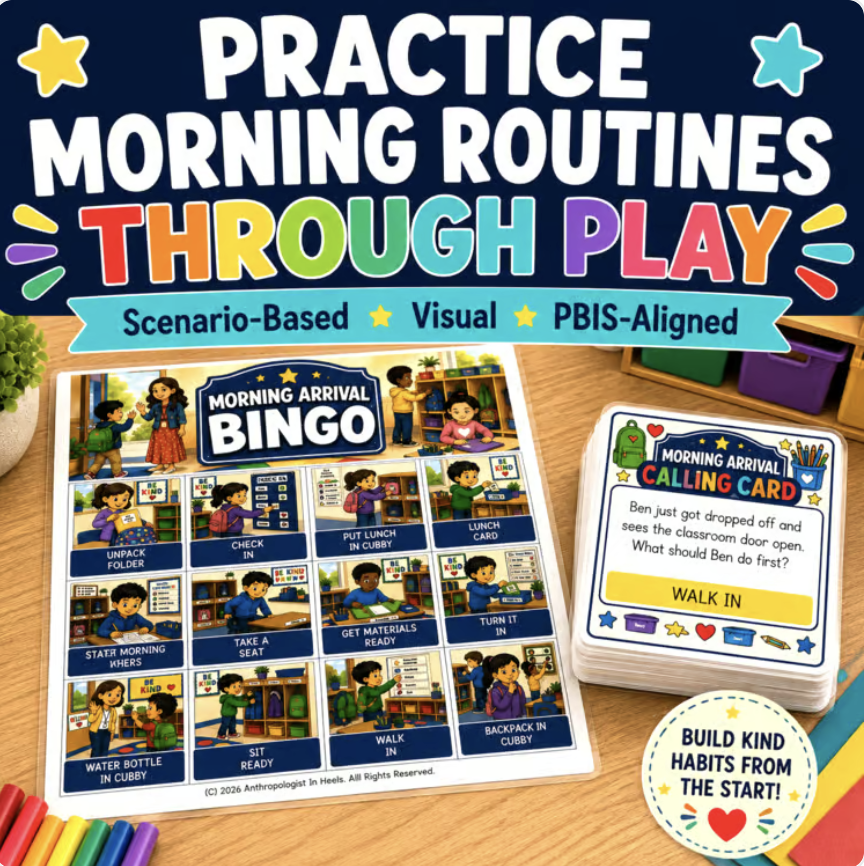 Image 2 of 4
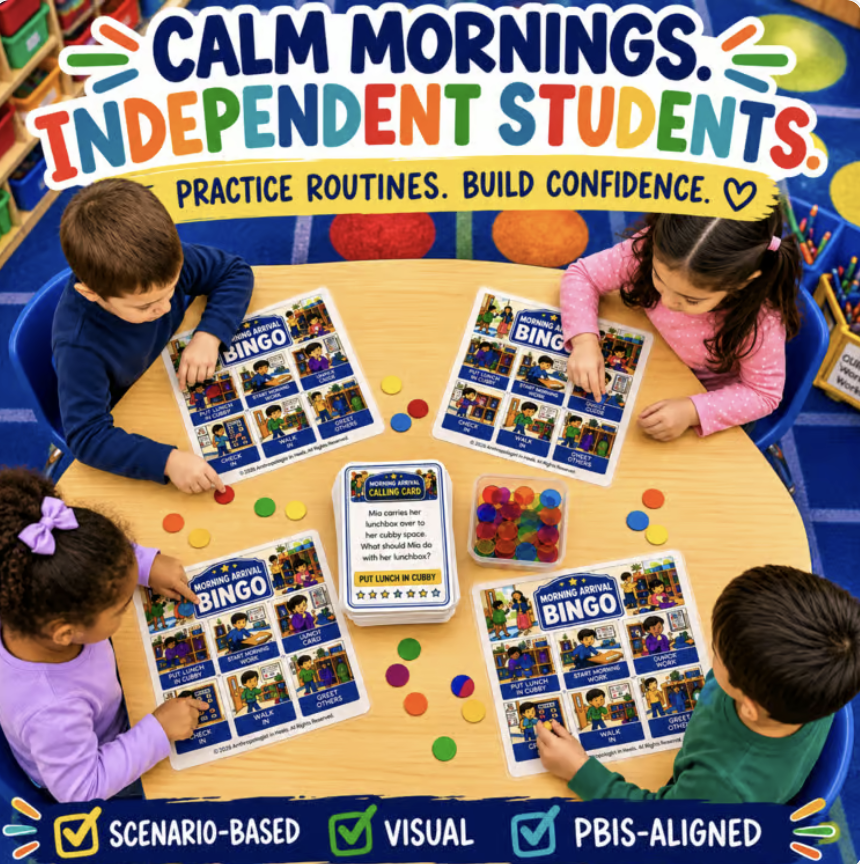 Image 3 of 4
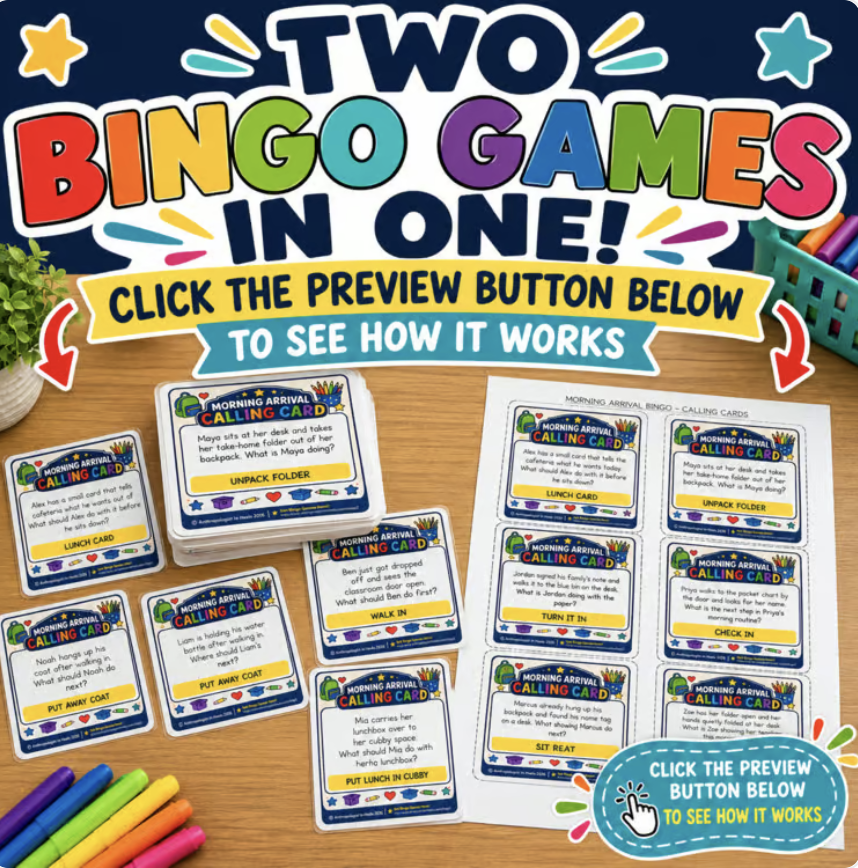 Image 4 of 4
Morning Arrival Bingo | PBIS Classroom Routines & Procedures Game | K-2
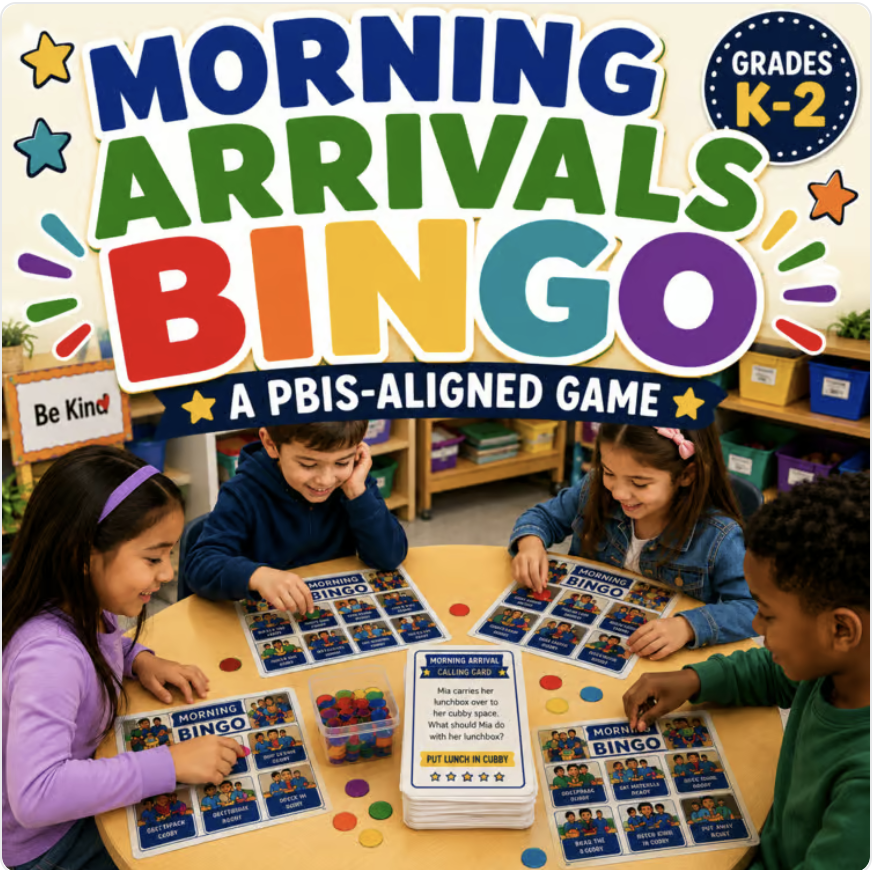
Teach, practice, and review morning arrival routines through visual supports, realistic scenarios, and play! Morning Arrival Bingo is a scenario-based classroom routines game created for Kindergarten–2nd grade students. Rather than simply calling out a vocabulary word, the teacher reads a short classroom scenario and students determine which morning routine or expected behavior the student in the scenario should use.
Students then locate the matching illustrated behavior on their Bingo board.
This makes the activity more than picture matching. Students listen to a situation, interpret what is happening, identify the expected routine, and connect it to a clear visual model.
How Does Morning Arrival Bingo Work?
Instead of saying:
“PUT AWAY COAT!” the teacher might read a scenario about a student arriving on a chilly morning while still wearing a puffy jacket and ask what the student should do when reaching the classroom hook. Students determine the answer and search their boards for PUT AWAY COAT.
The scenarios provide meaningful context for classroom expectations while the illustrated Bingo squares give young learners a concrete visual representation of each routine.
Two Levels of Bingo Boards
Choose the level that works best for your students. Thirty (30) bingo games per game, sixty (60) boards in all.
3×3 Bingo provides nine choices per board and focuses on highly recognizable morning routines such as walking in, greeting others, putting away a coat, taking a seat, checking in, and beginning morning work.
4×4 Bingo increases the challenge to 16 choices with no free space. Students encounter additional routines including unpacking a folder, turning in work, getting materials ready, reading the board, storing a water bottle, using a quiet voice, and sitting ready.
This allows teachers to select a simpler or more challenging game while addressing the same overall instructional goal.
Two Scenario Calling-Card Decks
Students can play more than once without simply memorizing the wording of the clues!
The resource includes two scenario-based calling-card decks that approach the routines through different students and situations.
For example, one deck introduces TURN IT IN through Jordan taking a family note to the classroom bin, while another scenario can present the same expectation in a different context.
Changing the scenario while maintaining the expected behavior encourages students to recognize a routine across situations instead of associating it with only one memorized clue.
Morning Arrival Skills & Routines
The 4×4 game incorporates 16 illustrated morning-arrival expectations:
Walk In • Greet Others • Put Away Coat • Backpack in Cubby • Water Bottle in Cubby • Put Lunch in Cubby • Lunch Card • Unpack Folder • Turn It In • Check In • Take a Seat • Sit Ready • Get Materials Ready • Read the Board • Start Morning Work • Quiet Voice
Because classroom procedures differ, teachers can use the routines and calling cards that correspond with the expectations in their own classroom.
Why Scenario-Based Bingo?
Young students don't only need to hear classroom expectations—they benefit from opportunities to recognize and practice when those expectations apply.
Morning Arrival Bingo combines:
visual models + teacher-read scenarios + active student responding + repeated practice
A student hears a situation and has to think:
“What should the student do?”
That makes the game useful for introducing procedures, reviewing previously taught routines, and providing additional practice when classroom expectations need a refresh.
PBIS-Aligned Classroom Practice
The instructional approach complements principles commonly associated with Positive Behavioral Interventions and Supports (PBIS), particularly the explicit teaching and practice of predictable classroom routines and expectations.
Tier 1 PBIS practices can include classroom-wide rules, routines, and expectations that are explicitly taught and practiced; morning arrival routines are specifically identified as an example of this type of Tier 1 practice in the supporting PBIS resource.
Rather than focusing on mistakes or inappropriate behavior, the game shows children successfully demonstrating expected routines and gives students repeated opportunities to identify what successful participation looks like.
Great for:
Kindergarten • 1st Grade • 2nd Grade • Back to School • Morning Meeting • Classroom Management • Classroom Procedures • PBIS-Aligned Practice • SEL • Special Education • Behavior Skills • Small Groups • Beginning-of-Year Expectations • After-Break Routine Review
Important Classroom Note
Morning procedures are not universal. Your school may store lunches, backpacks, folders, or water bottles differently from the examples shown in this resource.
Teach your classroom's expectations first and select the Bingo behaviors and calling cards that match your procedures.
Important PBIS Disclaimer:
This is not an official PBIS product. Morning Arrival Bingo is an independently created educational resource designed to align with and support practices commonly associated with PBIS, including explicitly teaching, modeling, reviewing, and practicing expected routines and behaviors. The same distinction applies to all “PBIS Bingo” games in this product category: the games are independently created resources designed to support or align with PBIS-related instructional practices; they are not official PBIS products.
Teach, practice, and review morning arrival routines through visual supports, realistic scenarios, and play! Morning Arrival Bingo is a scenario-based classroom routines game created for Kindergarten–2nd grade students. Rather than simply calling out a vocabulary word, the teacher reads a short classroom scenario and students determine which morning routine or expected behavior the student in the scenario should use.
Students then locate the matching illustrated behavior on their Bingo board.
This makes the activity more than picture matching. Students listen to a situation, interpret what is happening, identify the expected routine, and connect it to a clear visual model.
How Does Morning Arrival Bingo Work?
Instead of saying:
“PUT AWAY COAT!” the teacher might read a scenario about a student arriving on a chilly morning while still wearing a puffy jacket and ask what the student should do when reaching the classroom hook. Students determine the answer and search their boards for PUT AWAY COAT.
The scenarios provide meaningful context for classroom expectations while the illustrated Bingo squares give young learners a concrete visual representation of each routine.
Two Levels of Bingo Boards
Choose the level that works best for your students. Thirty (30) bingo games per game, sixty (60) boards in all.
3×3 Bingo provides nine choices per board and focuses on highly recognizable morning routines such as walking in, greeting others, putting away a coat, taking a seat, checking in, and beginning morning work.
4×4 Bingo increases the challenge to 16 choices with no free space. Students encounter additional routines including unpacking a folder, turning in work, getting materials ready, reading the board, storing a water bottle, using a quiet voice, and sitting ready.
This allows teachers to select a simpler or more challenging game while addressing the same overall instructional goal.
Two Scenario Calling-Card Decks
Students can play more than once without simply memorizing the wording of the clues!
The resource includes two scenario-based calling-card decks that approach the routines through different students and situations.
For example, one deck introduces TURN IT IN through Jordan taking a family note to the classroom bin, while another scenario can present the same expectation in a different context.
Changing the scenario while maintaining the expected behavior encourages students to recognize a routine across situations instead of associating it with only one memorized clue.
Morning Arrival Skills & Routines
The 4×4 game incorporates 16 illustrated morning-arrival expectations:
Walk In • Greet Others • Put Away Coat • Backpack in Cubby • Water Bottle in Cubby • Put Lunch in Cubby • Lunch Card • Unpack Folder • Turn It In • Check In • Take a Seat • Sit Ready • Get Materials Ready • Read the Board • Start Morning Work • Quiet Voice
Because classroom procedures differ, teachers can use the routines and calling cards that correspond with the expectations in their own classroom.
Why Scenario-Based Bingo?
Young students don't only need to hear classroom expectations—they benefit from opportunities to recognize and practice when those expectations apply.
Morning Arrival Bingo combines:
visual models + teacher-read scenarios + active student responding + repeated practice
A student hears a situation and has to think:
“What should the student do?”
That makes the game useful for introducing procedures, reviewing previously taught routines, and providing additional practice when classroom expectations need a refresh.
PBIS-Aligned Classroom Practice
The instructional approach complements principles commonly associated with Positive Behavioral Interventions and Supports (PBIS), particularly the explicit teaching and practice of predictable classroom routines and expectations.
Tier 1 PBIS practices can include classroom-wide rules, routines, and expectations that are explicitly taught and practiced; morning arrival routines are specifically identified as an example of this type of Tier 1 practice in the supporting PBIS resource.
Rather than focusing on mistakes or inappropriate behavior, the game shows children successfully demonstrating expected routines and gives students repeated opportunities to identify what successful participation looks like.
Great for:
Kindergarten • 1st Grade • 2nd Grade • Back to School • Morning Meeting • Classroom Management • Classroom Procedures • PBIS-Aligned Practice • SEL • Special Education • Behavior Skills • Small Groups • Beginning-of-Year Expectations • After-Break Routine Review
Important Classroom Note
Morning procedures are not universal. Your school may store lunches, backpacks, folders, or water bottles differently from the examples shown in this resource.
Teach your classroom's expectations first and select the Bingo behaviors and calling cards that match your procedures.
Important PBIS Disclaimer:
This is not an official PBIS product. Morning Arrival Bingo is an independently created educational resource designed to align with and support practices commonly associated with PBIS, including explicitly teaching, modeling, reviewing, and practicing expected routines and behaviors. The same distinction applies to all “PBIS Bingo” games in this product category: the games are independently created resources designed to support or align with PBIS-related instructional practices; they are not official PBIS products.