Bring the Strait of Hormuz and Iran current events into your World History, Human Geography, or Economics classroom with this inquiry-based lesson and activity. Students investigate Middle East geography, global oil trade, supply shocks, strategic chokepoints, and geopolitical power through maps, data, cause-and-effect reasoning, and current-event evidence.
Designed for grades 8–11, this Strait of Hormuz lesson helps students answer a bigger question: How can geography become a source of political and economic power? Instead of simply reading about a current conflict, students analyze why this small waterway matters to the global economy and how risk in one location can affect international trade.
✅ What’s Included
6-page student inquiry activity
10-page comprehensive teacher guide
Map-based Strait of Hormuz geography analysis
Global oil transportation and trade data analysis
Hands-on supply shock activity with six sequencing cards
Iran geography and geopolitical leverage analysis
Current-event evidence activity
Final evidence-based analysis
Key vocabulary support
Teacher facilitation notes and suggested questions
Complete class discussion guide
Compact answer key
Optional 30-point grading guide
4-level quick-grade rubric
45-minute, 60–90-minute, and two-day pacing options
Standards and course alignment
🌎 How It Works in the Classroom
This lesson follows an inquiry sequence:
GEOGRAPHY → DATA → SUPPLY SHOCK → GEOPOLITICAL LEVERAGE → CURRENT-EVENT EVIDENCE → STRATEGY & SYNTHESIS
Students begin with a map mystery before receiving information about oil or the conflict. They examine location, coastlines, movement, and access to open water to determine why the Strait might be strategically important.
Next, students analyze quantitative evidence about global oil transportation. They connect the Strait's narrow geography with the enormous volume of petroleum moving through it.
Then comes the economics connection.
Students build a supply shock by writing on, cutting, and sequencing cause-and-effect cards. They consider how conflict can make shipping riskier, increase shipping and insurance costs, disrupt oil shipments, create supply uncertainty, and eventually affect consumers.
Importantly, students discover that an economic supply shock does not require the Strait to completely close. Risk and uncertainty can change economic behavior before a physical shortage occurs.
Students then return to geography to investigate why Iran's location matters. They predict how territorial proximity can create geopolitical leverage before testing that prediction against current-event evidence.
The inquiry concludes with students evaluating the statement:
“Geography can be a source of political and economic power.”
Students must support their conclusion with geographic, economic, and current-conflict evidence.
🎯 Standards & Learning Goals
This Strait of Hormuz activity is designed for grades 9–11 and works especially well in:
Students will:
Analyze the geography of the Strait of Hormuz
Explain why it functions as a strategic chokepoint
Interpret quantitative oil and trade data
Model the cause-and-effect chain of a supply shock
Analyze incentives and markets under uncertainty
Explain how Iran's geography creates geopolitical leverage
Examine global economic interdependence
Analyze evidence from a contemporary conflict
Distinguish pressure, deterrence, leverage, and risk
Construct an evidence-based argument connecting geography, economics, and political power
The teacher guide provides alignment and practice with D2.Geo.2.9-12, D2.Geo.5.9-12, D2.Geo.11.9-12, D2.Eco.1.9-12, D2.Eco.2.9-12, RH.9-10.1, RH.9-10.7, WHST.9-10.1, and WHST.9-10.9, with corresponding grades 11–12 literacy standards identified for upper grades.
⭐ Why Teachers Will Love It / Key Benefits
✅ Makes current events academically meaningful
Students move beyond “what happened?” to analyze why the Strait of Hormuz matters economically and geographically.
✅ Strong Economics connection
Students explore supply shocks, incentives, risk, uncertainty, transportation costs, limited alternatives, global oil supply, and how costs can move toward consumers.
✅ Authentic Human Geography analysis
Students examine spatial relationships, movement, strategic waterways, territorial proximity, chokepoints, trade networks, and geopolitical power.
✅ Works across multiple courses
Use it for Economics current events, World History current events, Human Geography, Middle East geography, global trade, or Global Studies.
✅ Inquiry before explanation
Students analyze geography before seeing the oil statistics and make predictions before examining later evidence. The sequencing is deliberately designed to make students reason rather than simply repeat information.
✅ Built-in assessment options
Use the complete packet, final analysis, discussion performance, optional 30-point grading system, or quick-grade rubric for assessment.
✅ Flexible pacing
Teach the complete inquiry in 60–90 minutes, use the abbreviated 45-minute option, or divide it into a two-day lesson.
✅ Low prep
Print the student pages, provide pencils and scissors for the supply-shock activity, and teach using the detailed teacher guide.
Key Concepts & Vocabulary
Strait of Hormuz • Iran current events • Middle East current events • supply shock • strategic chokepoint • geopolitical leverage • global trade • international trade • oil supply • economic interdependence • pressure • deterrence • risk • geography and economics
📥 Add This Current-Events Inquiry to Your Classroom
Give students a way to understand the Strait of Hormuz, Iran, Middle East current events, and global oil trade through the combined lenses of Economics, Human Geography, and World History.
Download this Strait of Hormuz lesson and activity for an evidence-based current-events inquiry that asks students to analyze maps, interpret data, model a supply shock, evaluate geopolitical leverage, and connect a strategic waterway to the global economy.
─────────────────
┊ ┊ ┊⋆。 ┊ ┊ ┊ ┊
┊ ⋆。 ┊ ┊ ┊ ┊⋆。┊ ༊*·˚
┊ ┊ ┊ ┊ ┊ ┊
┊ ‧₊ ༉ ┊ ˚✩ ┊ ๑՞.
┊ ₊˚.༄ ┊
✩₊̣̇. ੈ♡˳
✧.*ೃ༄
FOLLOW MY STORE FOR FREEBIES
Thanks for visiting! Follow the store to see new products as they’re released 💛
Bring the Strait of Hormuz and Iran current events into your World History, Human Geography, or Economics classroom with this inquiry-based lesson and activity. Students investigate Middle East geography, global oil trade, supply shocks, strategic chokepoints, and geopolitical power through maps, data, cause-and-effect reasoning, and current-event evidence.
Designed for grades 8–11, this Strait of Hormuz lesson helps students answer a bigger question: How can geography become a source of political and economic power? Instead of simply reading about a current conflict, students analyze why this small waterway matters to the global economy and how risk in one location can affect international trade.
✅ What’s Included
6-page student inquiry activity
10-page comprehensive teacher guide
Map-based Strait of Hormuz geography analysis
Global oil transportation and trade data analysis
Hands-on supply shock activity with six sequencing cards
Iran geography and geopolitical leverage analysis
Current-event evidence activity
Final evidence-based analysis
Key vocabulary support
Teacher facilitation notes and suggested questions
Complete class discussion guide
Compact answer key
Optional 30-point grading guide
4-level quick-grade rubric
45-minute, 60–90-minute, and two-day pacing options
Standards and course alignment
🌎 How It Works in the Classroom
This lesson follows an inquiry sequence:
GEOGRAPHY → DATA → SUPPLY SHOCK → GEOPOLITICAL LEVERAGE → CURRENT-EVENT EVIDENCE → STRATEGY & SYNTHESIS
Students begin with a map mystery before receiving information about oil or the conflict. They examine location, coastlines, movement, and access to open water to determine why the Strait might be strategically important.
Next, students analyze quantitative evidence about global oil transportation. They connect the Strait's narrow geography with the enormous volume of petroleum moving through it.
Then comes the economics connection.
Students build a supply shock by writing on, cutting, and sequencing cause-and-effect cards. They consider how conflict can make shipping riskier, increase shipping and insurance costs, disrupt oil shipments, create supply uncertainty, and eventually affect consumers.
Importantly, students discover that an economic supply shock does not require the Strait to completely close. Risk and uncertainty can change economic behavior before a physical shortage occurs.
Students then return to geography to investigate why Iran's location matters. They predict how territorial proximity can create geopolitical leverage before testing that prediction against current-event evidence.
The inquiry concludes with students evaluating the statement:
“Geography can be a source of political and economic power.”
Students must support their conclusion with geographic, economic, and current-conflict evidence.
🎯 Standards & Learning Goals
This Strait of Hormuz activity is designed for grades 9–11 and works especially well in:
Students will:
Analyze the geography of the Strait of Hormuz
Explain why it functions as a strategic chokepoint
Interpret quantitative oil and trade data
Model the cause-and-effect chain of a supply shock
Analyze incentives and markets under uncertainty
Explain how Iran's geography creates geopolitical leverage
Examine global economic interdependence
Analyze evidence from a contemporary conflict
Distinguish pressure, deterrence, leverage, and risk
Construct an evidence-based argument connecting geography, economics, and political power
The teacher guide provides alignment and practice with D2.Geo.2.9-12, D2.Geo.5.9-12, D2.Geo.11.9-12, D2.Eco.1.9-12, D2.Eco.2.9-12, RH.9-10.1, RH.9-10.7, WHST.9-10.1, and WHST.9-10.9, with corresponding grades 11–12 literacy standards identified for upper grades.
⭐ Why Teachers Will Love It / Key Benefits
✅ Makes current events academically meaningful
Students move beyond “what happened?” to analyze why the Strait of Hormuz matters economically and geographically.
✅ Strong Economics connection
Students explore supply shocks, incentives, risk, uncertainty, transportation costs, limited alternatives, global oil supply, and how costs can move toward consumers.
✅ Authentic Human Geography analysis
Students examine spatial relationships, movement, strategic waterways, territorial proximity, chokepoints, trade networks, and geopolitical power.
✅ Works across multiple courses
Use it for Economics current events, World History current events, Human Geography, Middle East geography, global trade, or Global Studies.
✅ Inquiry before explanation
Students analyze geography before seeing the oil statistics and make predictions before examining later evidence. The sequencing is deliberately designed to make students reason rather than simply repeat information.
✅ Built-in assessment options
Use the complete packet, final analysis, discussion performance, optional 30-point grading system, or quick-grade rubric for assessment.
✅ Flexible pacing
Teach the complete inquiry in 60–90 minutes, use the abbreviated 45-minute option, or divide it into a two-day lesson.
✅ Low prep
Print the student pages, provide pencils and scissors for the supply-shock activity, and teach using the detailed teacher guide.
Key Concepts & Vocabulary
Strait of Hormuz • Iran current events • Middle East current events • supply shock • strategic chokepoint • geopolitical leverage • global trade • international trade • oil supply • economic interdependence • pressure • deterrence • risk • geography and economics
📥 Add This Current-Events Inquiry to Your Classroom
Give students a way to understand the Strait of Hormuz, Iran, Middle East current events, and global oil trade through the combined lenses of Economics, Human Geography, and World History.
Download this Strait of Hormuz lesson and activity for an evidence-based current-events inquiry that asks students to analyze maps, interpret data, model a supply shock, evaluate geopolitical leverage, and connect a strategic waterway to the global economy.
─────────────────
┊ ┊ ┊⋆。 ┊ ┊ ┊ ┊
┊ ⋆。 ┊ ┊ ┊ ┊⋆。┊ ༊*·˚
┊ ┊ ┊ ┊ ┊ ┊
┊ ‧₊ ༉ ┊ ˚✩ ┊ ๑՞.
┊ ₊˚.༄ ┊
✩₊̣̇. ੈ♡˳
✧.*ೃ༄
FOLLOW MY STORE FOR FREEBIES
Thanks for visiting! Follow the store to see new products as they’re released 💛

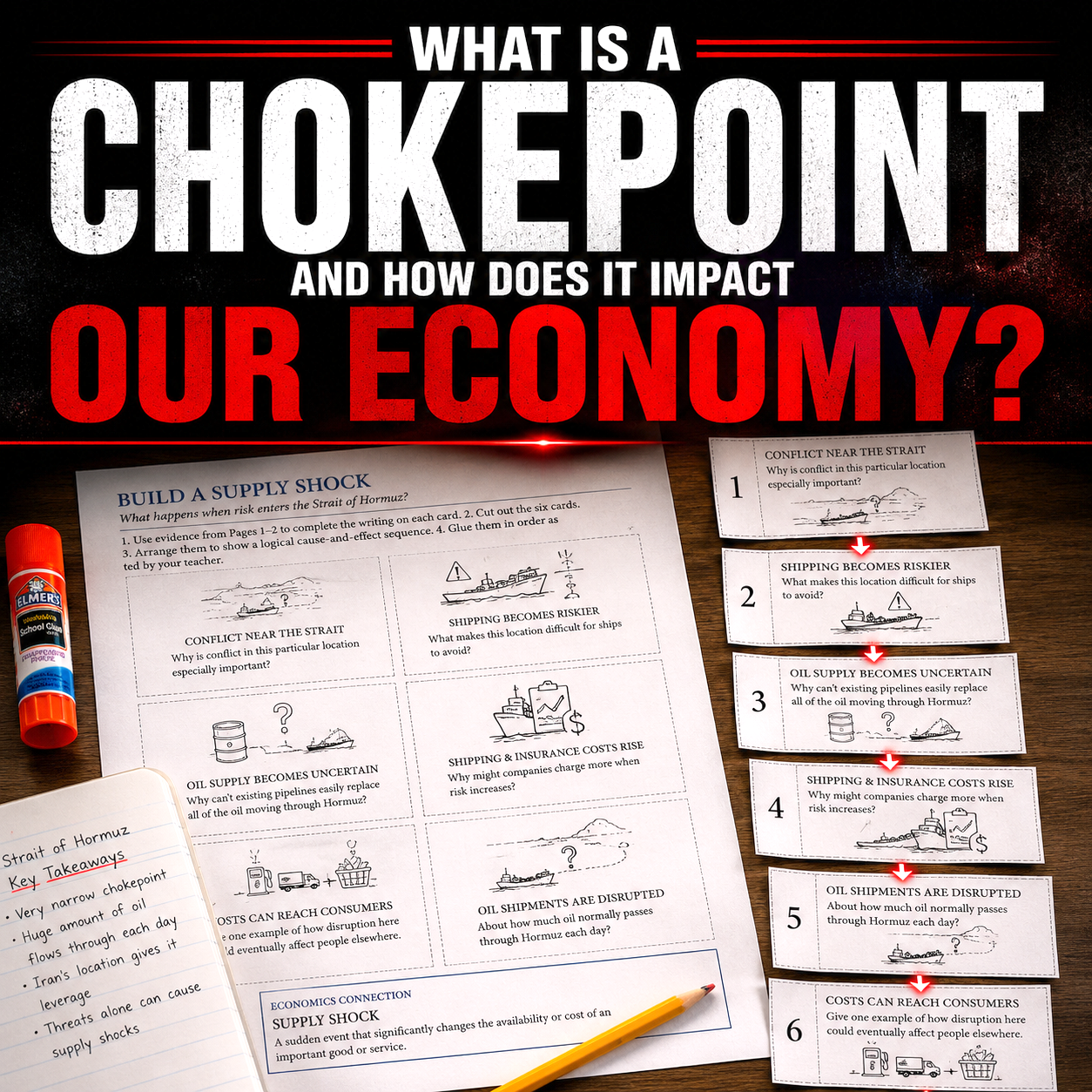 Image 1 of 9
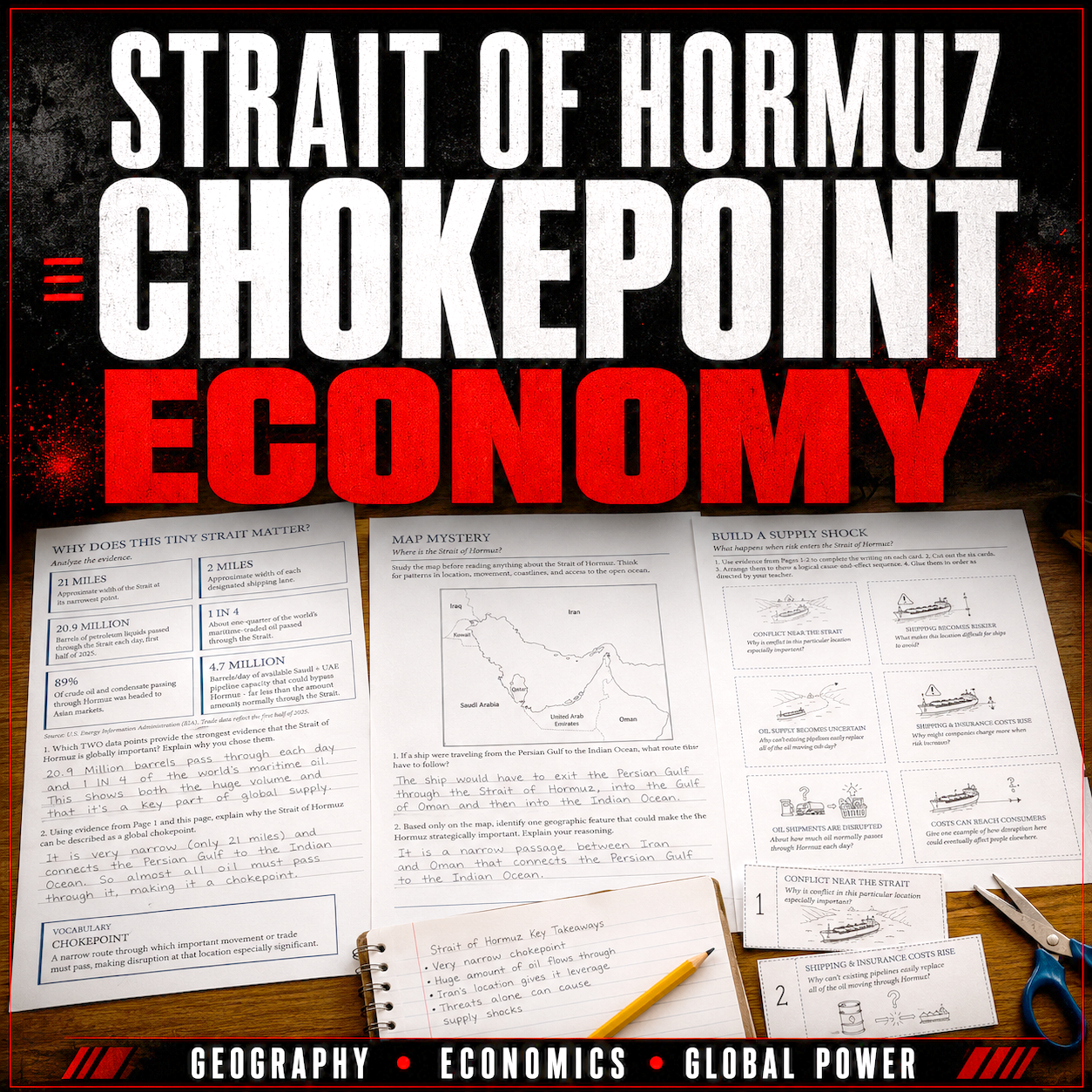 Image 2 of 9
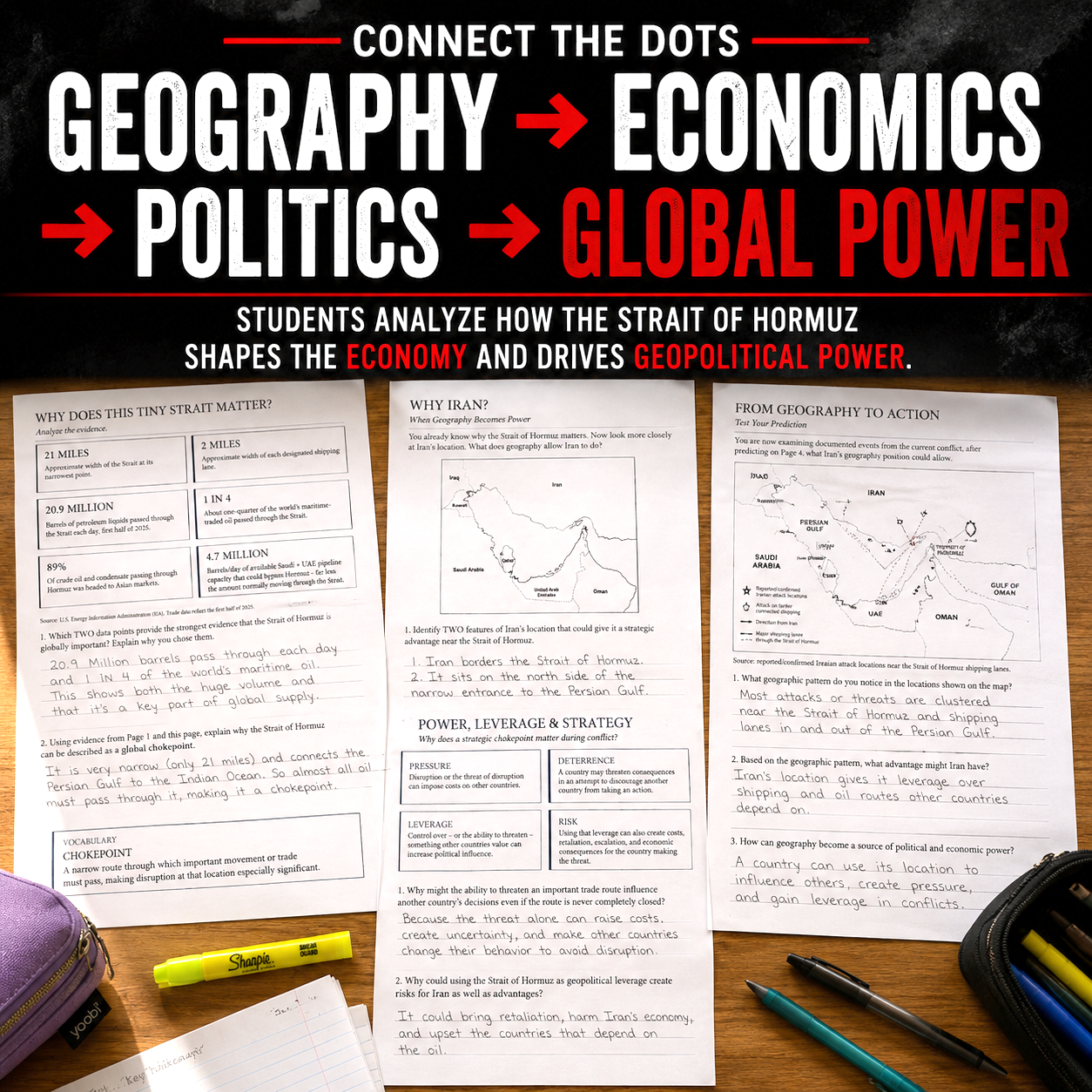 Image 3 of 9
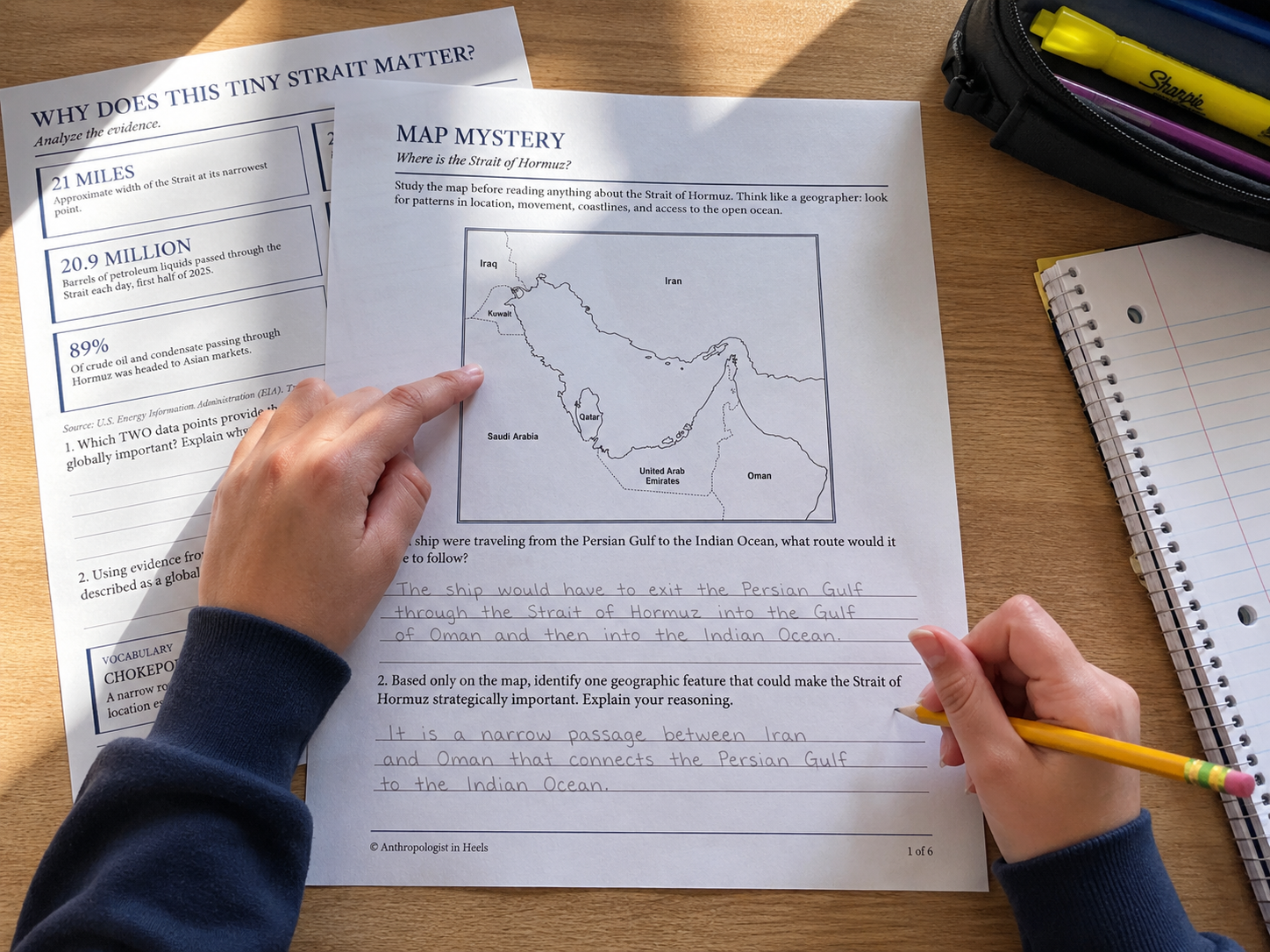 Image 4 of 9
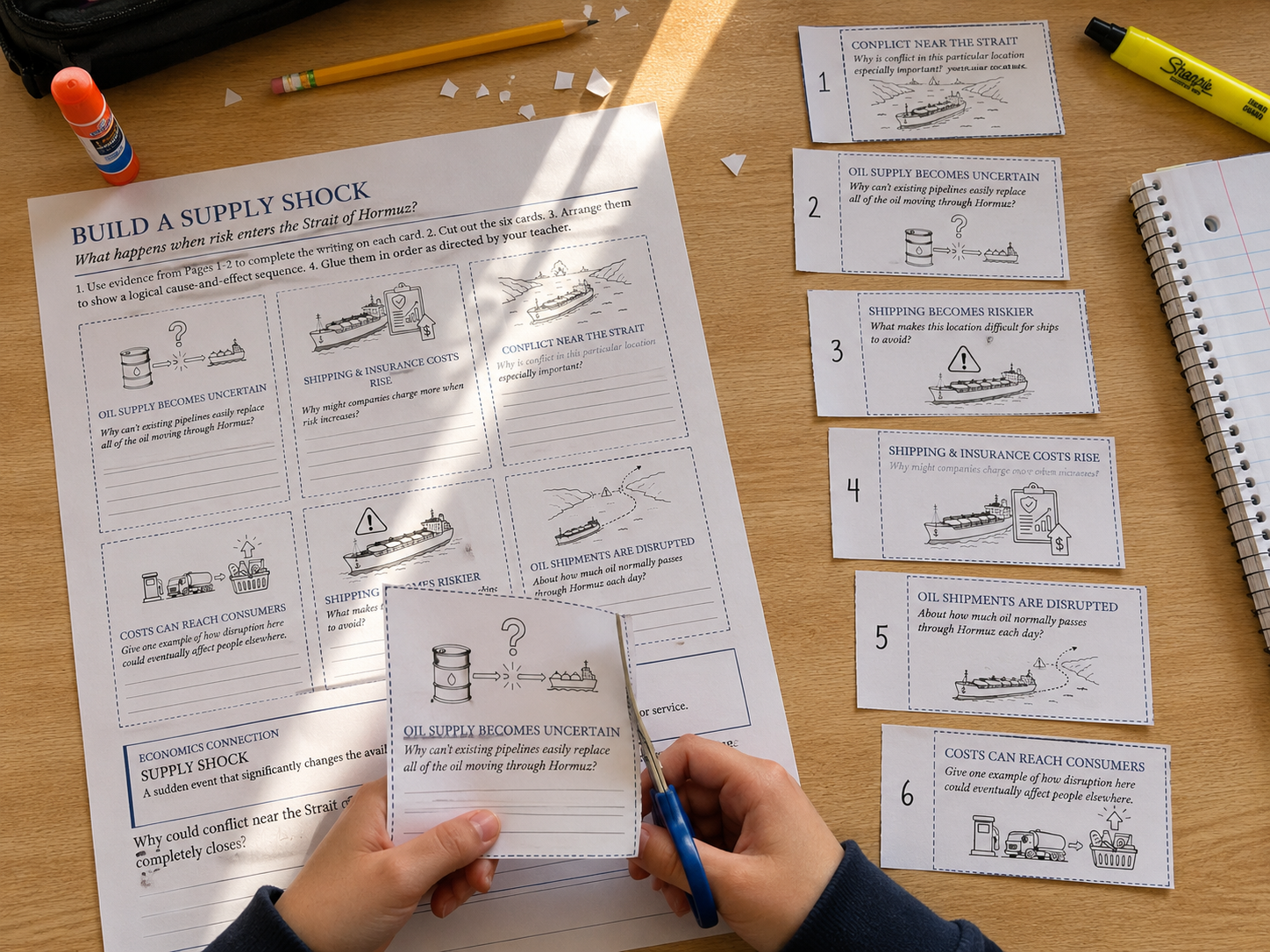 Image 5 of 9
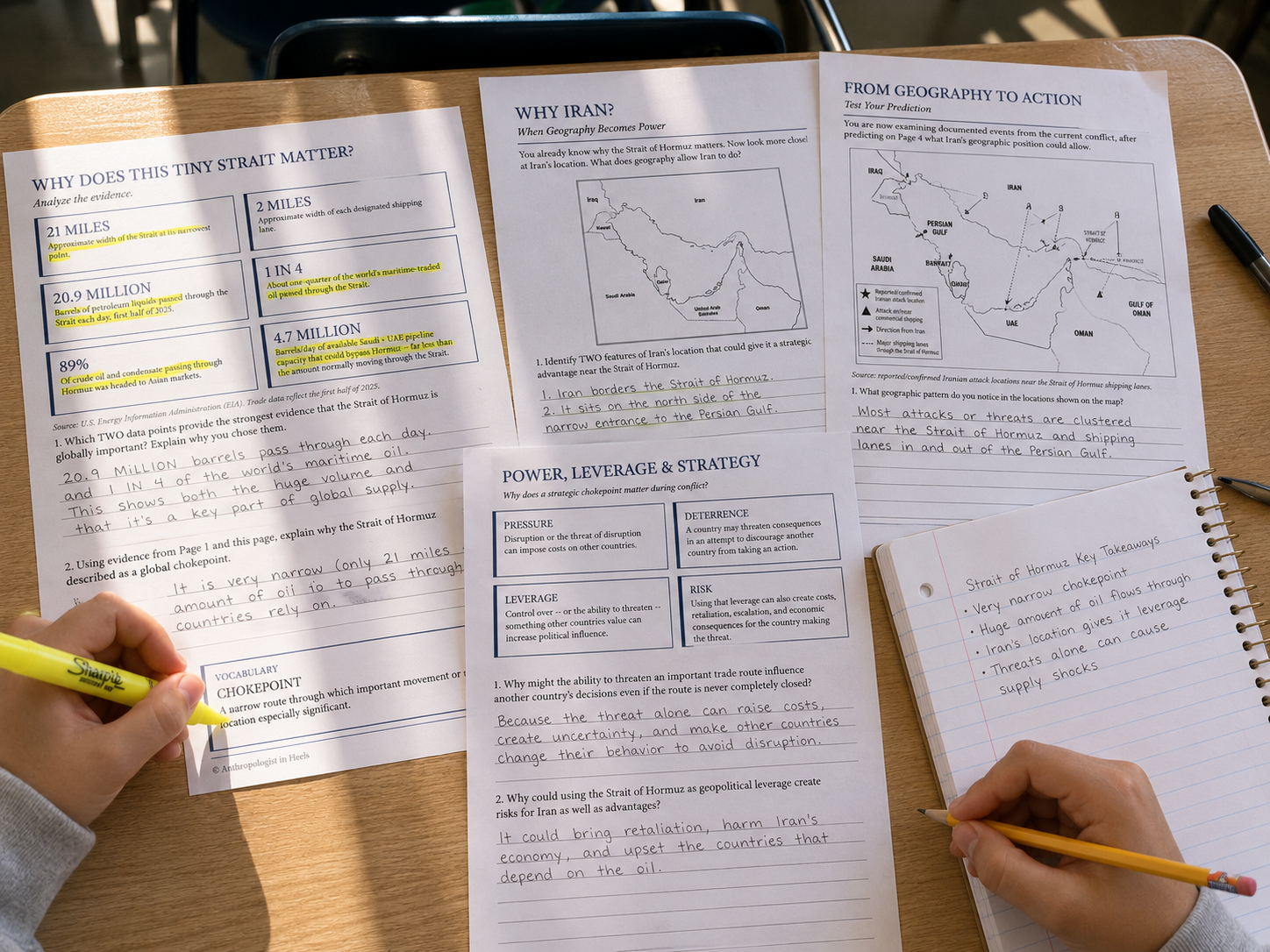 Image 6 of 9
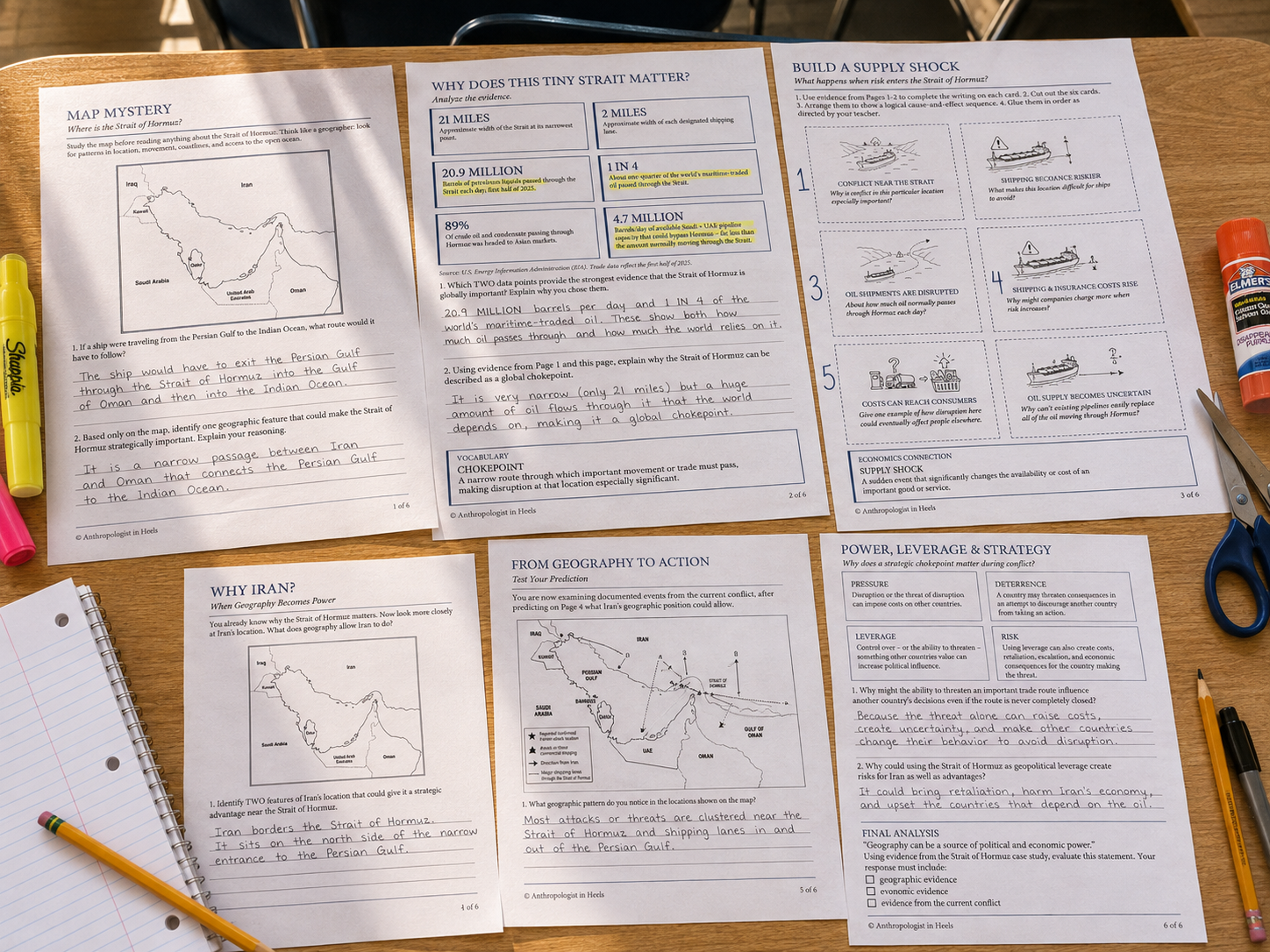 Image 7 of 9
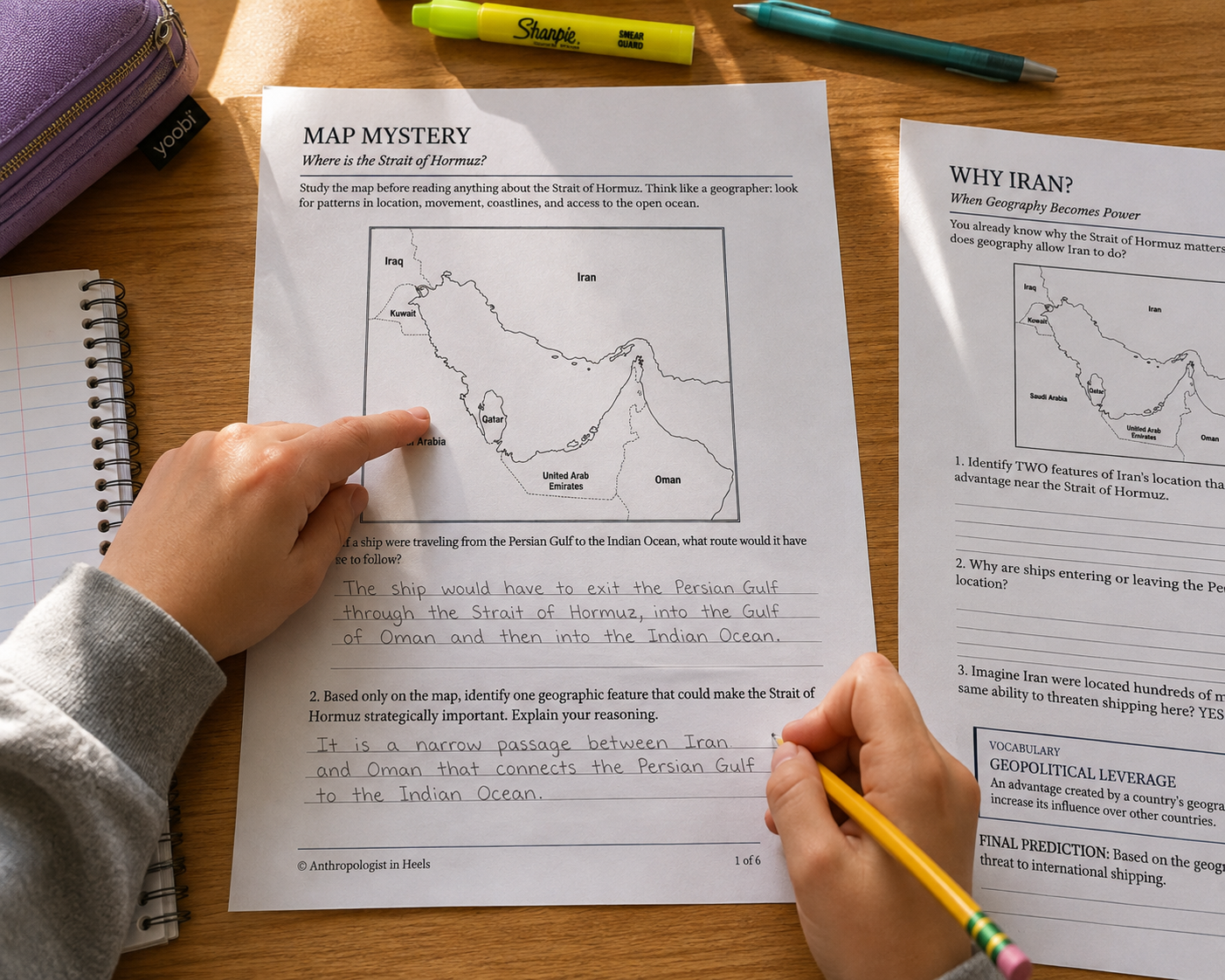 Image 8 of 9
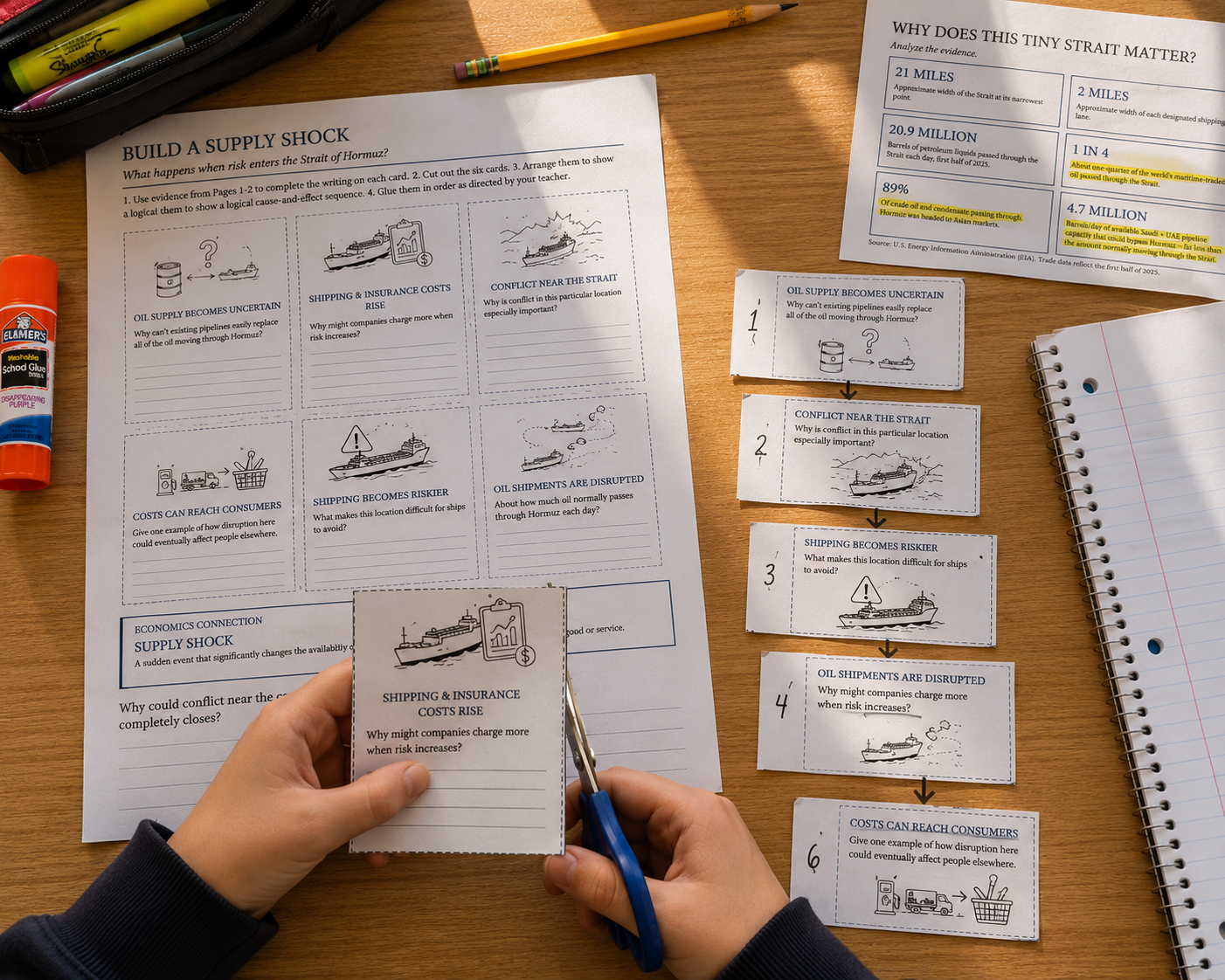 Image 9 of 9