How to find your narrative arch in TPT marking
As I’ve been using my TPT Preview Builder and remaking hundreds of pageview and preview images, I had a realization that completely changed how I approached marketing my resources.
What I didn’t need was better graphics or more information.
What I needed was a clear understanding of my narrative arc as a marketing tool to design the path for both my page view images and my preview images. This is important because narrative arc is like a little story that shapes how teachers interpret your product at a glance. The narrative arc gives your page view images and preview a marketing purpose, direction, and strategy. On TPT, every product already tells a story. The story your resouce tells should depend on what your buyers want. Sellers who can diagnose that narrative arc evolve their page views and previews into powerful, persuasive marketing tools — and that changes everything.
And the first breakthrough was this: You do not have to find your narrative arc — you must diagnose it.
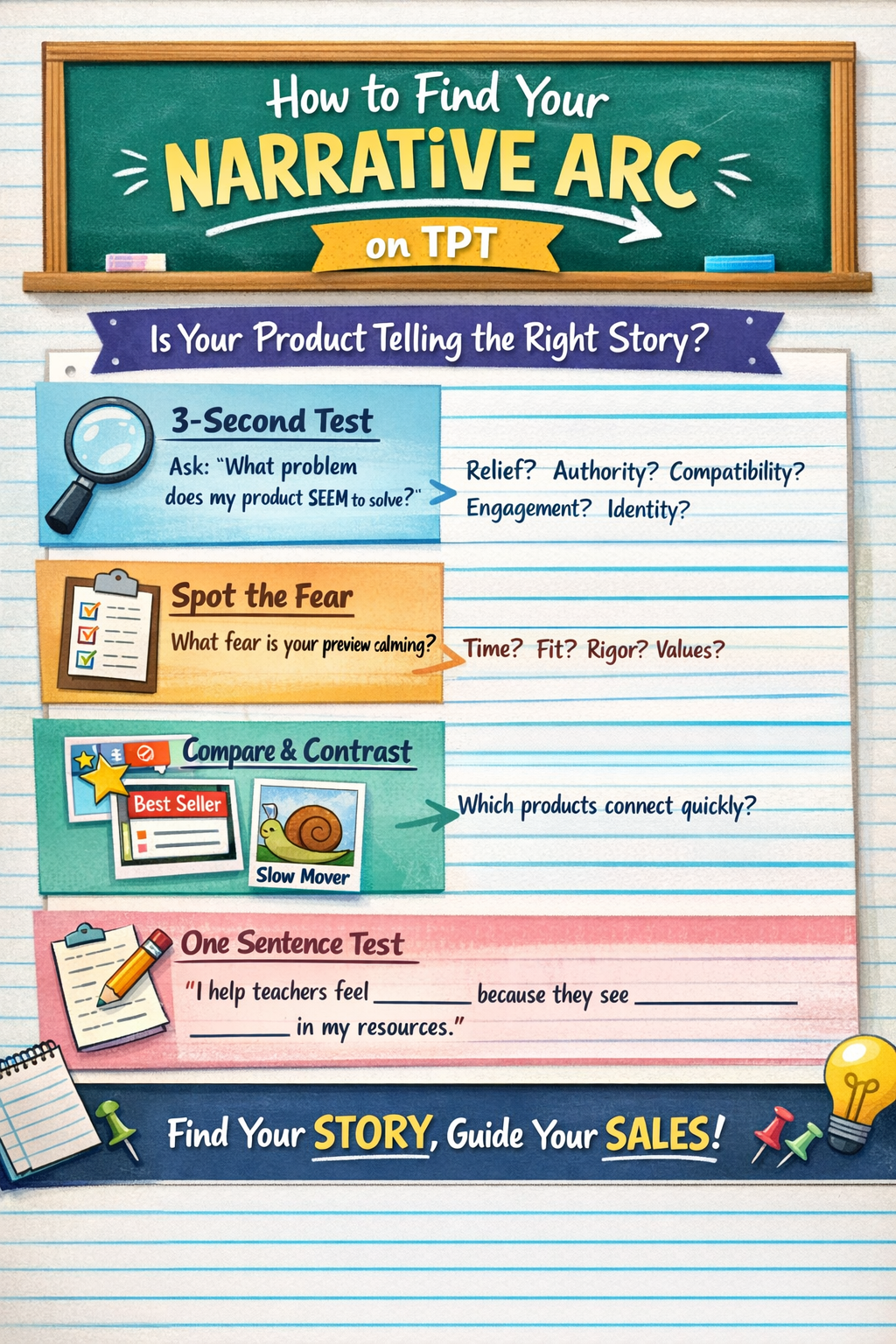
Every TPT Store Is Already Telling a Story
Every Teachers Pay Teachers store is already telling a story, whether the seller intends to or not. The question isn’t “What story do I want to tell?” — it’s:
“What story are teachers actually experiencing when they see my products?”
Once you understand that, you can make a conscious choice:
reinforce the story that’s working, or
redirect the story that’s holding your sales back.
The 3-Second Test: The Fastest Way to Diagnose Your Arc
Pretend you’ve never seen your store before.
Open one product and ask yourself:
“If I only had three seconds per image, what problem does this product seem to solve?”
Don’t overthink it. The first answer that appears is your current narrative arc.
“This saves time” → Relief Arc
“This looks rigorous / legit” → Authority Arc
“This would work with my class” → Compatibility Arc
“My students would like this” → Engagement Arc
“This aligns with my values or teaching style” → Identity Arc
Most sellers are surprised here.
The arc they think they’re telling is often not the arc buyers are receiving. Buyers don't experience your product through your intention — they experience it through sequence, speed, and instinct.
This gap between what you meant to say and what they actually hear is where sales friction begins.
But once you diagnose the arc that’s truly coming through, you gain the power to:
Refine it so it lands with clarity, or
Reroute it to better match your actual audience and product strengths.
And that clarity alone can be the difference between scroll-past and add-to-cart.
Look at What You Lead With (Not What You Include)
Your narrative arc isn’t revealed by everything inside your product.
It’s revealed by what comes first.
Look closely at Image 1 and Image 2 in your pageviews:
Do you lead with features or outcomes?
Do you emphasize ease, rigor, or student response?
Are you answering “Why buy this?” or “What is this?”
👉 Whatever you lead with is the opening line of your narrative arc.
Identify the Objection You’re Quietly Answering
Each narrative arc isn’t just a storytelling device — it exists to neutralize a specific fear your buyer has.
That fear is what drives their decision-making.
So when you create your preview images, don’t just ask, “What should I show?”
Ask instead:
“What doubt does my preview spend the most time calming?”
This is the marketing function of your arc — it guides what you highlight, what you lead with, and how each image earns its place.
Here’s how the arcs map to buyer fears:
Fear of wasted time → Relief Arc
Fear of poor fit → Compatibility Arc
Fear of low rigor → Authority Arc
Fear students won’t engage → Engagement Arc
Fear of misalignment with values → Identity Arc
And the structure of your preview will often reveal this unconsciously:
Heavy organization slides? → You're calming time anxiety (Relief Arc)
Lots of sample pages? → You're calming fit anxiety (Compatibility Arc)
Emphasis on scaffolds, standards, or academic language? → You're calming rigor anxiety (Authority Arc)
That’s not accidental.
That’s your arc — already at work.
The key is to name it, own it, and then design your visuals on purpose, so that every slide becomes a strategic step in resolving the buyer’s internal hesitation. But don’t worry - in this blog we will examine narrative arcs even deeper, identifying teacher + Subject = Narrative Arc. This narrative arc tells you how to design all of your page view and preview images, so this is an important part you don’t want to miss.
Your Buyers Are Already Voting
Your sales data is another diagnostic tool.
Compare:
your best sellers, and
your slow movers.
Ask:
Which products are easiest to understand at a glance?
Which ones feel “safe” to buy?
Which ones make their classroom use obvious immediately?
Your strongest sellers are aligned with your natural narrative arc — even if you never named it before.
Narrative Arcs Must Match Grade-Level Reality
Different grade bands are motivated by different things:
Elementary buyers default to Relief + Compatibility
Middle school blends Engagement + Fit
High school defaults to Authority + Identity
When your arc clashes with your audience (for example, selling high-school rigor with elementary-style “cute”), friction appears.
When sales feel harder than they should, it’s often an arc mismatch, not a product problem.
How Narrative Arcs Work Across Pageviews and Previews
Narrative arcs are the invisible story structures that move a teacher emotionally and cognitively from scrolling to buying.
On a TPT product page:
The four pageview images start the story. Their job is to stop the scroll, establish clarity, build relevance, and compel the click into the preview.
The 6-slide PDF preview continues the story. It functions as a long-form ad that deepens trust, answers objections, and resolves the decision with confidence.
Pageviews open the loop.
Previews close the loop.
Together, they form one continuous persuasive journey that moves the product into the buyer’s cart.
Five Narrative Arcs Every TPT Seller Should Know
1. The Time-Saving Relief Arc
Best for: Elementary, upper elementary, intervention
Core motivation: “I need something ready right now.”
Pageviews promise no prep and everything included. Previews prove it with organization, answer keys, and clarity.
2. The Classroom Compatibility Arc
Best for: Elementary → middle school
Core motivation: “Will this actually work with my students?”
This arc centers on fit: grade level, standards, digital vs. print, and accessibility.
3. The Engagement & Buy-In Arc
Best for: Upper elementary, middle school
Core motivation: “Will my students care?”
Pageviews highlight engagement; previews show that engagement is intentional and instructional.
4. The Pedagogical Authority Arc
Best for: Middle school → high school, AP, test prep
Core motivation: “Is this rigorous and defensible?”
This arc builds trust through skills, scaffolding, and academic clarity.
5. The Identity & Values Arc
Best for: Secondary, electives, culturally focused subjects
Core motivation: “This aligns with how I teach and what I value.”
This arc builds loyalty and brand connection by signaling belonging and intention.
Buy your Custom TPT Pageview and Preview Maker Powered By ChatGPT
Once you’ve diagnosed your arc, these next steps will help you bring it to life:
🧠 How to Use TPT Preview Maker Powered by ChatGPT
Get your preview images done faster — and more intentionally — with AI.📸 How to Use AI to Create Product Previews on Teachers Pay Teachers
A step-by-step guide to designing previews that match your arc and stop the scroll.✍️ How to Use My ChatGPT Teachers Pay Teachers Description Maker
Make sure your product descriptions reinforce the right story — not confuse it.