BINGO Games for AP Biology, Psychology & More | Anthropologist In Heels
When most people think of classroom BINGO, they imagine a teacher calling out a vocabulary word while students search their boards for a match. It's a familiar activity, especially in elementary classrooms.
But I've always been interested in what happens when we take something familiar and use it in an unexpected way.
What if BINGO could help students understand complex biological processes, explore psychological concepts, analyze historical events, or examine philosophical arguments?
What if teachers of advanced classes had access to games designed specifically for the challenging material they teach?
These questions inspired me to develop my growing collection of educational BINGO games at Anthropologist In Heels.
My goal wasn't simply to create more classroom games. I wanted to create games for subjects that are often difficult to turn into meaningful activities without sacrificing their academic complexity.
And I wanted them to be beautiful.
Making BINGO Games for Subjects That Are Difficult to Turn Into Games
Some academic subjects lend themselves naturally to classroom games. Others present a much greater challenge.
Consider AP Biology.
Students must understand processes such as signal transduction, cell cycle regulation, meiosis, and cellular respiration. Memorizing terminology is only the beginning. Students also need to understand how biological processes work, how they are regulated, and what happens when something goes wrong.
These are not necessarily concepts that fit neatly into a traditional vocabulary game.
But I wanted to find a way to make them work.
My AP Biology Cell Cycle & Cell Cycle Regulation BINGO focuses on the processes and regulatory mechanisms involved in cell division.
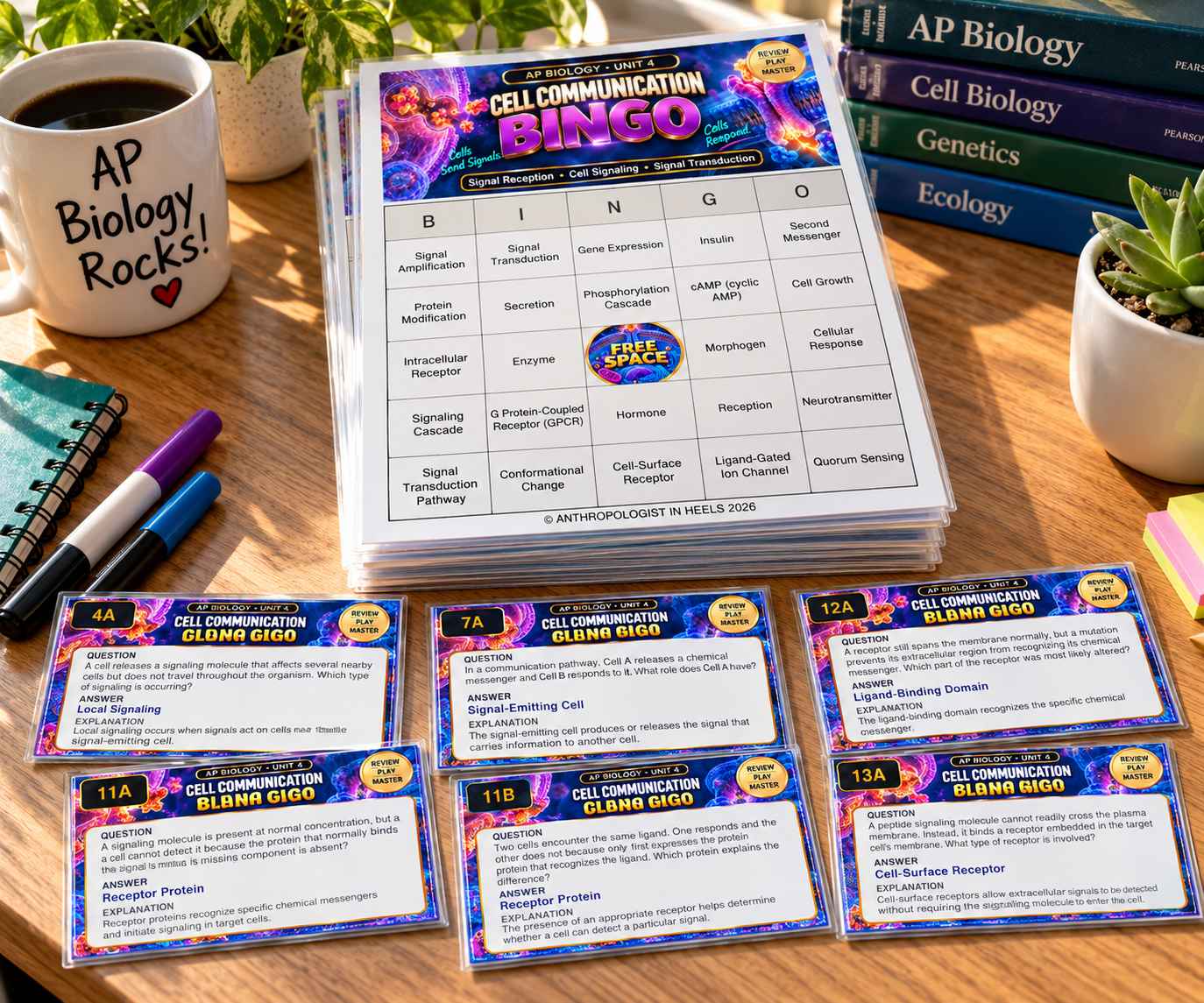
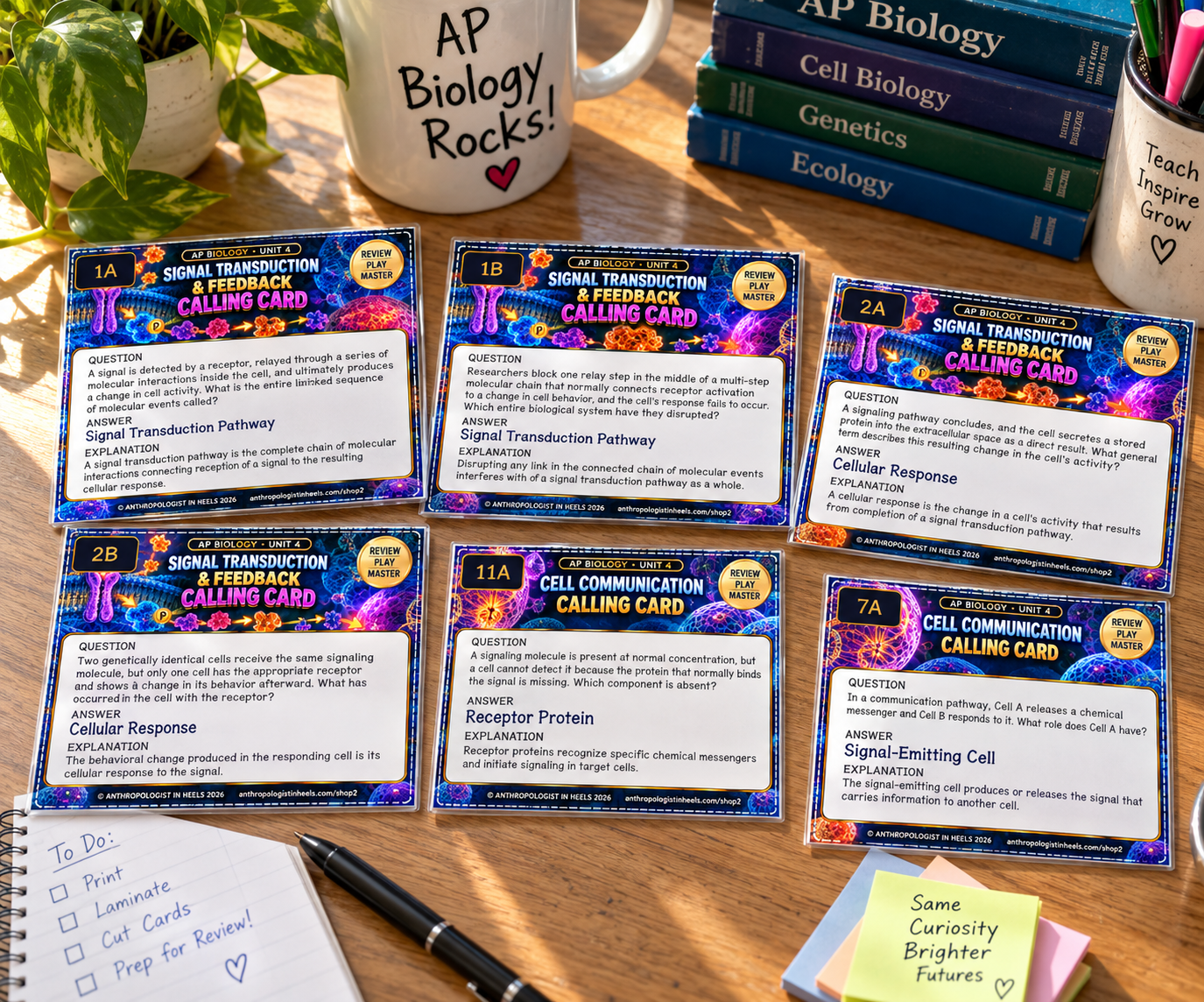
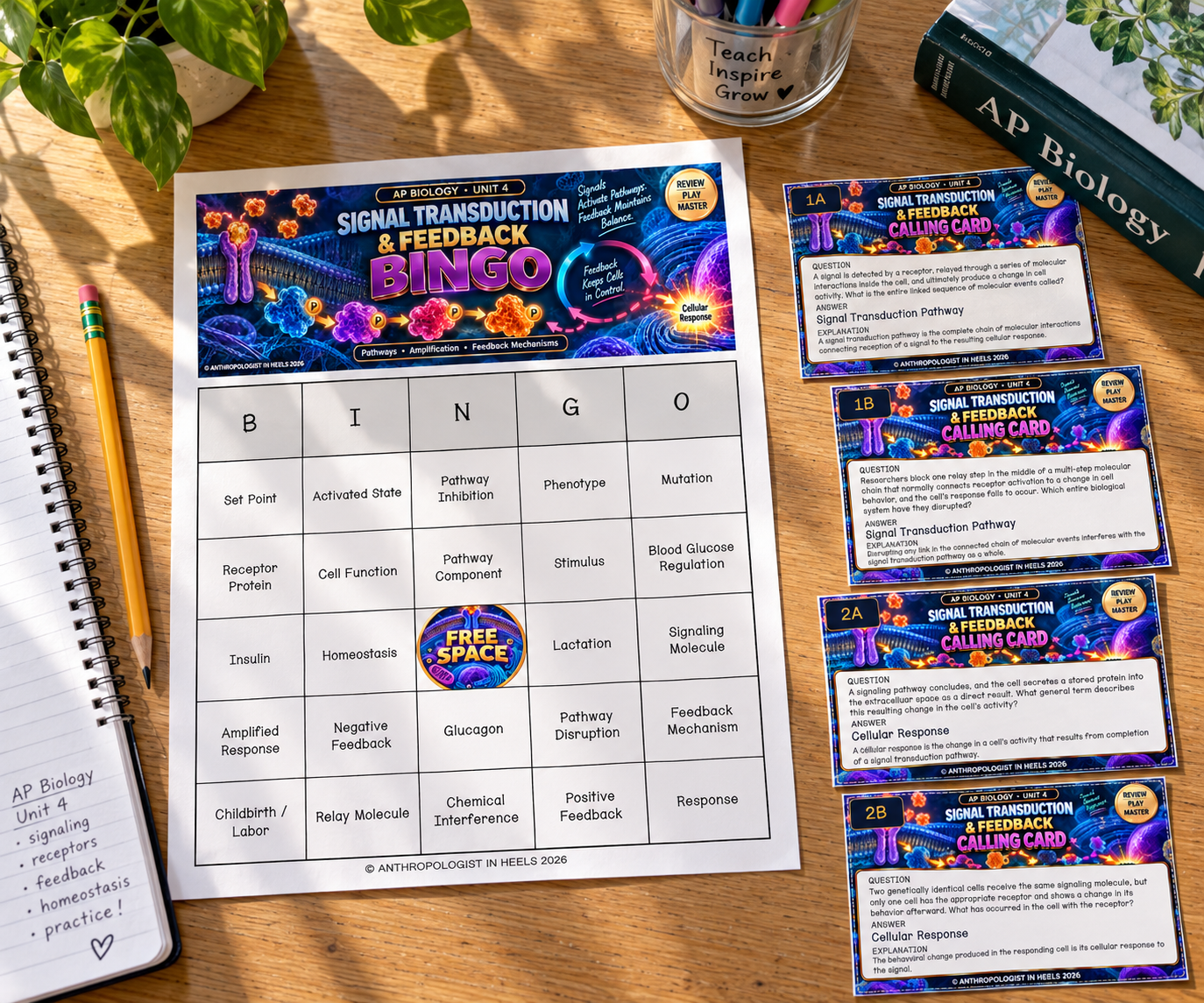
My Signal Transduction & Feedback BINGO explores how cells receive, transmit, and respond to signals.
I also created an AP Biology Meiosis BINGO game to help students review the processes involved in meiosis and heredity.
Then I developed a companion game, Chromosome Mutations BINGO: Nondisjunction & Chromosome Abnormalities, focusing on what happens when chromosome separation does not proceed normally.
These subjects require students to understand relationships, mechanisms, and consequences.
The challenge was to preserve that intellectual depth while making the material accessible through a familiar classroom activity.
That's what I find so satisfying about creating these games.
The academic content remains challenging. The game simply provides another way for students to engage with it.
The Calling Cards Are Where the Thinking Happens
One of the most important decisions I made was to change how the calling cards work.
In a traditional vocabulary game, a teacher might say "homeostasis," and students look for the identical word on their boards.
But what happens if the teacher asks:
"What process maintains relatively stable internal conditions despite changes in an organism's environment?"
Now students must understand the question, recall the relevant biological concept, and determine which term belongs on their board.
The answer is still homeostasis, but the thinking required to arrive at it is different.
This is the approach I use in many of my games.
My Characteristics of Living Things BINGO explores 40 biological terms, including cellular organization, metabolism, heredity, homeostasis, and adaptation.
Rather than relying exclusively on word recognition, the calling cards ask students to identify concepts from scientific questions.
I also include the correct answer and a brief explanation on the calling cards.
This allows teachers to do more than announce whether an answer is correct. They can reinforce the underlying science, clarify misconceptions, or invite students to explain their reasoning.
For me, the calling cards are just as important as the BINGO boards themselves.
A well-designed question can turn a simple game into an opportunity for meaningful academic discussion.
Different Questions Create Different Levels of Challenge
Another feature I particularly enjoy developing is the use of multiple calling-card decks.
Some of my games include two or three decks that approach the same subject at different levels of complexity.
One deck might emphasize foundational knowledge and terminology.
Another might require students to apply their understanding to a scientific situation.
A more advanced deck might ask students to interpret a process, analyze a relationship, or consider the consequences of a biological change.
For example, my AP Biology Nervous System BINGO uses three levels of questions to explore neurons, neurotransmitters, and nervous system processes.
I like the flexibility this gives teachers.
Students can become familiar with the game format while the questions become more demanding.
A teacher might begin with foundational review, return to the game later in the unit with more challenging questions, or select a deck that matches the class's current instructional needs.
The BINGO board remains familiar, but the intellectual demands can change.
This approach allows me to develop resources that support different kinds of learning without making the activity unnecessarily complicated.
Every Game Deserves Its Own Artistic Identity
The academic content is only part of what makes these games special to me.
I also love designing them.
I don't want every resource to look like the same generic template with a different title.
I want the artwork to reflect the subject.
When I create a biology game, I think about scientific imagery, molecular structures, anatomical illustrations, and the visual language of science.
When I create a literature game, I want the design to evoke the atmosphere of the work itself.
When I create a philosophy game, I want the artwork to reflect the intellectual and historical character of the subject.
Each game begins with its own visual identity.
I design custom BINGO board banners, coordinating FREE SPACE illustrations, and distinctive color palettes. I also select fonts and decorative elements that complement the subject.
My Philosophy of Ethics & Morality BINGO, for example, explores the ideas of philosophers such as Aristotle, Kant, Mill, and Rand.
My The Scarlet Letter BINGO takes the same familiar game format into the world of literary analysis.
These are very different subjects, and I want their visual designs to reflect that difference.
The custom banners and FREE SPACE illustrations are not simply decorations I add at the end.
They're part of the creative process that makes developing each new game enjoyable.
I want teachers to open a resource and see something that feels thoughtfully designed for the material they are teaching.
Bringing BINGO Into AP Psychology
Psychology is another subject that has given me opportunities to explore what a BINGO game can become.
Psychological concepts often require students to distinguish between closely related ideas, understand underlying processes, and apply terminology to human behavior.
That makes psychology particularly interesting to me as a game designer.
My AP Psychology Memory BINGO focuses on concepts related to memory and cognition.
My AP Psychology Biological Bases of Behavior BINGO brings biological and psychological terminology together in a classroom review activity.
These games allow students to encounter familiar concepts through questions rather than simply reading a list of definitions.
I especially enjoy developing questions that require students to distinguish between related terms or identify a concept from a description of how it functions.
The goal is not to make psychology less challenging.
It's to create another way for students to work with the material.
From Scientific Concepts to Real-World Decisions
One of the things I appreciate about this approach is that it can extend well beyond science.
Financial literacy, for example, involves terminology that students need to understand, but it also involves decisions and consequences.
Knowing what credit means is different from understanding how credit works in a real financial situation.
My Financial Literacy BINGO: Credit, Debt & Investing brings these concepts into a classroom game.
Financial literacy gives me opportunities to develop questions about practical situations, financial choices, and the relationships between different economic concepts.
I find this particularly valuable because students can connect the vocabulary to decisions they may eventually encounter outside the classroom.
The same principle applies to many subjects: understanding a term is important, but understanding how to use that knowledge is even more meaningful.
Can BINGO Work for Constitutional Law and Philosophy?
This is one of my favorite questions to explore.
Some subjects seem almost incompatible with BINGO at first.
Constitutional law? Philosophy? Literary analysis?
These are subjects that involve interpretation, argument, evidence, and abstract reasoning.
But a game doesn't have to reproduce every aspect of a discipline to provide useful practice.
It can focus on a particular part of the learning process.
My Supreme Court Case Analysis BINGO connects a familiar review format with the study of Supreme Court cases and constitutional concepts.
My Philosophy of Ethics & Morality BINGO introduces philosophical ideas through a structured classroom activity.
These resources reflect something I find especially interesting about curriculum development.
Sometimes the most engaging challenge is figuring out how to make an activity work for a subject that doesn't initially seem suited to it.
A BINGO game cannot replace a philosophical discussion, a close reading of a novel, or a detailed analysis of a Supreme Court decision.
But it can give students another opportunity to retrieve important information, recognize concepts, and prepare for deeper work.
That's the role I want these games to play.
A Familiar Game With More Than One Classroom Use
Another reason I enjoy creating BINGO resources is their flexibility.
Teachers can use them for whole-class review, but they don't have to stop there.
Calling cards can become independent practice questions.
Students can work in small groups, discuss possible answers, and explain their reasoning before marking their boards.
A teacher can use the questions to identify concepts that need additional instruction.
Some of my newer biology resources also incorporate informational reading, vocabulary references, and written responses.
This allows students to encounter the material in several ways.
They can read about a scientific process, explain it in writing, and then apply their understanding during the game.
I particularly like the idea of students using the calling cards independently at learning centers.
Instead of simply listening to a teacher read a question, students can read the question themselves, record their answers, and use the explanations to check their understanding.
The same resource can become a different kind of activity depending on how the teacher chooses to use it.
Why I Keep Creating Them
What began as an interest in making classroom games has developed into a growing collection of resources covering biology, psychology, history, government, philosophy, literature, financial literacy, and more.
Each new subject presents a different challenge.
How can I turn this concept into a meaningful question?
What vocabulary should students understand?
How can I create different levels of difficulty?
What should the artwork look like?
How can I make the finished resource practical for a teacher to use?
I enjoy every part of that process, from developing the academic content to designing the banners and seeing the finished boards come together.
But what I find most satisfying is creating a game for a subject that initially seems too complicated for one.
Advanced academic material doesn't always need an elaborate activity to become engaging.
Sometimes a familiar game, carefully designed questions, and thoughtful visual presentation can give teachers another way to help students practice challenging concepts.
That's what makes these BINGO games special to me.
They bring together my interests in curriculum development, academic subjects, creative design, and classroom learning.
And every time I begin a new game, I get to explore another subject and ask myself the same question:
How can I turn this into something students can think about, discuss, and enjoy?
Explore My Educational BINGO Games
If you're looking for classroom review activities designed around specific academic subjects, you can explore my growing collection at Anthropologist In Heels.
You'll find resources for middle school science, AP Biology, AP Psychology, financial literacy, history, literature, philosophy, and other subjects.
Each game reflects my ongoing interest in combining thoughtful academic content with the simplicity and enjoyment of BINGO.
Thank you for visiting Anthropologist In Heels!
Naomi
Curriculum Developer & Creator of Anthropologist In Heels